This Vee's for Victory book is a complete education on aircraft
engines.
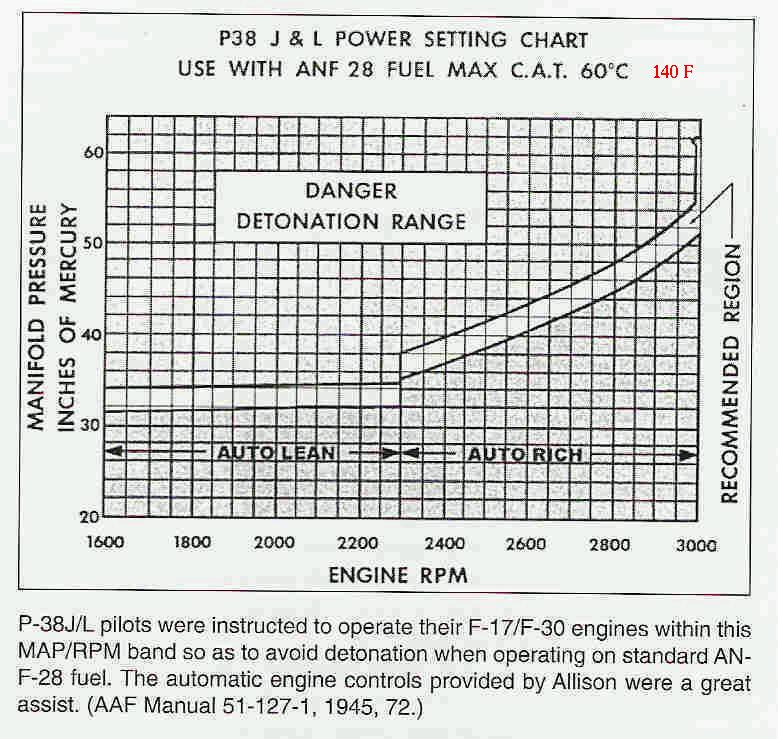
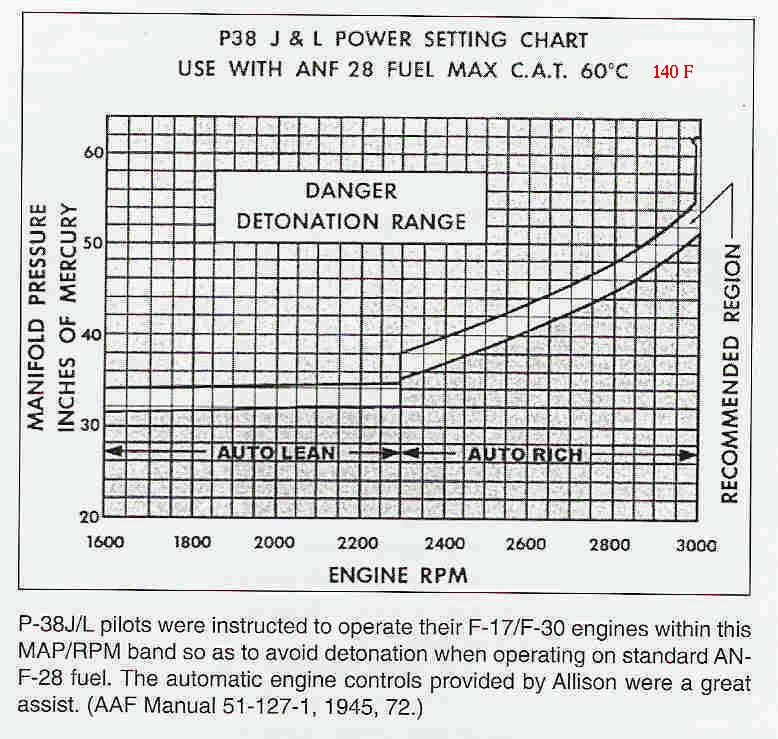
Here is a chart showing that detonation is primarily a low RPM high
load
phenomena.  The white band in the chart is the no detonation max HP
operating range. Cars and airplane engines with variable pitch or
constant speed props are much more likely to suffer from detonation
than an aircraft engine with a fixed pitch prop running at max RPM.
This is because at less than max RPM prop load on the engine and
consequently the boost from the turbo charger, drops off drastically.

NACA did some studies on this back in the late 30's. In no particular
order of importance this is the list of factors that affects
detonation.

Compression ratio.
Inlet air temperature.
Spark advance.
Fuel air ratio.
Size and shape of the combustion chamber.
Temperature of the combustion chamber and cylinder walls.
Engine speed.

The chart is limited to 140 F inlet air temperature  indicating the
extreme importance of intercoolers. I fully intend to install an inlet
air temp gauge on my turbo 13B.

An idea suggested by this data is if you have a knock sensor it is a
good idea to not only retard the ignition but richen it up instantly
if detonation occurs. Not possible without electronic fuel injection.

Another idea is to place one or more fuel injectors up stream from the
turbo to cool the mixture. All the Allison's and Merlin's had the carb
up stream from the
turbos and superchargers for just this reason.

Paul Lamar

The AirCraft Rotary Engine NewsLetter.  Powered by Linux.
ACRE NL web site. http://home.earthlink.net/~rotaryeng/
Copyright 1998-2003 All world wide rights reserved.