http://members.iquest.net/~aca/
http://groups.yahoo.com/group/algiecompositeaircraft/

There are a lot of outrageously ridiculous statements about range
and fuel burn on here. Not to mention the points Russell brought
up about pressurization and boost at 30K.

Makes one wonder whether this guy is qualified to engineer an
airplane or a propeller. I mean.... suppose the spar is improperly
designed regardless of how well it is made?

I had a long exchange in private email and I was not able to get
through
his mental firewall.

Here is what he had on the web site about range and fuel burn.

**********************************************************************
"I have some more permanent fuel consumption figures based on Sport
Aviation's July 2001 issue. Page 46 has an LS1
powered Seabee that is producing 320 hp at 4,400 rpm using 10.2 gal/
hr. I intend to cruise at 3800 rpm with 300 hp, this drops it to
about 9.8 gallons per hour, giving an over 2200 mile range at 350
mph, less reserve. This is a far better range than I had ever hoped
for and makes Atlantic crossings a reality. I knew this engine was
efficient but not how much!"
********************************************************************

This was my initial response to him.

________________________________________________________________

IC Engines have what is called Brake Specific Fuel Consumption.
BSFC for short. What this means is the number of pounds of fuel burned
each hour for each HP generated. Since a gallon of fuel weighs about
six pounds 10 GPH is 60 pounds of fuel per hour.

First and foremost a car traveling down the highway at 60 to 80
only needs 40 to 60 HP regardless of what the peak HP rating is.
Lets say it is getting 20 MPG at 60 MPH. In one hour it will use 3
gallons or 18 pounds of fuel. Divided  by .4 BSFC is 45 HP!  A
Corvette will do even better because of it's low frontal area.

Also a good trick is install a manifold pressure gage on a car engine.
The HP consumed is a product of the manifold pressure and the RPM.
Since a Corvette Cruises down the road at under 2000 RPM and under
15 inches of HG it is not generating much power.

I think if you remember what a race car engine burns you will
come closer to what an aircraft engine burns. They both generate
a high percentage of peak power. As I recall we had about 30 gallons
in the Chaparral II for a 45 minute to one hour road race back in the
60's. At .4 BSFC 180 pounds of fuel that was 450 HP average. About
right
because of the time out spent braking on a road coarse.

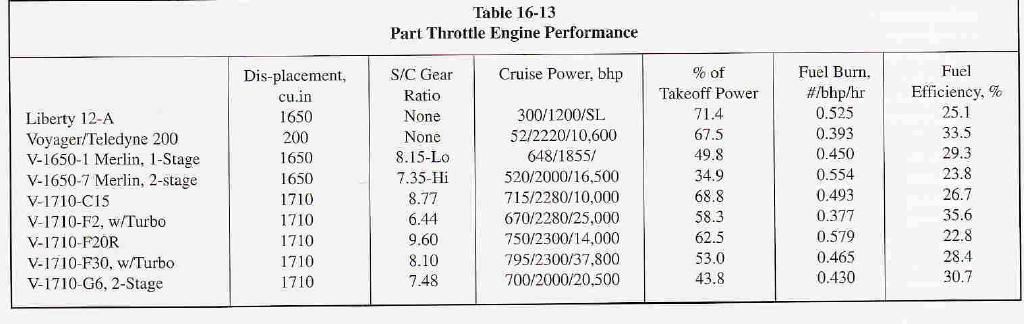
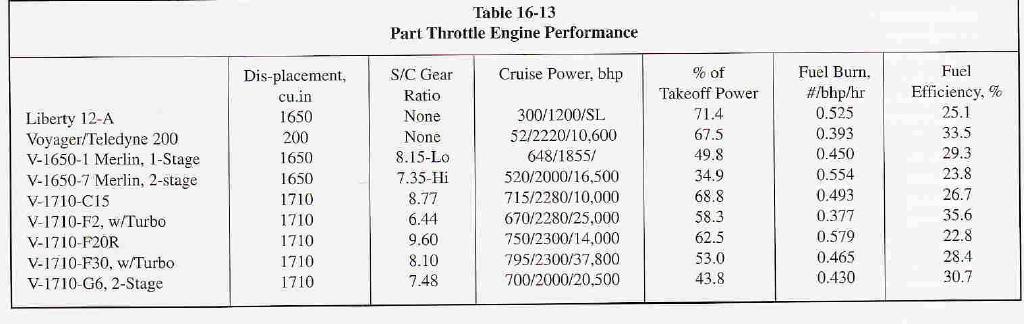
Here is a list of aircraft engines and their BSFC's. Note that the
very efficient liquid cooled Continental Voyager engine that got Rutan
around the world was about .4 BSFC. The LS1 is no better than this
despite the electronic fuel injection. In order to do much better
than this one must recover some of the waste energy in the exhaust
and feed it back into the crank. This is called turbo compounding.
Allison built such and engine called the V1710 F2. That engine got
down to .377 BSFC. CW built some R3350 TC's in the late 50's that got
down to almost .3 at altitude. That was right down there with the
largest diesel ship engines in the world. I can show you dozens
of dyno curves where the BSFC is measured.

The point is somebody is lying to you. 10.2 gallons an hour
at a BSFC of .4 is 61.2 pounds of fuel burned per hour divided
by .4 is only 153 HP and  not 320 HP!! Assume for the moment GM,
through some miracle of automotive engineering, got the LS1 BSFC
down to .3. That would be 61.2 pounds of fuel per hour divided by
.3 or only 204 HP and not 320 HP!

If some guy is telling you his aircraft engine is burning 10 gallons
an hour he has throttled back and is cruising at 150 HP. Most
airplanes will cruise around 150 MPH with 150 HP."

____________________________________________________________


It went down hill from there.

Paul Lamar

The AirCraft Rotary Engine NewsLetter.  Powered by Linux.
ACRE NL web site. http://home.earthlink.net/~rotaryeng/
Copyright 1998-2003 All world wide rights reserved.