I have had a lot of trouble in the past with this subject.
I have posted the NACA scientist's and engineer's cautions that
invented the device back in 1945 on using it with heat exchangers
many times in the past. Some people ignore that.

Engineers by nature tend to qualify statements just in case they
are wrong. In other words they do not generally make dogmatic
or black and white statements even if they are sure they are
absolutely right about something. Unfortunately this leaves
an opening for the disbelievers.

Consequently that statement has NOT been enough to dissuaded the
proponents. They WANT to believe in NACA scoops because they LOOK
like they have little or no drag. Besides that... they look cool.
This then becomes  emotional belief in NACA scoops.

Therefore I thought of a way to illustrate in an intuitive manner
the problems of a NACA scoop starting with the first principle of
Physics. Namely Newton's First Law.

******************************************************************
Every body continues in its state of rest, or if in uniform motion
in a straight line, unless it is compelled to change that state
by force impressed upon it.
********************************************************************

It is not just a good idea...... IT IS A FUNDAMENTAL LAW OF NATURE!!!!

Now think of air molecules as a zillion tiny marbles moving at 200
MPH parallel to a surface that contains a red NACA scoop. Just behind
this NACA scoop and above it there is green P51 type scoop with an
opening
that is perpendicular to those straight lines those tiny marbles
are traveling in.

1: Which duct is scoop to gather more marbles?

2: What force or forces causes the marbles to go into the NACA scoop
if any?

3: What force or forces causes the marbles not to go into the NACA
scoop?

4: What force or forces causes the marbles to go into the P51 scoop?

NACA scoops  require suck like a jet engine or a carb air intake to
work.
It is the force that deflects the marbles into the NACA scoop.
Ironically they don't even work for jet engines very well. You never
see them
on jets. The fastest RV's in the world don't use them for carb air
intake either. Boeing had to use this kludged up fix to make them
work for 737 APU air intakes as much as someone at Boeing wanted them
to work.

Paul Lamar
Now I am as far from being a scientist as is possible, so my thoughts are
pure intuitive and I may be very well in "wishful thinking" - territory.

2. I always thought this would be coanda-effect.........as the boundary
layer wants to follow the surface.
3. + 4.  Inertia.......so it depends on the medium you are using the scoop
for.
Of course they don't work for jets as you don't want any boundary layer in
there.

Though I wish I had the means to try out the following things:

a) For the amount of air the APU on the Boing needs, would it be possible to
get the NACA scoop to the right size, so the Boundary layer alone would
provide enough air, even with the "corners" mentioned on the NACA scoop
thread.

The idea: As the boundary layer enters the scoop and the scoop gets wider
and deeper it will slow down and recover pressure. The question is:
# At what point does the laminar flow turn turbulent? I guess that is where
the "corners" came into play - they would keep the turbulence inside the
scoop instead of spilling it.
As mentioned a pressure analysis would be interesting, but obviously it
helped - 30 deg. CHT drop is no small feat.
# At the necessary size of the scoop, does it still (..or at all!!) have any
drag advantage to alternatives?

I guess if it would work for jets it would have to be so that it intakes the
boundary layer only, to avoid a mix of layers in the intake and all the
trouble that comes with it. The immens amount of air jets need make this of
course theory. However for a huge surface (Boing airliner rear fuselage) and
a relative small jet (APU) it might work.....

b) How "dirty" can the scoop become before it looses performance? The one
pictured on the first message is REALLY bad corners and trips everywhere -
that airflow got to be turbulent!

c) What's the speed range and the according behaviour regarding spillage,
pressure recovery, switch to turbulent airflow?

Question: What was the original idea behind the NACA scoop? Why was it
developed?

Thomas J.
2: The Coanda effect is a different situation. It only works for short
distances
over a curved surface. What happens in the typical pusher NACA duct
situation
is the high velocity marbles moves away from the surface separated  by
a slow moving boundary layer. In fact the marbles in direct contact
with the surface are not moving at all relative to the surface. This
is
caused by the finite viscosity of air.

3: + 4: not really. If by "medium" you are referring to air anything
that has mass
will act in the same way. Air definitely has mass. The impact of the
air marbles
is what causes drag on an airplane.

"would it be possible to get the NACA scoop to the right size"

a) Maybe if the APU sucks hard enough.

"At what point does the laminar flow turn turbulent?"

You got me there. Probably depends on a lot of other factors such as
surface finish. I don't see how that is going to get the marbles
flying
in a straight line into the NACA scoop. Sure, you might get some
additional
overall net motion of the boundary layer into the NACA scoop.

"30 deg. CHT drop is no small feat"

Perhaps a few of the many other variables that affect temperature
changed like the ambient temperature to mention only one. How can you
make
a change on the ground, go fly and be sure nothing else has changed?
A pressure measurement on the other hand, if related to dynamic
pressure, does
a very good job of controlling the pertinent variables. Temperature
has
no effect as it changes dynamic pressure at the same time. It is much
faster
and much simpler to check the pressure across the rad. It is the tried
and
true method. In fact it is the method recommend by Lycoming when
checking
the function of the cooling baffles. I don't expect blocking off the
corners of
the NACA scoop at anything to do with the path of the marbles.

The scientific method depends on the repeatability of a particular
experiment.
One successful out come proves nothing. Only when the experiment is
repeated
over and over with the same outcome is it accepted.

"At the necessary size of the scoop"

If the NACA scoop is made larger than the width of the fuselage it
certainly will greatly increase the drag. Most of the NACA scoops
used now on pushers are already the width of the fuselage.

"relative small jet (APU) it might work"

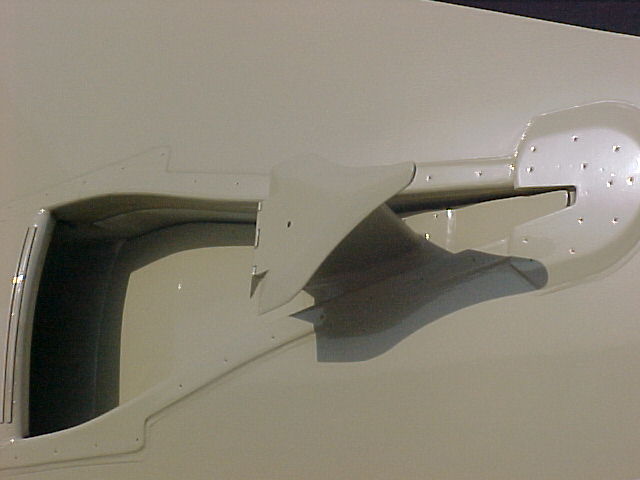
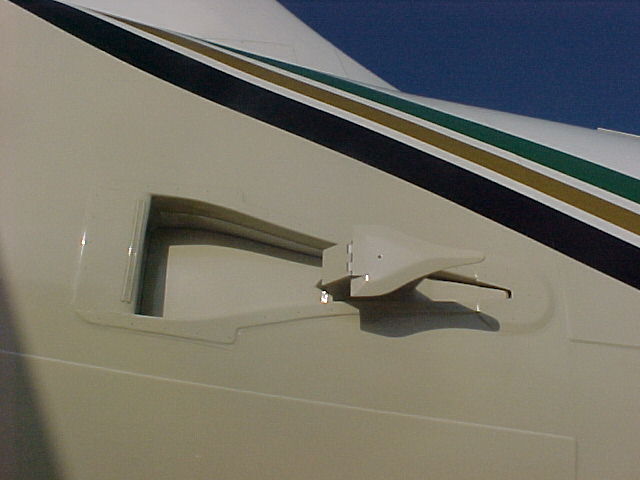
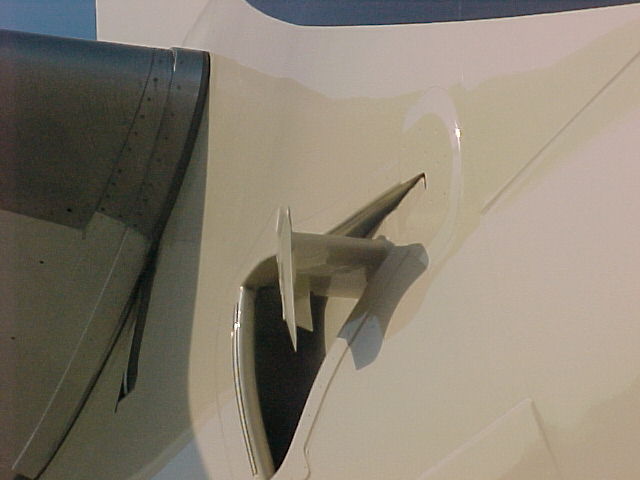
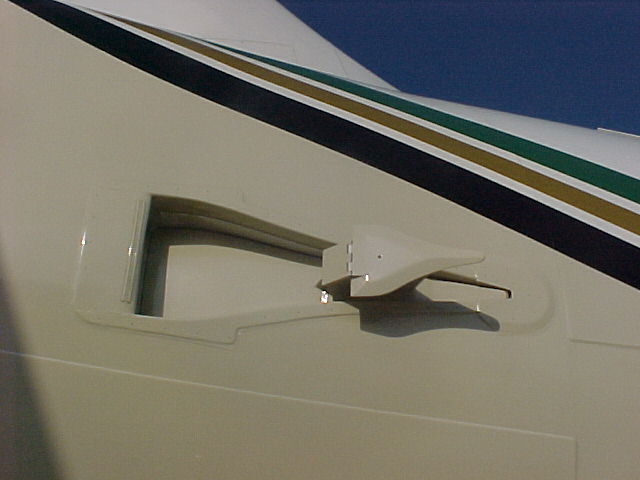
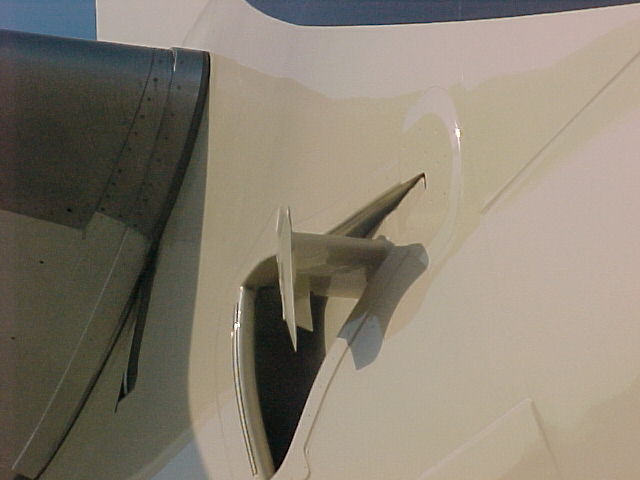
Obviously it did not work for Boeing as they had to add an
angled delta wing, with a flap no less, to change the direction of
the marbles. See the pictures below.

You will have to read the original paper to answer your remaining
questions.
Look up NACA on google and you will find a site where you can download
it
in pdf form. NACA ACR-5120.pdf

My guess is they were looking for a low drag inlet they could use for
the then new jet engine. They obviously failed as NACA scoops are
never
used for jet engine's primary intakes.

Paul Lamar

The AirCraft Rotary Engine NewsLetter.  Powered by Linux.
ACRE NL web site. http://home.earthlink.net/~rotaryeng/
Copyright 1998-2003 All world wide rights reserved.