Paul,

In reference to your second scenario, what do you think about the following?

1.  Have the rad set with the aft most part at the highest point - and the front at the lowest, such that the air
flows from the top side of the rad - down and back and out.  From the bottom front of the scoop to the  bottom front
of the rad should have a  convex shape to keep the boundary layer here attached.
I do not understand the second part of your question. What you want is a
constant area duct from the P51 scoop opening to the wedge shaped diffuser
above the rad. Once the air is in the duct there is little you can do to prevent
a thin boundary layer from building on the duct walls. This is caused by
the viscosity properties of air. It is best to keep the duct as short
as possible.
2.  The exhaust can then extend down  vertically, or nearly so,  elbow under the rad and elbow again to the augmentor
tube.
Well since the augmentor needs to be about 36 inches long that does not leave
much room for the augmentor. If you want to make it shorter (~12") figure on
about four inches of H2O or at about .037 psi per inch of H2O or .148 psi.
Also the exhaust pipes run cherry red so there is a lot of heat radiation going on.
the rad must be protected from this radiation. It can be made to work.
3.  The cowl on the bottom side of the rad can then be one piece, a la P-51, or venetian blind; of course easier to
do without the aug. tube.
Yes I agree. Assuming you are using a P51 ram air scoop as well. With out some
sort of suction the NACA scoop is not going to work IMHO.

I think there would be little to gain in terms of drag reduction
with venetian blind flaps this far back on the airplane. I could be wrong.
If you tried the P51 exit duct type it would have to be bulged down near the front
of the rad to meet the 10 inch wall clearance rule. That adds frontal area
and drag. Just leaving the back side of the rad open will work fine as
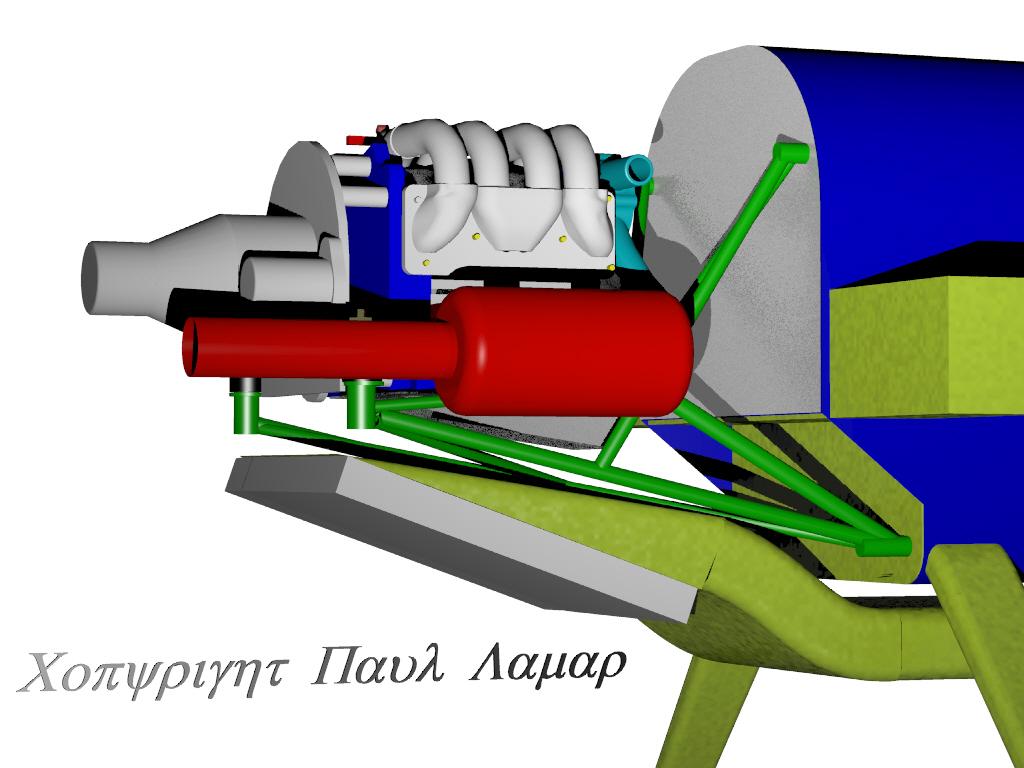
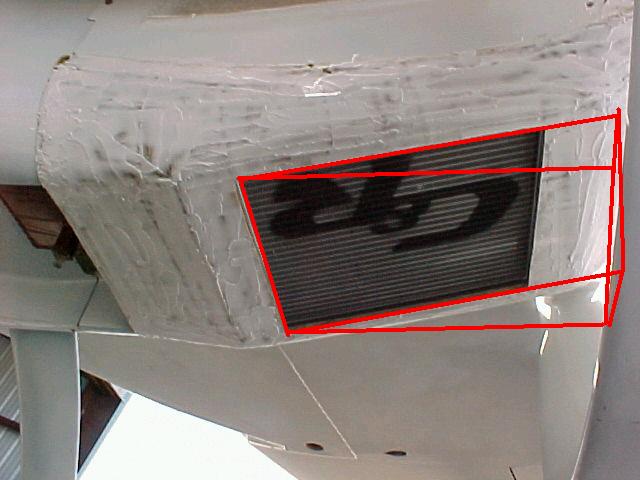
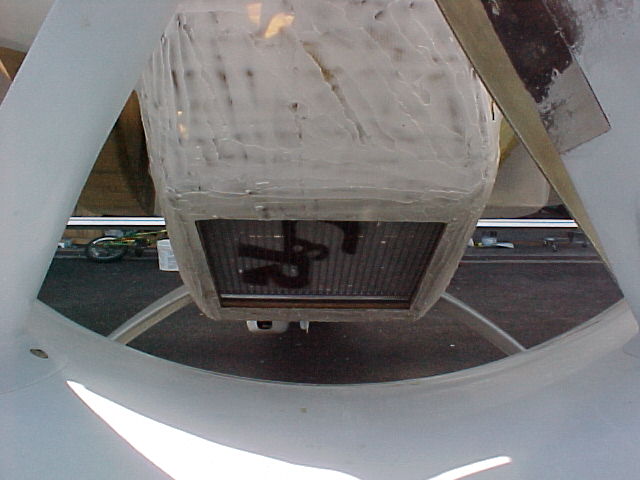
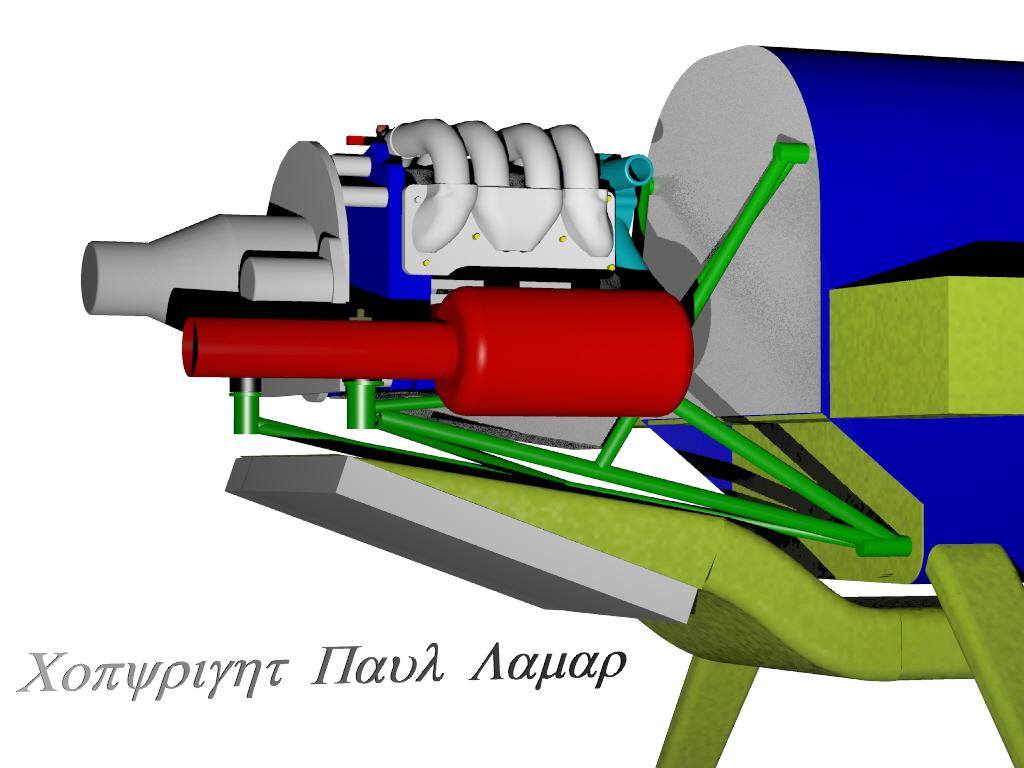
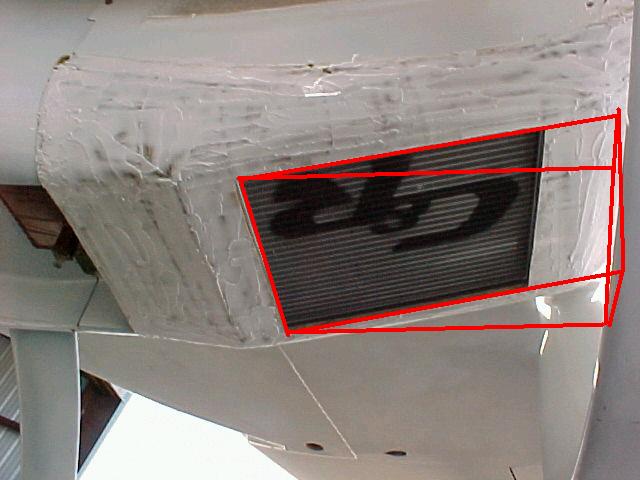
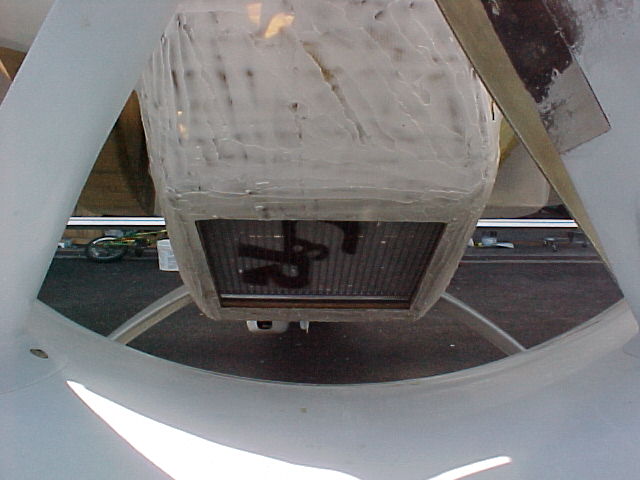
Perry Mick does. Here is a 3D I did for Dick Gregory on this configuration.
Also some pictures of Perry's airplane for the new people. Perry's tried the outlet
duct shown in red and it did not work as well as just leaving it open.
4.  Also, the boundary bleed air could be picked up above the P-51 scoop at the front and coweled into the engine
compartment.
True. That might supply a little cooling air for the engine and the exhaust system.
5.  With the above scenario, it would be nice if both the rad and the oil cooler could sit side by side, with a 9"
width each, and length of  21" or thereabouts.  They would have to be kept separated such that they both saw only
their own air.

Joe Graham
That side by side idea is what I had in mind. Look closely at some of
the 3D's and you can see the oil cooler on the left side.

Paul Lamar

The AirCraft Rotary Engine NewsLetter.  Powered by Linux.
ACRE NL web site. http://home.earthlink.net/~rotaryeng/
Copyright 1998-2003 All world wide rights reserved.