John Gibbons wrote:

Paul,

    I have a couple of questions to ask of you and the group.


          1) On your engine that you will be using on your test stand are you using you crank angle sensor or will you be using an alternate pickup
          ?
I'll be using the crank angle sensor to save time.
2) Which PRSU are you installing ?
I have Tracy's 4 pinion 2.17:1. Not necessarily the best choice. Just what I have
at the moment.
3) When do you figure testing will start, giving your travels and volunteer efforts ?
Good question. Every time I set a target it seems to slip. I am working on it a little bit almost
daily.
4) How standardised are the crank angle sensors from one engine to the next ?
I think they are all pretty much the same in the 1986 to 1992 time frame. The 1993 3rd gen
and RX8 did away with them.
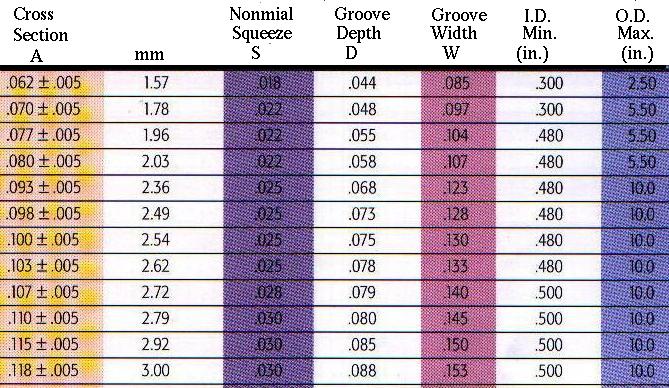
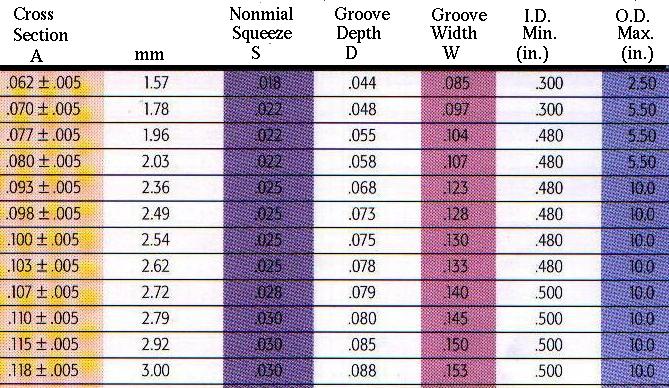
          5) In designing a groove to house an O-ring how wide and deep do you make the groove relative to the O-ring itself ?

    Thanks,
                John
Those are dimensions that are called out in O-ring catalogs.

Here is something from Creavey Seal Company, manufacturer of teflon encapsulated
silicone O-rings.   http://www.creavey.com

I strongly urge everybody to use these when they are overhauling their engine in
every location where an O-ring is called out. There is little difference in
cost yet they provide a lot more margin for temporary overheating. They are inert
to most hot chemicals and they accommodate 500 degree F 260 C temperatures.

Here are the major sizes for the 13B water and oil O-rings.

I get no kickbacks or any kind of benefits what so ever from this company or any
other company for that matter. I just strongly believe these will add durability
to the rotary engine.

Paul Lamar

The AirCraft Rotary Engine NewsLetter.  Powered by Linux.
ACRE NL web site. http://home.earthlink.net/~rotaryeng/
Copyright 1998-2003 All world wide rights reserved.
I will outline what we are talking about.
There are four coolant sealing O-rings per rotor housing.
Two outer and two inner.
There are also four oil sealing O-rings per rotor. Two on each side of
the rotor proper. These are located on the flanks of the rotor.
Two per side.

Teflon encapsulated silicone O-rings are the best there is for this
application. Teflon is about the most inert material you can
find and it is resistant to most known chemicals. Unfortunately
it is not rubber like and that is where the high temp silicone
rubber core comes into play.

http://www.creavey.com/
1.  Inner coolant oring -

    circumference  = 28.625
    diameter       =  9.111
    slot depth     =  0.062
    slot width     =  0.141
    section size   =  0.103
2.  outer coolant oring -

    diameter       = 11.340
    slot depth     =  0.062
    slot width     =  0.110
    section size   =  0.093
This is critical! The proper section size is .093. Not 3/32
as a 3/32 O-ring is bigger in section size than .093.

The TES O-rings are stiffer than the stock O-rings. It is harder
to get them to lie in the groove. Even with Vaseline.  When you buy
them they don't come flat. I found that using a plywood
form to pre set the slightly under size TES  O-rings for a few
days  works well. Here is a picture.


--------------------------------------------------------------
Oil O-rings.

I checked the installation of the oil O-rings with the new
sizes I got from Creavey. They worked perfectly and were
very easy to install. You will need a little O-ring lube
and a 2 by 8 to install them. They were also easy to remove
with no signs of distortion.

One of the secrets is if you reuse the old oil scraper rings
they must be spotlessly clean inside and out. Soak them
in carb cleaner for a few days. If you use new scraper rings
this will not be a problem of course.
The second thing to watch out for is don't nick the
rotor wall between the two scraper rings when you remove them.
Very very important!!


These can be the same or just a little more than the
stock oil O-rings from Mazda.

The proper oil O-ring sizes are:

0.093" section 4.68 inch ID
0.118" section 4.33 inch ID

I can vouch for the quality of the Creavey O-rings but some
of those water TES o-rings from Mcmaster Carr I have seen
are not as good. This is not to say they won't work. They just
don't look as good around the joints as Creavey O-rings.

Viton is good only to 400 degrees F. The center of the rotor runs
as high as 500 degrees F. I think 400 degrees F leaves's too
little of a safety margin when 500 degrees F is available
in TES O-rings at the same price probably.