Brett & Tiana wrote:

Hi all, me again. Still working on the same relative merits report comparing the 13B, Subaru EJ-22 (Stratus), and the Belted Air Power 4.3L V6, and looking
for some confirmation of the accuracy of my hp and torque figures.
My comparisons heavily favor the 13B based on info gathered over several years, but accuracy on my part is crucial and the sources of some of these figures
are sketchy since they rely on info from the installation suppliers.
For example, the April 2002 issue of Kitplanes lists the hp and torque figures for the Stratus EJ-22 as being 180hp @ 5900rpm and 157ft-lbs of torque at
4600rpm; The BAP V6 is listed as producing 180hp @ 3700rpm and 375ft-lbs of torque at 3600rpm; and the Atkins 13B is listed as producing 160hp at 5500rpm and
159ft-lbs of torque at 5200rpm.
Dave Atkin's figures sound accurate, and assuming that the fine folks at BAP and Stratus aren't bald-faced liars I have accurate info to go on. One question I
have is this: We know the rotary is capable of 180hp without internal mods, but in examples such as Tracy's at what rpm does this occur? I'm aware that the
stock engine in automotive configuration produces peak hp at 6500rpm, but does this hold true in aircraft config?
I plan to compare all three in my report at equal hp settings of 180hp if possible, and many who will read it are pro-Lycosaurus types.
Can any of you back up this info (or contradict it), and do you have a graph confirming any discrepancies?
Again, thanks in advance for any input you may have!

Brett.
You can't compare these engines strictly on HP and torque figures Brett.
What you need to know is how long they live at a given HP level.
Rotaries typically last ten times as long as piston engines in car racing.

That makes the rotary apples and oranges to all other passenger car engines.
Really what you need to compare it to are other high duty cycles engines
like aircraft and heavy duty truck engines.

Passengers car engines are highly cost optimizes for the duty cycle they are
asked to perform. Mainly a very low duty cycle somewhere between 12.5 %
and 50% depending on the size of the engine. The smaller the automotive
engine the higher the duty cycle. A V8 is about 12.5% while an old 36 HP
VW is 100%. Typical very small automotive engines today are around 100 HP so
their duty cycle is as high as 50 to 75% depending on how they are driven.

This is done to keep the piston engines cost competitive. Cheaper materials are
used in the larger automotive engines. What you should be looking at when comparing
automotive engines is what material are the parts made from and how they
are manufactured. Forged, shot peened, heat treated, etc., etc., etc..

Think about how an automotive engine is used. You drop the clutch and floor
the accelerator. The engine only generates peak power for an instant as the
revs climb towards red line. Then you shift and repeat the process all
over again until you get to the speed limit. You back off on the gas
and cruise on the highway using somewhere between 30 and 50 HP.

You can prove this by simple calculations. Most engines have a BSFC of around
.45 pounds of fuel burned per HP generated per hour. Lets say your car
gets 20 MPG at 60 MPH to keep it simple. That means you have used 3 gallons
to go 60 miles in one hour. That is 18 pounds of fuel. Divide that weight by
0.45 BSFC and you get 40 HP. If by some miracle your automotive engine
is super efficient and it has a 0.40 BSFC than the HP is still only 45 HP.

The rotary, due to its inherent superior kinematic design, has a very durable and
robust structure. It is totally WAY out in front when compared to piston
engines structurally speaking. The piston engine is a Rube Goldberg device.
There is no real comparison.

It's a rotary! End of story!

Paul Lamar
BTW the improvement in MPG in cars in the last thirty years has not come
from major improvements in BSFC, aerodynamic drag or reductions in weight. If
anything cars are heavier due to crash safety considerations.  It is mainly to do
with gearing. Thirty years ago a typical car cruised down the highway at 65
MPH and at 4000 to 5000 RPM. Now a days it is less than 2000 RPM. What this
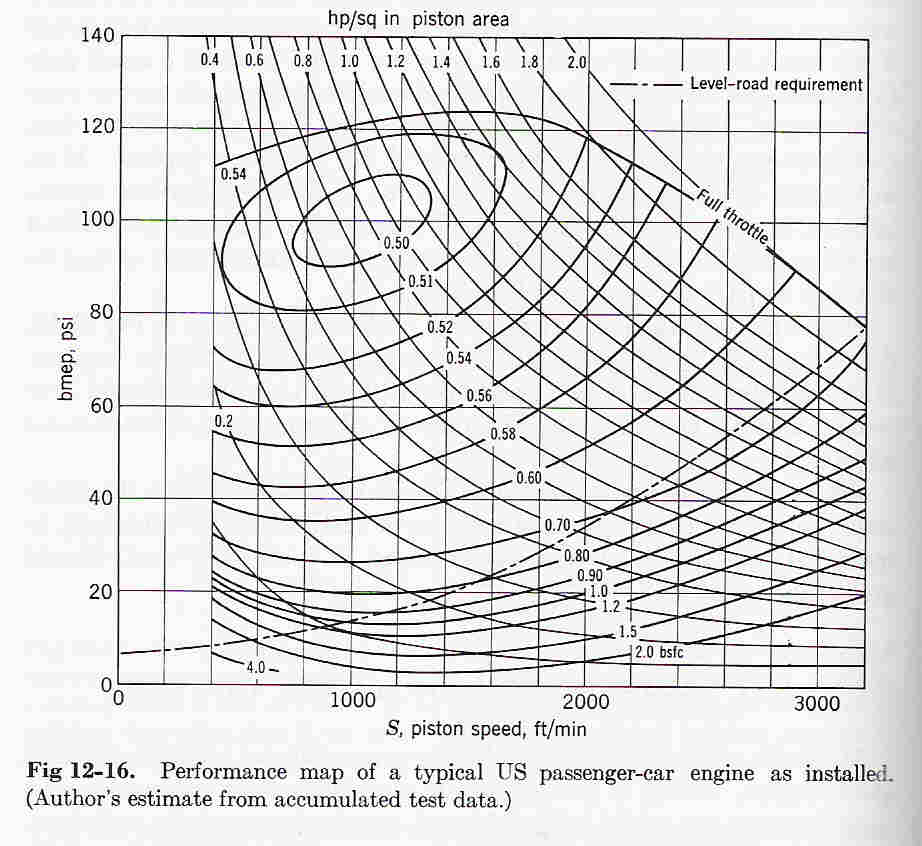
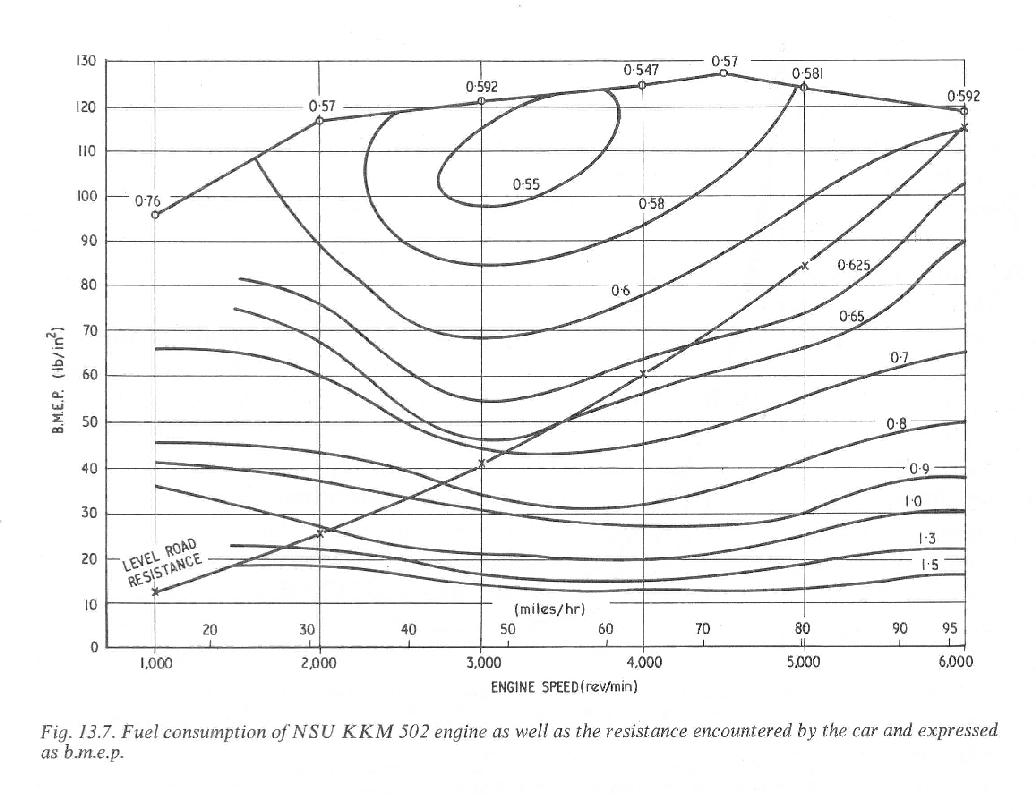
has done is move the road load curve closer to the best BSFC island as shown
in these BSFC maps. This is a very early map for the Wankel. The Mazda Wankel
BSFC as been improved down to about .47 from .55. Also note that the Taylor
map uses piston speed instead of RPM which is more or less the same thing.

Mazda has spent a lot of money enlarging the rotary best BSFC island particularly
with the RX8 side exhaust port engine. In other words improving the BSFC in
the low HP and low RPM ranges of typical automotive use.

If you want to get the best MPG in your airplane you need a variable pitch
prop so you can slow the cruise RPM and move closer to the best BSFC island.

Paul Lamar

The AirCraft Rotary Engine NewsLetter.  Powered by Linux.
ACRE NL web site. http://home.earthlink.net/~rotaryeng/
Copyright 1998-2003 All world wide rights reserved.