Perry,

I don't have mail here at the office but the auto racers seem to use
very high volumetric efficiency numbers for the rotary--better than
1.0 (which I know sounds crazy). I'll look for the mail from
www.teamfc3s.org <http://www.teamfc3s.org> on sizing turbos.

Barry Gardner
Wheaton, IL
Perry Casson wrote:
Hi Barry,

Thanks for the reply, I'd sure like to see those number if your have
them.   I've seen some 1.2-1.4 numbers before and I'm starting to
believe them because without >1 VE's  the rotary does not seem to pump
enough air to make the rated HP.   If I'm doing my math right a 13B
pumps 162 CFM at 7000 RPM (if the VE is 1.0).  At sea level 162 CFM
works out to 730 lbs / hr of air which equals 9.72 lbs of fuel if
running a rich 12.5:1, that gives you 124 HP at .47 BFC.  Something is
not right here.

Perry Casson
Nothing is wrong Perry.
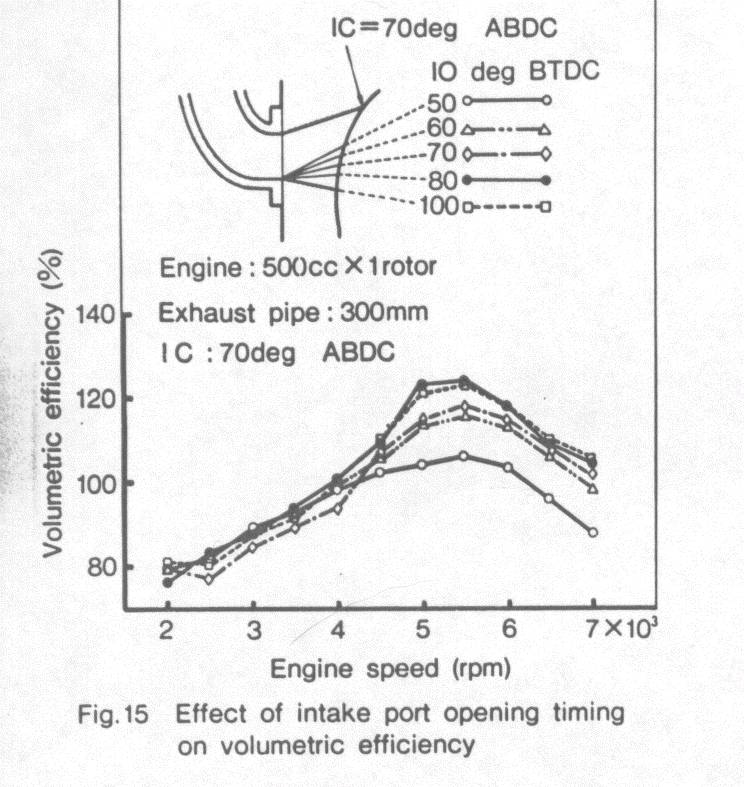
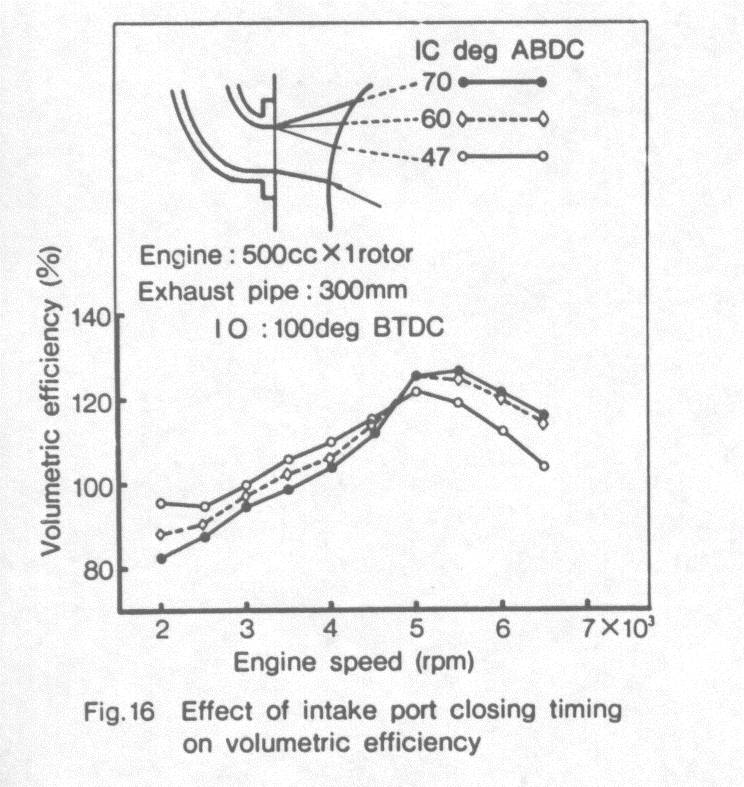
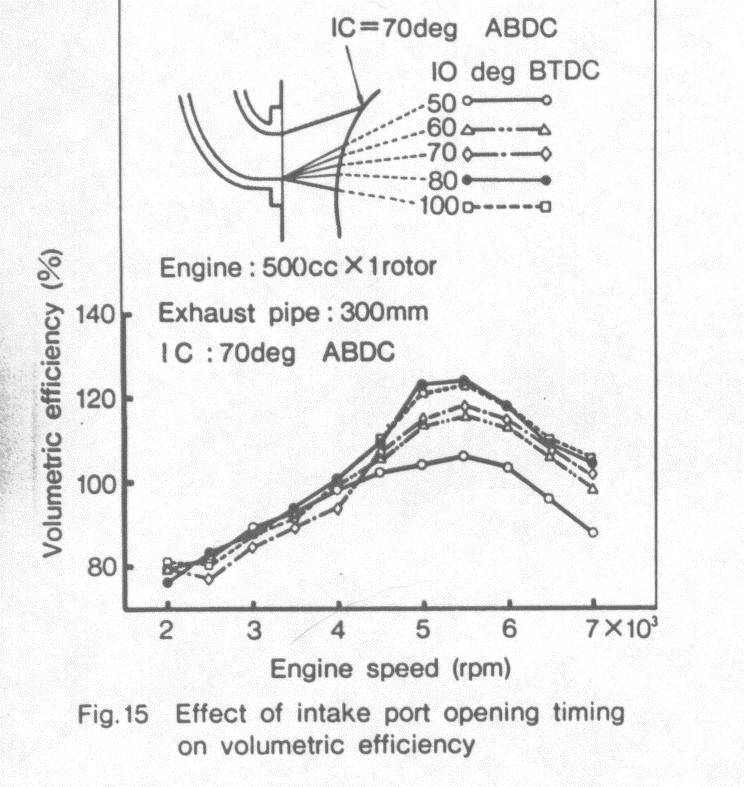
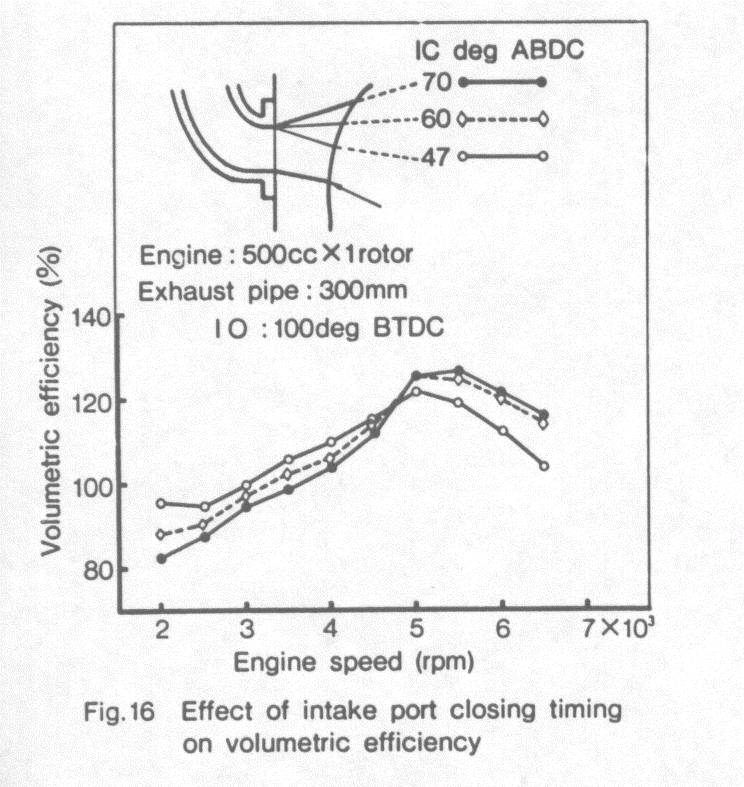
Did you not see the graphs I sent? In case they did not come through
here they are again.

Yes indeed the volumetric efficiency of the rotary is typically well
over one over a wide RPM range due to dynamic supercharging as Chrysler
used to call it. AKA tuned intakes. This has been true almost from the get
go.
There are no silly poppet valves to get in the way.

BTW the .47 BSFC may be a bit optimistic at sea level and 12.5:1.
That number is usually obtained leaned at altitude.

Paul Lamar
OK Perry - we will use your own procedure for the caculations
First - each rotor of the Wankel fires and expands a full one
cavity charge for each turn of the E shaft - I think we can all
agree on that, So if it burns and expands that charge - it
had to pump it - so potentially it pumped about 40 cu in
for each rotor for one turn. The 13B with two rotors thus
80 times the rpm 7000 = 560,000 cu in or 324 cu ft min
With sls air at ,0023769 slugs per cu ft is 1488 lbs per
hour. Notice that the new numbers are quite different
than yours - I do not Know what you used but there is
no smoke nor mirrors to the method I have just described
and it will work equally well for any positive displacement
heat engine Using this flow and your same 12.5 and .47
we would be entitled to 253 hp, A good, modified NA 13B
does about 180HP/253 for an equivalent V.E. of 0.71

The answer is not ram charging but a procedural
error related to displacement confusion. For those that
espouse the similarity to a two stroke engine of 1.3L
at E shaft RPM  you would get this same low answers
for BMEP and v.e.  using two stroke equations
\Vance
"First - each rotor of the Wankel fires and expands a full one
cavity charge for each turn of the E shaft."

Well, well, well are we making progress or what? :) :)
That takes care of the displacement argument.
I am going to turn you into a rotor head yet before I die Vance :)

The flaw in your argument Vance is the 180 HP side intake port engines
don't have good breathing at 7000 RPM. Note that your 253 HP number is
almost perfect for the RX8 despite the side intake ports.
The RX8 engine has much better breathing and 30% larger intake ports than
the older 13B. For the older 13B side port engine the .71 VE number is
probably about right at 7000 RPM. Note that even with the peripheral
intake ports with these old Mazda engines the VE starts dropping off
at 5500 RPM and can be as low as .9 at 7000 RPM. these are probably
rather small peripheral ports by today's standard.


Paul Lamar

The AirCraft Rotary Engine NewsLetter.  Powered by Linux.
ACRE NL web site. http://home.earthlink.net/~rotaryeng/
Copyright 1998-2003 All world wide rights reserved.