François Badoux wrote:

I have noticed on the ACRE site, as well as on the pictures of several engine installations, that there was a tendency to locate the injectors and the
associated fuel rail on the spark plug side of the engine, away from the turbo and/or the muffler, for fire prevention.  Well, we at MISTRAL Engines know a
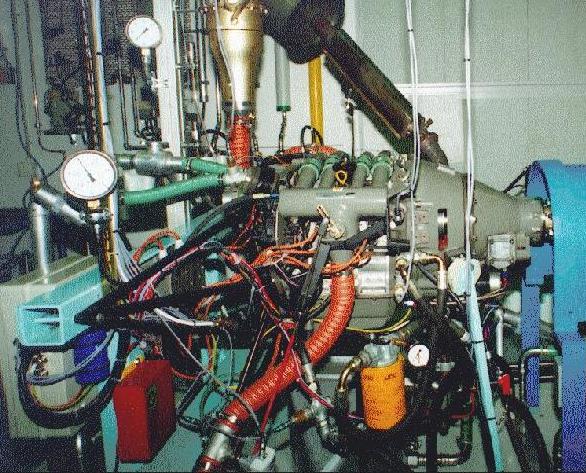
little bit about that because we did exactly the same ... and I feel I should comment.  Initially, we located the injectors on the turbo side... where Mazda
had put them, as close to the intake ports as possible (see first picture of engine on bench).  It was before my time but I was told that insufficient heat
shielding "cooked" the seals, resulting in two consecutive engine fires... thankfully with no serious consequences!  It prompted my predecessors to relocate
the injectors to the side of the engine opposite from the turbo (see second picture) as often recommended.  It solved the problem... no more fire.


Unfortunately, during more recent testing of ours to improve the engine's BSFC, it was quickly discovered that this arrangement, while safe, is very
unfavorable to achieve a proper mixture in the combustion chambers.  The injectors are just way too far from the chambers.  Fuel is being sprayed onto the
intake tubes.  Back pressure waves from the closing of the intake ports compound the problem of the fuel liquefying onto the tubes.  Part of the fuel
evaporates again, of course, but it is enriched in the lighter fraction of HC.  To make it short, by placing the injectors 20-24'' from the intake ports, you
end up feeding the engine a cocktail of vaporized mixture enriched in hexane (C6H14 ), and liquid fuel enriched in its heavier fractions.  You end up having
two systems in one:
1) a rotary engine working on a mixture enriched in light HC which is more detonation prone, and

2) an oil stove which burns liquid heavy
fuel in the exhaust (or in the chimney when running it on a bench), resulting in a red orange exhaust system.  Of course, I exaggerate a bit to make my point,
it's in fact only a question of a few percent shift, but this injection configuration does seem to result in a kind of "pre-distillation" of the fuel and a
very unoptimal mixture.  This is especially true with mogas which has a very wide distribution of hydrocarbons.  By using 100LL avgas which has a much higher
concentration of heptane, we very noticeably reduced the problem.


In addition, you run the risk of having icing occur in the intake tubes, especially on a normally aspirated engine.  We never had icing on a
turbo-supercharged engine because of the higher intake air temperature, except during very prolonged idling.


After all, if Mazda installed its injectors very close to the intake ports, and operating in a "semi-direct" injection mode, it might be for a good reason.


So we moved back the injectors to the "muffler" side of the engine, taking extra precaution to heat shield the fuel system and to route any possible leak away
from the hot muffler or turbo.  It made a world of a difference.  BSFC dropped down very sensibly, the engine worked much better, especially in transients,
the EGT dropped more than 100C and the exhaust system went from bright orange to dark cherry red... and the insulation in the chimney stopped burning (sorry,
I don't have more scientific data to submit on exhaust temperatures past our EGT probes)!


Sure, many of you are flying happily with the injectors away from the turbo... and so will we initially, as our airworthy new intake manifolds will not be
delivered before next month.  Nevertheless, I believed I should share with this great group of people some knowledge of ours in return for all we have learned
reading this newsletter.  Have any of you made similar observations?


Francois Badoux
That is all very interesting Francois. Jim Mederer at Racing Beat and Mazda with the
Lemans four rotor both found a slightly BETTER BSFC with the injectors mounted near
the front of the intake tubes. The problem with the Lemans engine with the injectors mounted
near the front of the intake tubes was unacceptable throttle response. You are correct. We are concerned with in-flight fires. We have had several.

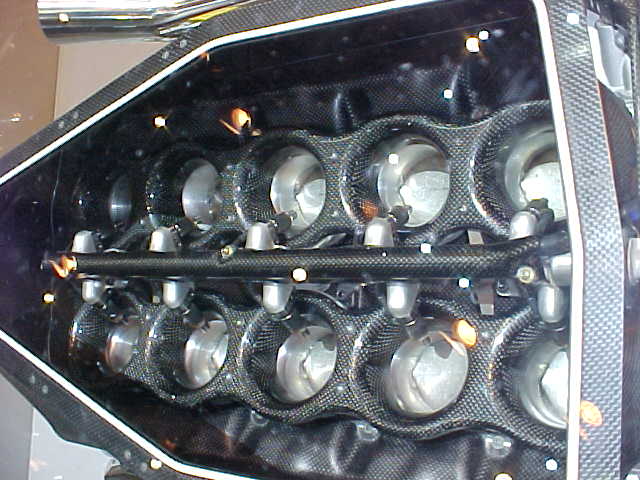
BTW just to confuse the issue here is a picture I took at Geneva of a Renault Formula 1
engine with the injectors mounted outside the bell  :)

Paul Lamar

The AirCraft Rotary Engine NewsLetter.  Powered by Linux.
ACRE NL web site. http://home.earthlink.net/~rotaryeng/
Copyright 1998-2003 All world wide rights reserved.