> > > >> hi, group does anyone know of anyone documenting an
RX8
conversion on
     > the
     > > > >> web. : cliff
     > > > >
     > > > > Sure Don Dunbar is installing an RX8 engine in his
Mustang
II. There
     > may be
     > > > > others.
     > > > >
     > > > > Paul Lamar

     > > > Tracy Crook is already flying one.
     > > > Bulent
     > >
     > > What else do you know about this Bulent?
     > > I am surprised I havent heard anything from Tracy on this.
     > > I guess he is pretty busy. Probably trying to fly off the
40
hours before
> > Sun & Fun. My guess is he is also using the 2.85 six pinion
gear box.
     > >
     > > I better bring the Everett Hatch Memorial Fund check book
in
case he
> > decides to enter the Sun 100 race and average more than 220
MPH.
     > >
     > > Paul Lamar

     Richard wrote:
     >
     > As far as I know, Tracy is flying the 2.85 gear on his 13B
with a
new prop.
> He is checking out this combination before putting it on the
Renisis.
     > Sorry Tracy, I should have left it to you, just couldn't.
     >
     > Richard Sohn
     No sweat Richard, glad to have help getting out the details.
    Very busy getting plane ready for Sn'F.  Up to my ears in
fiberglass
doing plastic
surgery on cooling inlets. Airflow changes with right hand
prop
made this necessary.
Tracy
Wow Tracy if the 2.85:1 alone is making that much more HP on takeoff
what
is going to happen when you get the RX8 engine in there? :)

BTW what prop pitch and diameter are you using?

Paul Lamar
There you go Paul - confusing torque with horsepower - P factor
is not all torque but swing a "big" prop they are closely related
Vance
No I am not :) He is running more RPM with the 2.85:1 hence in a free
breathing
rotary HP is directly proportional to RPM. 2.85/2.17 X 180 HP = 236 HP!!!!
Tracy has a street ported engine so peak HP is probably up around 8500
RPM.
BTW I don't expect the RX8 engine to generate much more HP than a current
street ported 13B.

So you think it is prop gyro torque? When Tracy says "big prop" he is
probably
means 74 inches instead of 69 inches. Hardly a huge change in rotational
inertia.
The usual problem with too much power is the airplane flies before the
control surfaces
become effective. What killed most Gee Bee pilots was the airplane would
leave the
ground before the ailerons became effective and rolled over. Either that
or
the helical slip stream is impinging on the vertical stabilizer turning
the
airplane.

Tracy, what is your new prop diameter and pitch?

Paul Lamar
Tracy Crook wrote:
74 X 88  but Vance may have a point.  The diameter or mass of the prop
doesn't have anything to do with the torque it is absorbing.

Tracy
I don't follow you there. At a given RPM a larger diameter will absorb more torque
and HP due to increased tip speed drag if nothing else. At higher air speeds you won't buy
much improvements in prop efficiency by having a larger diameter. It certainly will
work better during take off and climb however if you have the additional HP required
to turn it at the same RPM as a smaller diameter prop. What RPM were you able to
achieve during take off?

More prop mass will not increase the steady state torque absorption but will increase the
turning moment on the aircraft when you quickly raise the tail and pitch the nosed
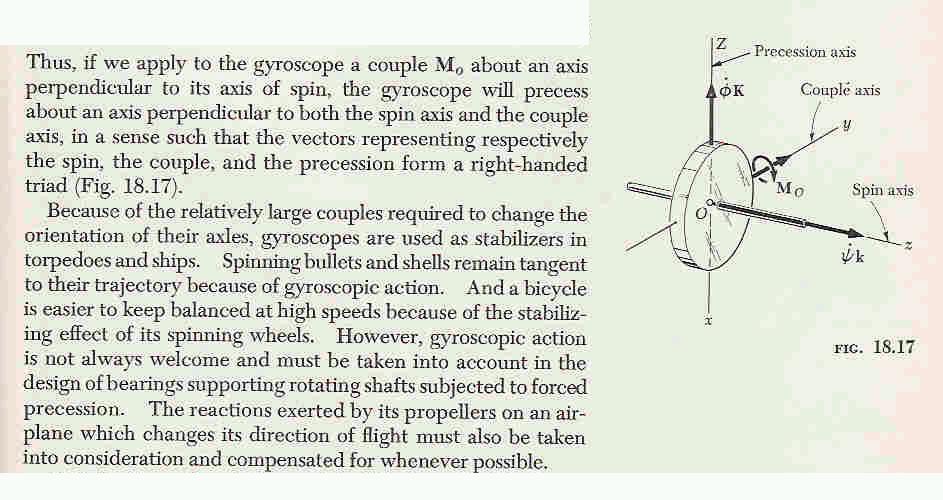
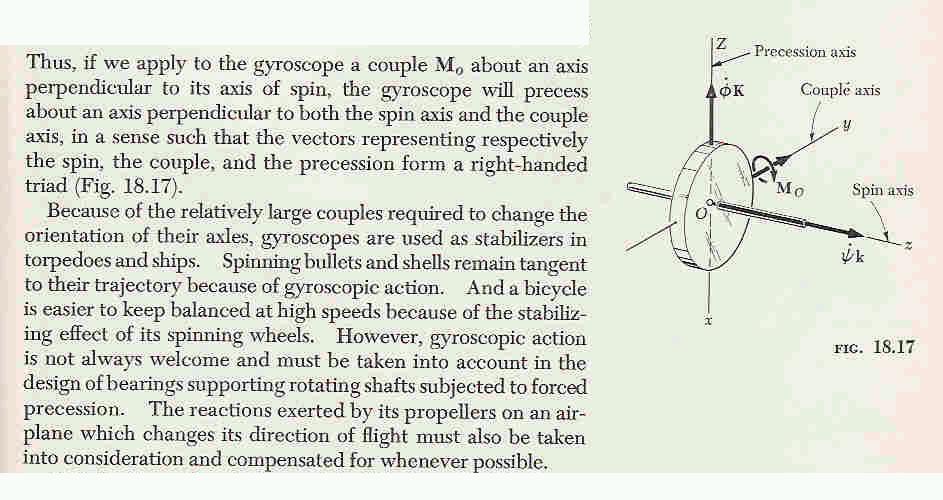
down for take off. This is due to the well know gyroscopic reaction torque working
90 degrees out of the pitching plane. It amounts to about 600 ft pounds if you
pitch at a 67 degree per second rate using a typical constant speed (heavy) prop
turning at 2700 RPM. Raise that tail slowly :) Here is an illustration and
text from my college course on dynamics. Nose draggers don't suffer from this
phenomena to the same extent.

By the way I don't mean to insult anybody by explaining these basic fundamental
principles. Many of you already know these things. Much of what I say is intended
for the wide range of educational backgrounds of those subscribers found on here.

Paul Lamar

The AirCraft Rotary Engine NewsLetter.  Powered by Linux.
ACRE NL web site. http://home.earthlink.net/~rotaryeng/
Copyright 1998-2003 All world wide rights reserved.