ESI wrote:
Hello Paul,

I would like to thank you once again for the informative and interesting
website. To refresh your memory.  I am building a SeaWind for an around
the
world flight challenge making my own fuel as I go. Ethanol probably but
biodiesel is much much easier.  I choose the SeaWind because I will use
it
afterwards in exploring the South Pacific. It also gives me more options
on
where to land.  I am now completing the body and sanding and sanding.  I
have contacted Mazda Motors (I live in Japan) and am making tentative
inquiries to the cost of a Renesis engine.

I like your drawing of the turbo compound system and would like (with
your
permission) to test the concept. Any idea that improves fuel mileage
would
be helpful. Of course blade profiles as well as potential heat transfer
into
the PSRU would be some challenges to overcome.

Perhaps going over 18,000' with a turbo assist may give the best fuel to
mileage range. Your thoughts?

Doug Fir

Nagano- Pref.  Japan
The Rutans and crew pretty thoroughl researched this maximum range thing
and concluded (rightly) that low and slow was the best for range. I know
this is contrary to common belief, but a close look at aircraft and engine
characteristics will verify this. Vance
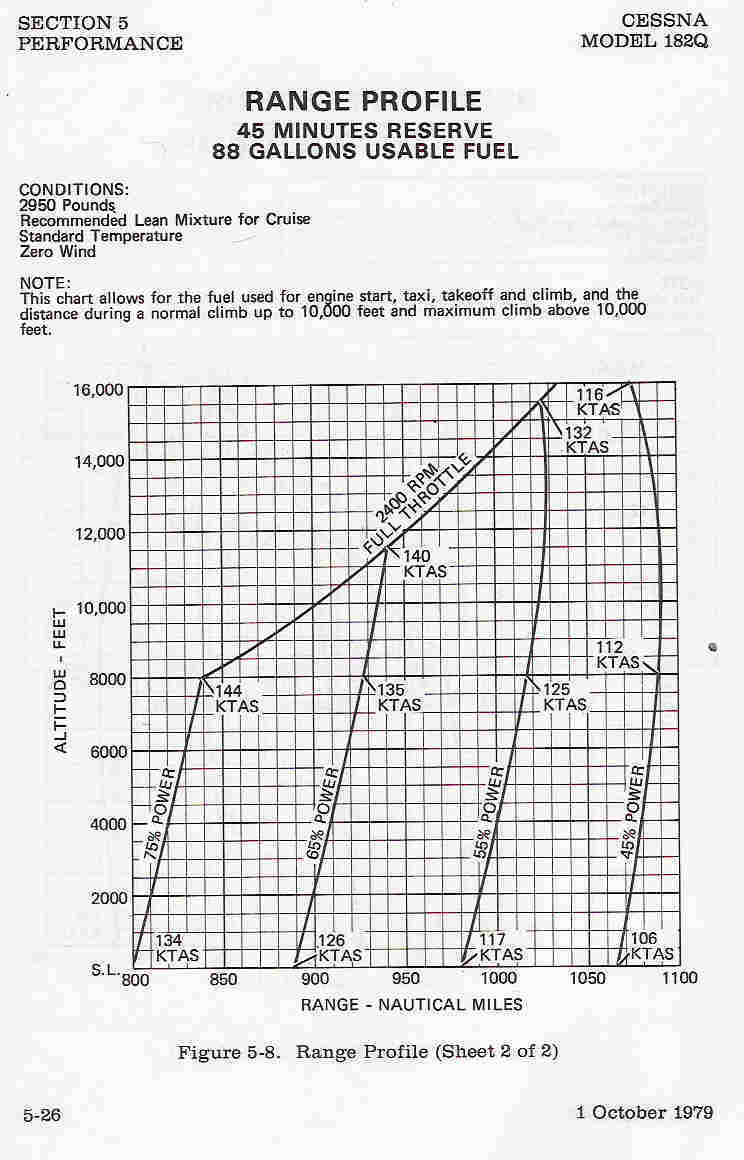
The range on my 182 goes up slightly with altitude as I recall. The books with the
range charts are up in the hangar. I'll check them out tomorrow. I agree with
the slow part. There is an overall drag bucket where induced drag drops off and skin
and form drag starts to dominate.

Paul Lamar
OK here is the range chart for my C182. This becomes more pronounced surprisingly
as the fuel fraction of total weight goes up.

Paul Lamar

The AirCraft Rotary Engine NewsLetter.  Powered by Linux.
ACRE NL web site. http://home.earthlink.net/~rotaryeng/
Copyright 1998-2003 All world wide rights reserved.