Sorry! I saw something blue on the outlet pipe but it was not clear what that

was. It is not like yours are the only messages I have to read :)
Let me get this straight. Your oil pan is deeper than the stock oil

pan so you were losing suction with the 89-'92 13B single-turbo pump

but not the 93-'95 twin-turbo pump?
Paul Lamar
It's all right Paul, just kidding!
The depth of the oil pan has nothing to do with the problem.
The 89-'92 13B single-turbo pump is losing suction for two reasons:

1. When entering the pump. The oil has to do a sharp 90° around very sharp unfinished edges.  There are quite a few more sharp edges as a matter of fact as
Mazda's finish on the pump's pad is abysmal (ask Lynn for pictures if you don't have one of those iron to look at).

2.  The rear rotor is fed oil THROUGH the first, fast revolving rotor.  Past 2-3000 RPM (depending on the quality, temperature and therefore viscosity of the
oil), it just becomes impossible.  I strongly suspect the rear rotor to cavitate first, but I don't have proof yet. I may have one next week as we'll do a
"post mortem" on what seems to be a well worn pump.


In the 93-'95 twin-turbo pump, Mazda has done two things to correct the problem:

A. Modify the iron so as to limit the head loss described in point 1 above (the geometry is better, but the finish still can be much improved a la Lynn
Hanover).

B. It has modified the pump body by adding a 3/4''x 1/4'' channel to the side of the body (half the cross section of the pickup tube... makes sense, doesn't
it?), feeding the oil DIRECTLY to the rear rotor and not through the front rotor anymore.


These changes make the WHOLE DIFFERENCE. As we all know, Mazda never invests a penny in any mod unless it is necessary.  Therefore, I am persuaded they had
problem reports with the 89-'92 13B single-turbo pump.  Another hint that it was the case:  the maintenance manual for that engine precisely describes the
procedure to measure the tolerances on the pump rotor and gives values beyond which the rotors or the whole pump must be replaced.  It is a sign that those
rotors MAY wear prematurely, depending on the use of the engine.


Have a great weekend,


Francois
I have several front end housings and I can see how a bit of oil passage
porting could help. How do you account for all the race cars that came before 93?

The Racing Beat 1985 Technical Manual and Catalog has a history of all the
racing modifications dating back to about 1972. I never saw this pump problem
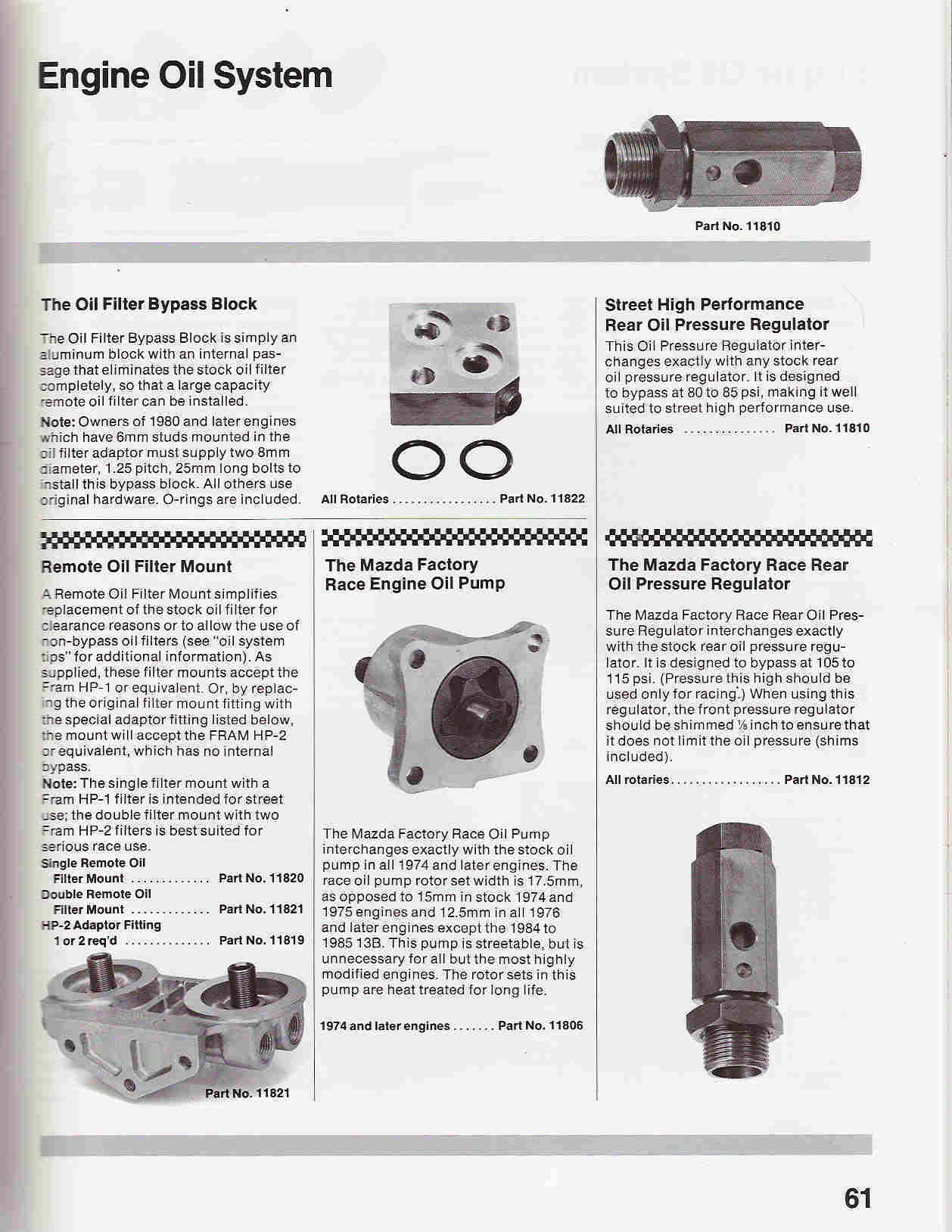
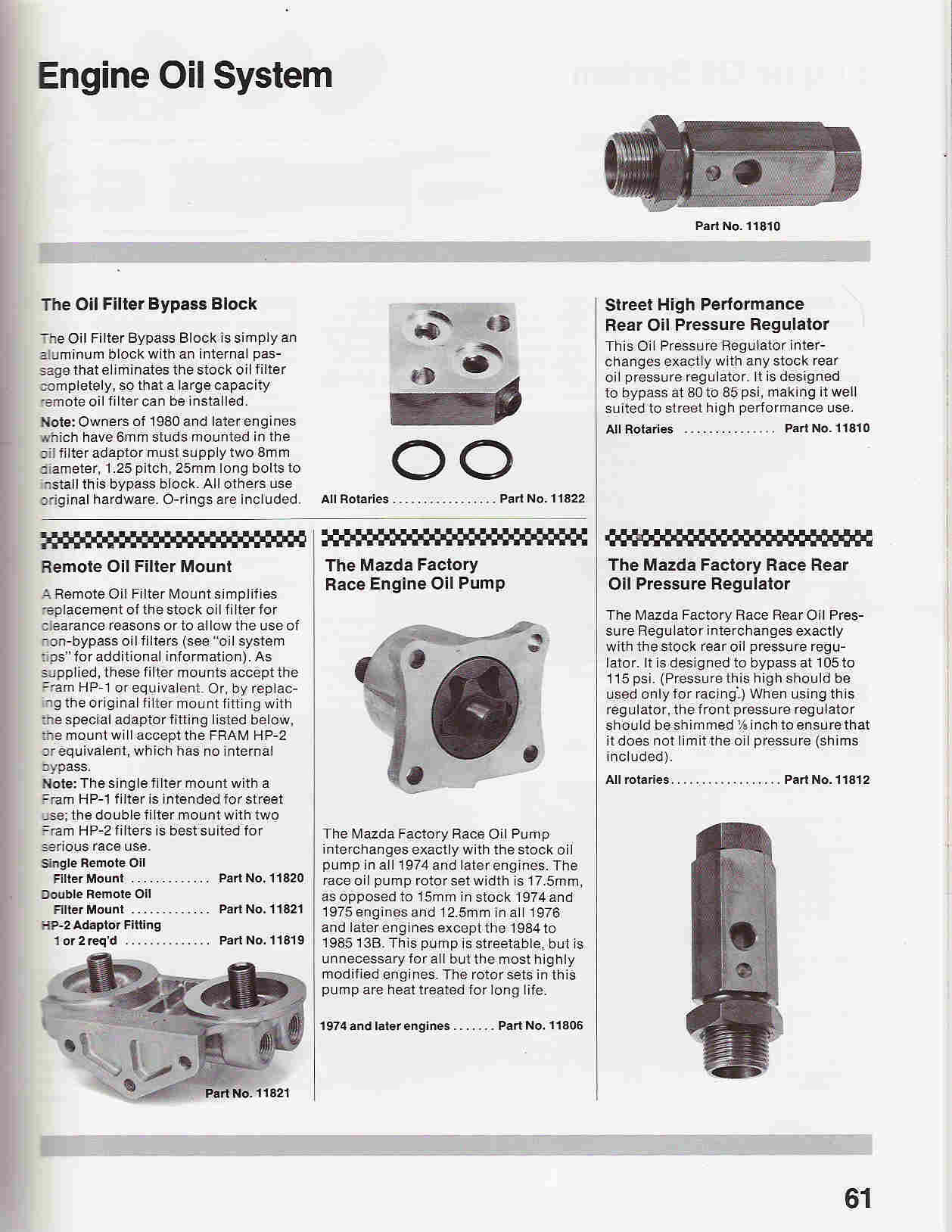
identified before this. They did have a racing oil pump in the catalog
on page 61 but they said it was unnecessary on all but the most highly modified
engines. The big difference was it had hardened and wider rotors. There was also a front
housing modification for engine running over 8000 RPM but should not be done
on street engines as it reduces the oil pressure.
They also have a oil pressure regulator set to 105 to 115 psi.

Racing Beat engines hold several land speed records and have been used by
many people in 24 hour road races. Many of which they have won. I seriously
doubt there is anything wrong with the stock 89-91 turbo oil pump for 6000 RPM
aircraft use.

I still think there is something else going on here that we don't understand yet.
Perhaps your earlier pump was some how defective.

You may feel you have the problem solved but I am not convinced there is a problem.
Too many people have been running this engine hard for too many years.
I myself thrashed my RX2 across the entire country at 6000 RPM and above 30 years
ago.

Paul Lamar

The AirCraft Rotary Engine NewsLetter.  Powered by Linux.
ACRE NL web site. http://home.earthlink.net/~rotaryeng/
Copyright 1998-2003 All world wide rights reserved.