| Subject: P Ports |
| From: ACRE |
| Date: 5/21/2004, 2:42 PM |
Lynn, do you know of anyone using the side ports and P Ports forandintake configuration. I hear from different sources of poor idlewith PPorts and that the power band is very narrow. I was thinking ofusingthe side ports and have the P Ports open above 7000 RPM. TomWebberThe Pport idles quite a bit better than the bridge port. There ismuch lessoverlap on the Port. You can drive it around the paddock area asthough it werea street car. It has very little power just off idle, but it is notbuckingand back firing through the intake. The bridge ported engine is anasty mess todrive just off idle. The idle is set at 2,000 RPM and attempts toexceed thatwith a load on it are met with a stalled engine or a bucking monster,orboth. You have to slip the clutch quite a bit to get it going becauseyou need tohold it at about 4,000 RPM. Once it is rolling fast enough,everything is justfine. None of this applies to aircraft applications. The plate that carriestheplastic damper units is more flywheel mass than we have and it is ata largerdiameter, plus the flex plate mass is a help. So right there is abigimprovement. Also the propeller system is a big flywheel that cankeep things goingsmoothly. On the Vintage rotaries web site there is a fellow who has both portstylesin one engine and switches manifolds between the two with manifoldflange tobloc off the unused ports. He claims that the open volume of theunused ports isnot a problem. He is driving this thing (an RX-3) on the street, so he has manyhours ofoperation on both setups. He no doubt has a flywheel also, so hewould not seethe problems we have. Even with no rotating mass, the Pport idlesvery smoothly.It just doesn't like to go anywhere just off idle. A plane side portwould bejust the same as a street car and would be great for driving aroundon theground. If you build your own Pport, you could shorten the timing a bit andmove thetorque peak down the RPM band as much as possible. Higher runnervelocity andmore torque where you need it, around 6,000 RPM. I think that both port styles at the same time would be a waste oftime.Going from one to the other could be done. But it would be curing aproblem that Ihave not seen. A fast idle to get warmed up and to the end of therunway, andthen a gentle shove up to full throttle, then full rudder and alittle brake,then shove the nose back down at 50 feet and wait for 100 knots andavertical departure. Lynn E. HanoverThanks Lynn, I'm going P Ports, then Have you ever used Racing Beats P Port Rotor housings? Good, Bad? Price high but I don't have the skill to create my own. Anyway thanks for the information. Tom WebberTom, originally I investigated Racing Beats P ports. A couple of points that I want to bring up but if they sound wrong to anyone else, don't hesitate to set the record straight. These ports are very large and they are timed for an engine turning very high rpm. Jim Mederer told me they would not perform at 6000 rpm. They will not perform at 7500 rpm either. I believe he said 10,000rpm and up. Another point, these are just inserts. Not throttle bodies. There is no way using the RB housings to have the butterfly right at the port. This is important for throttle response and idle. Lastly, the ports are bored perpendicular to the housing. Consequently, they are angled upward. This makes it even harder to get adequate intake runner length. At our relatively slow turning engines the runners need to be around 22 inches in length for 6000 rpm. For these reasons (and some others) I decided to roll my own. But I got a lot of expert help and advice all along the way. At this point, I think we have the timing, size and shape of the ports optimized for our application. Within weeks we will have a nice, air worthy throttle body. Boring the housing is not hard to do, but a local machinist is going to set up to do a precision job at a very reasonable rate. All this is coming together right now. It a few months you will be able to send in your housings and get them back p ported with throttle body installed. JerryJerry,Do you have a "concept" sketch of what your final intake system might look like? I've been following this closely, trying to figure out where you are heading with this. My impression so far is dual throttle bodies placed in close proximity to the rotors, but then you mention 22" runners. Where do the injectors, air intake, and runners all fit in? Bob LemingsIt will look almost identical to this Power Sport P-port manifold that Allan Tolle used in 1995 to go 238 MPH in the Sun 100 race. Paul LamarThanks, Paul, Neat seatup, looks like. However, I can't pick up a lot of detail from the photos. I can see the injectors, but can't tell if they are in the runners or the housing. I also can't make out where the throttle valve is. Bear in mind that I have not seen a rotary outside an engine compartment on a car. Hopefully, tomorrow, if the weather forecast is decent, I am going to drop in on Tracy and Laura. Might help to clear the fog. Bob
You won't see P-ports at Tracy's.

Well here are some more drawings and pics.

Paul Lamar
Thanks.  I already had these.  Is the fuel/air mix going through these or just the air?  My problem with all the things I don't understand is that I don't much care for the idea of having fuel injectors doing their thing any distance from where combustion takes place without a "door" to close.  I can just see engine fires developing from an abundance of fuel vapors in the induction system. I think most of you are going with two injectors in the housings and two in the runners, but I always figured that those in the runners would be close to the ports, with the throttle body or bodies outside all this.

You can also drop this line if you like, and I will develop some patience and "wait and see" in Jerry's final design.

Bob
Mazda engineering in 1990 and Racing Beat later discovered putting the injector as FAR from the
port as possible helped the BSFC slightly. Mazda decided the resulting poor throttle response
was not worth it on the Leman engine. Not a factor for aircraft engines. NSU of course
had a carb on the end of a 2 foot long bent intake runner on both the RO80 and the Spider.
>From the point of view of  potential in-flight fires mounting the injectors on the
cold side of the engine makes sense. The current Mistral turbo rotary powered
Piper Arrow starts and runs better than an aircraft engine with the injectors on
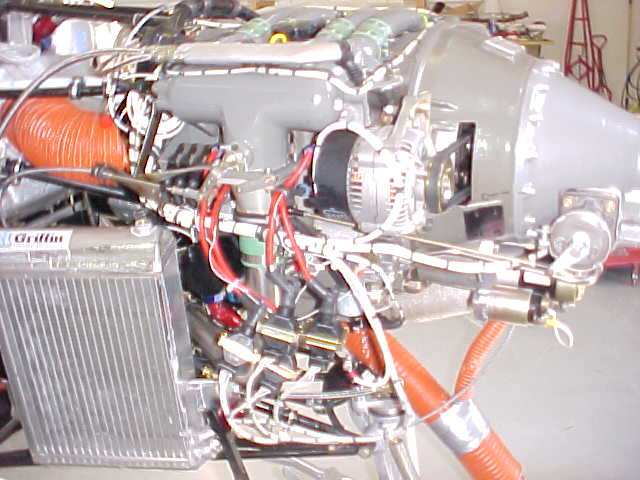
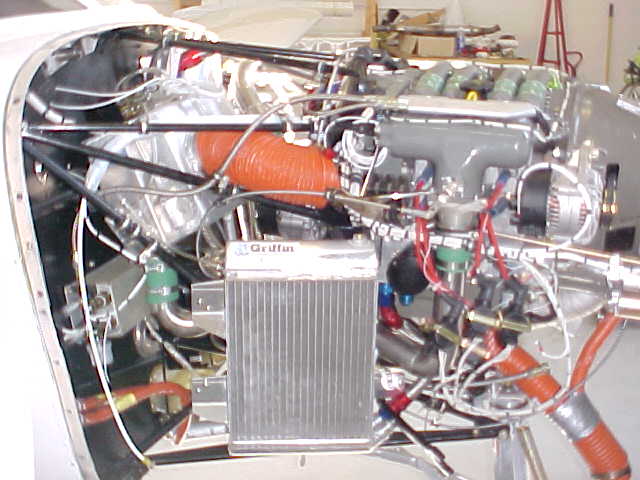
the cold side. I heard it run at Embry Riddle last week. Here are a couple of pictures.

Francois on the other hand thinks otherwise so I'll let him present his
side of the story.

Paul Lamar

The AirCraft Rotary Engine NewsLetter.  Powered by Linux.
ACRE NL web site. http://home.earthlink.net/~rotaryeng/
Copyright 1998-2003 All world wide rights reserved.