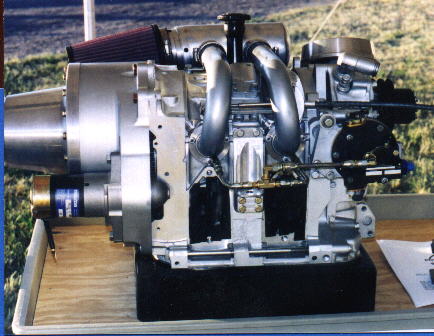
Lynn, do you know of anyone using the side ports and P Ports for
and
intake configuration. I hear from different sources of poor idle
with P
Ports and that the power band is very narrow. I was thinking of
using
the side ports and have the P Ports open above 7000 RPM. Tom
Webber
The Pport idles quite a bit better than the bridge port. There is
much less
overlap on the Port. You can drive it around the paddock area as
though it were
a street car. It has very little power just off idle, but it is not
bucking
and back firing through the intake. The bridge ported engine is a
nasty mess to
drive just off idle. The idle is set at 2,000 RPM and attempts to
exceed that
with a load on it are met with a stalled engine or a bucking monster,
or
both. You have to slip the clutch quite a bit to get it going because
you need to
hold it at about 4,000 RPM. Once it is rolling fast enough,
everything is just
fine.

None of this applies to aircraft applications. The plate that carries
the
plastic damper units is more flywheel mass than we have and it is at
a larger
diameter, plus the flex plate mass is a help. So right there is a
big
improvement. Also the propeller system is a big flywheel that can
keep things going
smoothly.

On the Vintage rotaries web site there is a fellow who has both port
styles
in one engine and switches manifolds between the two with manifold
flange to
bloc off the unused ports. He claims that the open volume of the
unused ports is
not a problem.
He is driving this thing (an RX-3) on the street, so he has many
hours of
operation on both setups. He no doubt has a flywheel also, so he
would not see
the problems we have. Even with no rotating mass, the Pport idles
very smoothly.
It just doesn't like to go anywhere just off idle. A plane side port
would be
just the same as a street car and would be great for driving around
on the
ground.

If you build your own Pport, you could shorten the timing a bit and
move the
torque peak down the RPM band as much as possible. Higher runner
velocity and
more torque where you need it, around 6,000 RPM.

I think that both port styles at the same time would be a waste of
time.
Going from one to the other could be done. But it would be curing a
problem that I
have not seen. A fast idle to get warmed up and to the end of the
runway, and
then a gentle shove up to full throttle, then full rudder and a
little brake,
then shove the nose back down at 50 feet and wait for 100 knots and
a
vertical departure.

Lynn E. Hanover