Alex Madsen wrote:
Ok. Here is the carbon fiber p-port intake manifold concept. I found a
perfect throttle body for it. Unfortunately the TBs are a little on the
expensive side
at ~$200 each. Don't worry about fuel rail placement, I have it
figured out.  This will be it for manifold development for the next few
weeks. I have finals
then I am moving to CO and starting my internship. The length of the
runners is not set. At the moment they are about 17 in.
Alex Madsen
You still need a plenum and an air filter Alex. It would be better if
you
made the runners round so one could adjust the length according to the
gear box ratio he was using. What throttle bodies are you proposing?
Most throttle bodies are over kill and consequently too expensive as we
don't
need throttle position sensors or mass air flow sensors.

Paul Lamar
Alex Madsen wrote:
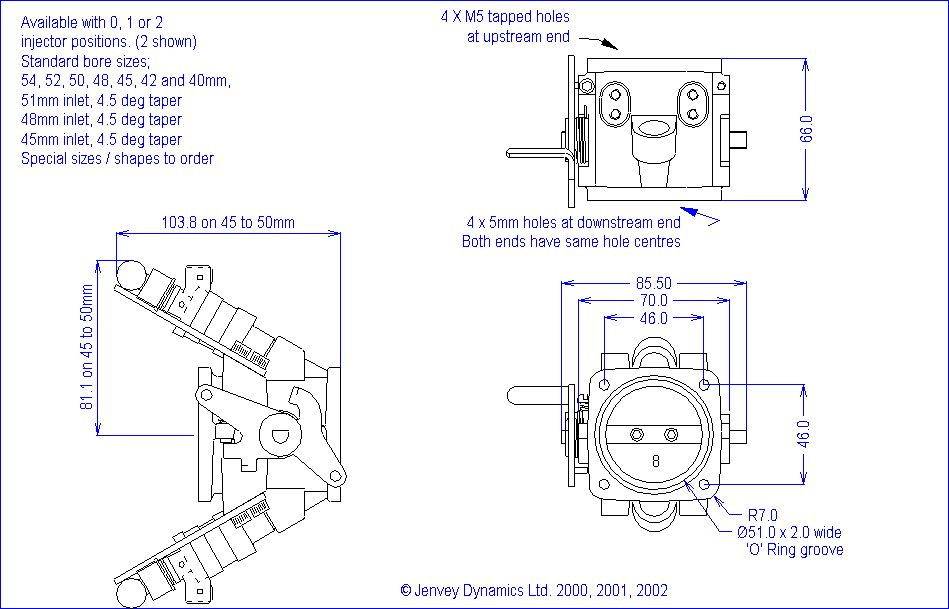
I am proposing using the Jenvey Fuel Injection Throttle Bodies. They
look perfect but are $$.  It is easy change the length of the runners.
I would allow custom runner length for a very small fee. I could also
provide straight runner tube if someone wanted to change there runner
length (of course round runners are also easy to make). Down the road I
will also look at dynamic runner.

I do not see the need for a plenum. There are individual throttle bodies
at the base of each runner and the air is stagnant at the ends of the
runners (max density).

In regards to an air filter I am not sure. Cars with individual throttle
bodies do not appear to have air filters. However, these are high
performance cars that probably do not run much. I was under the
(probably wrong) impression that many aircraft engines do not use air
filters because they are removed from dust sources most of the time (in
the air). I could a plenum only for air filtering but it would be extra
work. Another option would be to put a filter on each runner. Of course
the easiest and best looking would be no filter.

Alex Madsen
That places the injectors on the hot side of the engine above the exhaust.
The exhaust runs cherry red. All you need is a pin hole leak at 50 psi and
you got an in-flight fire if not an explosion. That could ruin your whole
day if not 5 years of work and untold amounts of money spent on your airplane.

BTW folks speaking of crashing if you are not running AN plumbing or high
quality water hose and constant torque hose clamps you should be practicing
your side and forward slips. Nothing like a slip to get you into a short field
with a dead engine or worse...an in-flight fire.

Paul Lamar

The AirCraft Rotary Engine NewsLetter.  Powered by Linux.
ACRE NL web site. http://home.earthlink.net/~rotaryeng/
Copyright 1998-2003 All world wide rights reserved.