There IS a valve on the outlet pipe to
simulate pressure drop across the block!  Look on the right hand side of
the rig's picture. I also mentioned it in my previous email above.

Yes, it's a synchronous electric motor, RPM 2780.  We vary the pump RPM
by changing pulleys and cross check with a stroboscope to make sure
there is no slippage (which happens if we are not very careful at
dropping no oil on the transmission belt). All flows mentioned below are
measured at 3630 pump RPM, which corresponds on this engine to 5450
shaft RPM.

We made some new tests and we now have a pretty complete picture of what
happens:

1.  We changed oil from AeroShell 15W50 to a mineral single-grade
SAE-50.  It improves the situation somewhat but doesn't solve the
cavitation problem.  The difference in the rheology of the two oil
qualities seems to have only a second degree order of influence.

2.  We varied back pressure at iron's outlet between 3.5 bar (50 psi)
and 7 bar (100 psi).  Flow varies as a function of back pressure but
only marginally:  20.7 gal/mn at 3.5 bar vs 19.0 gal/mn at 7 bar.

3.  We varied oil temperature and therefore viscosity:  no measurable
influence on the oil flow.

4.  The REAL DIFFERENCE comes from a) changing the pump body to the
'93-'95 twin-turbo pump, and b) decreasing substantially the headloss on
the suction side to feed BOTH pump rotors properly (thanks Lynn, your
suggestions worked... and we added one of our own to complete the job).

Conclusion:  we missed being at SNF with our Arrow because we needed 16
gal/mn of oil flow across the oil cooler and only had 9.  Now, with a
few relatively simple mods to the suction side of the pump, we have
flows in excess of 20 gal/mn.  Let's implement these changes on the
plane and go flying!

Thanks to all who contributed suggestions.  This newsletter is great
value indeed.

Francois badoux
Another data point:
The stock 20B pickup tube is rather long with a number of bends, which
seemed to me could be a limiting factor in oil flow.  I have a custom deeper
pan (about 6"), and I made a custom pickup tube going straight down from the
pump inlet - as I recall the tube is about 5-1/4" long.  I used a 3/4" SS
tube with an i.d. that matches the pump inlet quite closely (a tad larger).
I intended to flare the inlet end of the tube, but decided to forego that in
order to install the stock inlet screen.

For the dyno runs we ran Castrol 20-50.  The oil pressure regulator valve in
the engine is 100psi.  The oil goes first through the dyno cooler loop, and
I don't know what the pressure drop there is.  The flow rate as a function
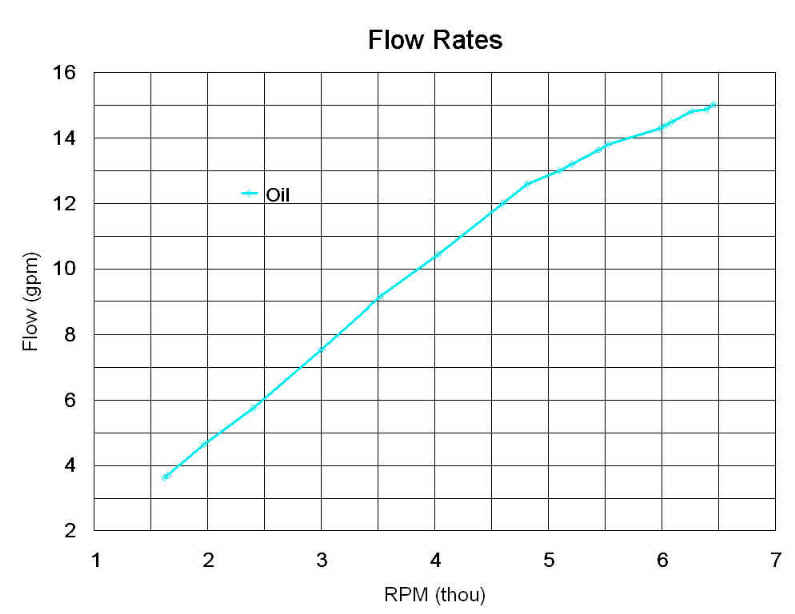
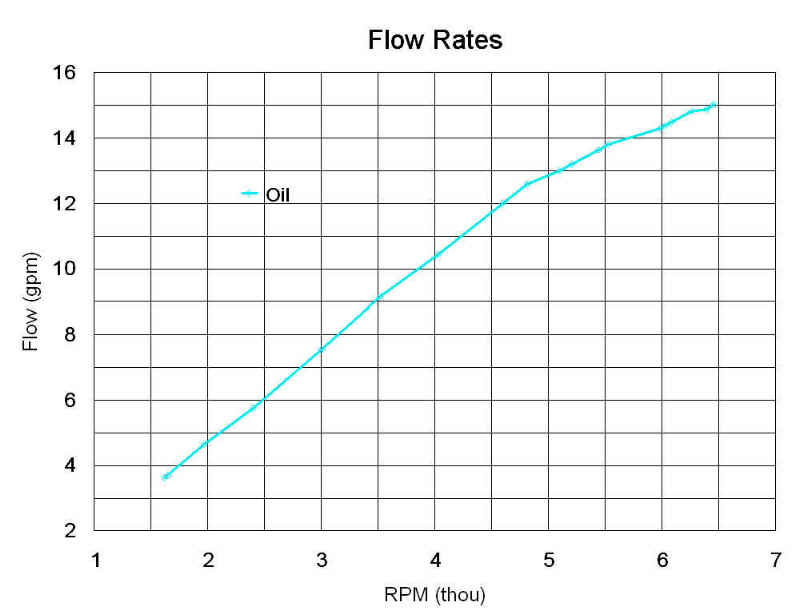
of engine RPM is shown on the attached chart. I don't know what pump speed
is.

The curve is quite linear up to about 5000, and then begins to bend over a
bit.  Flow at 6000 it is 14.2 gpm.  At 5450 engine rpm the flow is 13.6 gpm
- lower than Francois reports on their engine, but I don't know if the
gearing ratio is the same.

FWIW,
Al
The AirCraft Rotary Engine NewsLetter.  Powered by Linux.
ACRE NL web site. http://home.earthlink.net/~rotaryeng/
Copyright 1998-2003 All world wide rights reserved.