Paul - I have a BASIC program that predicts performance pretty
well
and it computes induced drag, uses prop diameter, airfoil tables
wing span,shape etc. The 2G is easily modeled by increasing
gross weight by twice. Weight is a minor player in top speed,
and the turns in the F1 class course are a larger factor than on
the unlimited course. It took F1 guys a long time to get the
message
on aspect ratio. Acceleration is also a factor in F1, but not so
much
in unlimited with the paced start.
If you like I could run some straw man cases for you. Vance
Figure 4000 HP and a R3350 Rare Bear or Corsair R4360 size airplane
and
see
what you get. The unlimited guys are saying pretty much 2.5 G's
continuos
at 500 MPH. If you are not going 500 you might not be pulling 2.5.
I think you will have to model the course.

Paul Lamar
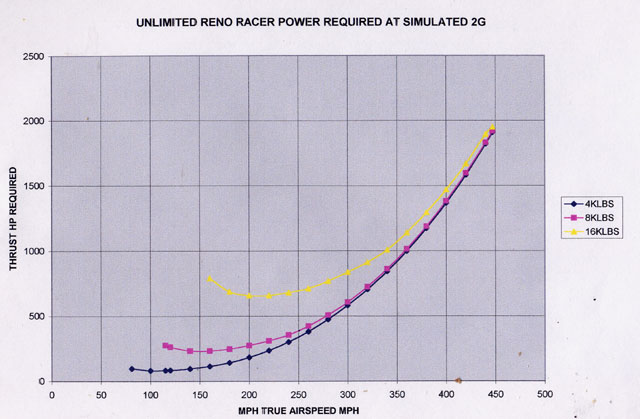
Paul - the problem is definately not induced drag. I modelled a
smaller
plane
than the big radials - sort of a stripped, clipped wing P51 class
racer
probably a contender but not a gold. Input values were 4000lb race wt
200 sq ft wing 2500 sea level hp, fuse ACD 2.52 sq ft (pretty clean
but not "slick glass" - 10 ft prop. 2G was simulated by running a
8000lb
case. 3000ft eq alt. for both. The lift coeff above 400 mph is so low,
that
with
anything but a symetrical airfoil, the light wt case backs out of the
drag
bucket, and the loaded plane is actually slightly faster top speed.
Putting
in a symetrical 66 series 12pct foil, and I get the curves shown on
the Excell plot. Thrust HP is after all the prop losses are factored
in. Top speed was 447mph true in both cases, with the increased load
only showing up at the lower speed - Interesting!! Vance
I still think you need to model the course. As you go faster on a given
course
the G's go up. Do you have a map of the course? It takes over 500 MPH to
win.
Centrifugal force is (mass x V^2)/turn radius

Also I think 4000 pounds is way too light for a P51. According to
Crawford
an empty P51 is 7125 pounds. A Bear Cat is 7070 and a F4U is 8694.
Hawker Sea
Fury is 9240. You will need to add fuel, water (ADF) and pilot and take
out armor.
Paul Lamar
BTW Crawford gives 3 for the flat plate on the P51, 4 for the Bear Cat,
4.1 for
the Sea fury and 4.3 for the F4U.

Paul Lamar
The flat plate (CdA) I gave was just for the fuselage - the total CdA at
speed was
3.21 - a bit more than the 3 total from Don. I suspect he backed those out
from race results and power estimates. 3 sq ft at 3000 ft alt and 500mpTAS
equates to 2556 thrust hp, or about 3000 shaftHP with a good prop. I ran a
case at 16000 lbs and even that only dropped top spee by a couple of mph.
As I stated, it does not look like induced drag from G forces is the main
player - CdA and brute power set the speed . I think the CdA of Nemisis
was down around 1 - if you shoehorn your 900HP 3 rotor in that, you
might hit 500 mph.
According to the books the fastest stock 51 was the H at 2218bhp?
and 6585Lb empty 487 mph at 25,000 ft -  the 4000lb race wt was
pretty optimistic. Vance
I think you still need a course map. They could be pulling 3 G's in the
corners at 500 MPH. Also the altitude is 5000 feet as I recall making induced
drag more important.

Paul Lamar

The AirCraft Rotary Engine NewsLetter.  Powered by Linux.
ACRE NL web site. http://home.earthlink.net/~rotaryeng/
Copyright 1998-2003 All world wide rights reserved.