Perry Mick wrote:
It takes 2200 RPM to taxi with the duct on, 2800 with duct off.
With the duct on and a 10 knot headwind, it took 1000' to reach 70 knots
airspeed, was airborne at 1500'. It usually takes me 1800' with no headwind.
So sorry guys. I guess you just don't understand what that duct is doing
for me. As far as I can tell there is just no way a 38" fan turning 5000
RPM will ever get off the ground in a reasonable manner unless you have
about 400 HP available and maybe a variable pitch mechanism. I think
it's a combination of capturing the tip losses and the venturi duct
shape that makes it a success at more than doubling the thrust of
stand-alone fan.
I still think you need to broad band that duct. Make a more streamlined
lower drag duct such as found on turbo fan jets with a smaller diameter opening
and use the variable geometry opening. I still think it can be done with
an inflatable rubber lip.

Marc de since you are on here now perhaps you can help Perry extend the speed
range of his ducted fan. In other words reduce the high speed drag from the duct
with out losing too much low speed thrust.
Paul Lamar
Marc de Piolenc wrote:
The way to broaden the speed range of a duct is to provide variable EXIT
area, which allows a duct that is otherwise optimised for cruise to
develop high mass flow under static conditions. I don't know any easy
way to do this so you're on your own where actual construction is
concerned. If your configuration happens to require a transition from a
circular section at the fan plane to a rectangular section at the exit,
all kinds of things become relatively easy to do - thrust vectoring,
variable exit area, thrust reversal... But I'm begging the question
because there are losses involved in making the change in cross-section
and, although I have a pretty good idea how to mitigate them, I don't
know how to quantify them.

Of course you can't completely ignore the inlet - you still have to
provide enough lip camber and radius to ensure that flow doesn't
separate under extreme conditions.

Best,
Marc
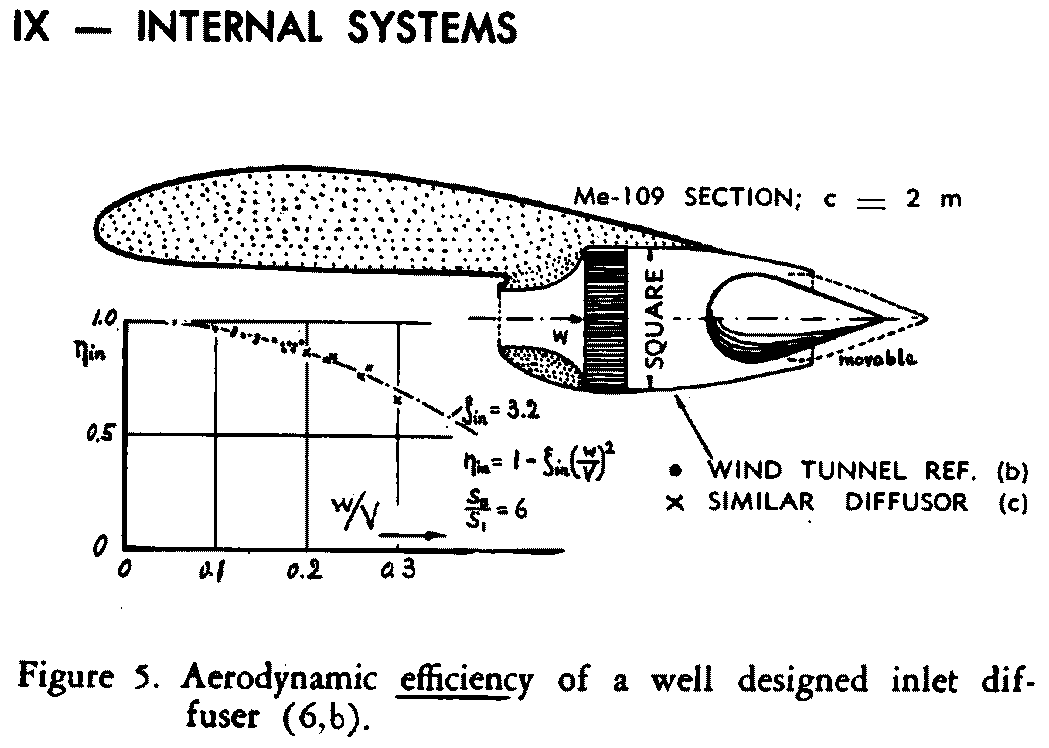
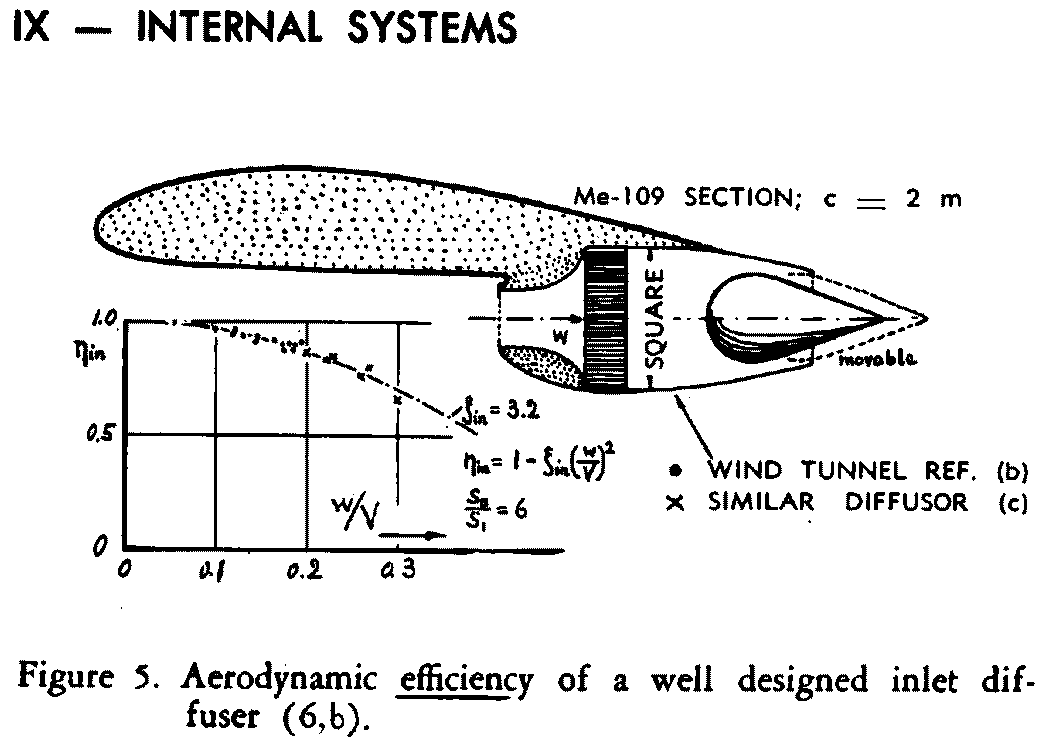
The usual way of doing that is to use a movable cone as in this ME109 rad duct.

Paul Lamar

The AirCraft Rotary Engine NewsLetter.  Powered by Linux.
ACRE NL web site. http://home.earthlink.net/~rotaryeng/
Copyright 1998-2003 All world wide rights reserved.