With the 38in dia at 5500 the tip speed is a tad above 900 fps, a bit high
for a typical thick wood prop but modest for metal or composite sections.
A search on net suggests that at least at one time the soob was running
about
50 inch dia and 60 in pitch - looking for 4000 where the Soob shoud be just
a tad over 100hp. I was suprised to hear that your exit area is greater than
the
fan area. This means that you are diffusing the flow velocity down before
exit. This cannot be good. Treating your whole plane as a controll volume,
thrust is the total air weght flow times the difference between entrance
velocity and exit velocity, so diffusing that exit flow is thrust loss.
Only sonic throat flow (ie rockets and turbojets) benifits from a
diverging exit. Vance
I have thin sections made from carbon fiber. It was only turning 4800 at
70 knots but no noticible acceleration. I think the blade must have been
stalled, but if so there was no speed less than 70 knots where it became
unstalled.
Actually you want exit area larger than fan plane area for a slow ducted
fan (<200 mph). I'll let Marc explain it if he will. I tried the exit
nozzle with less exit area (duct3), it bogged the engine down and was no
faster.

Perry
Just to get the nomenclature right.
The advance ratio in propellor speak is the ratio of the distance the prop
would travel in a solid to that distance it actually travels in a fluid. Typical
numbers for a unducted fan is advance ratios well over two. Here is a graph.
So yes, you could call it stalled, but that is normal for an unducted
fan. Here is a graph for a proper unducted fan blade. I think your main
problem is not the advance ratio but lies in the shape and twist of the blade
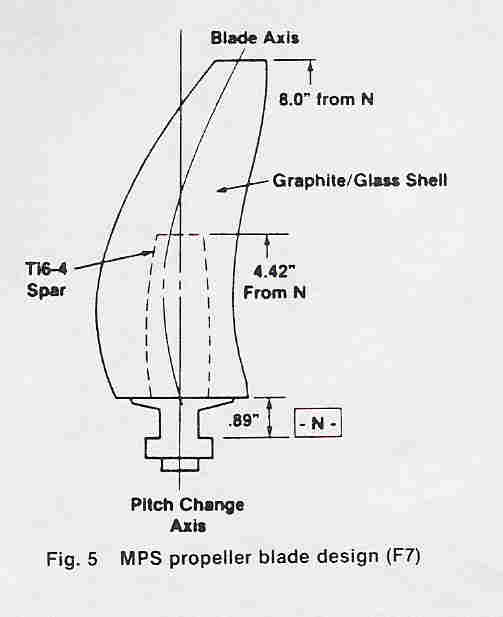
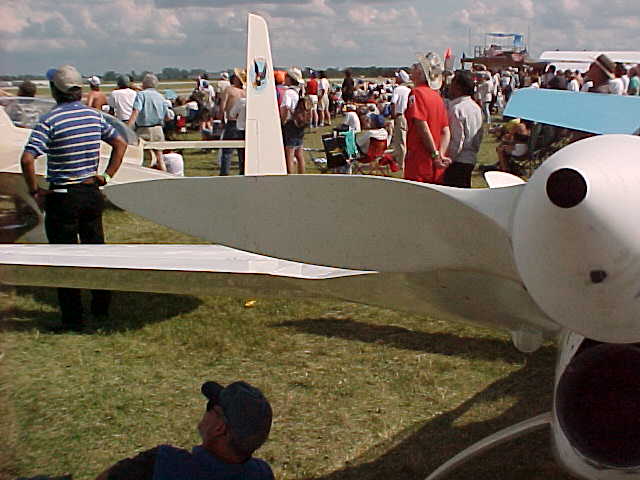
plan form for unducted fan use. The last picture is Charley Airesman prop
blade he did 200 MPH with using a direct drive Soob on a Vaieze. No data on takeoff
performance. To be fair Charley did have a long prop extension so negative
pressure effects on the drag, on the back of the fuselage, was mitigated.

Paul Lamar

The AirCraft Rotary Engine NewsLetter.  Powered by Linux.
ACRE NL web site. http://home.earthlink.net/~rotaryeng/
Copyright 1998-2003 All world wide rights reserved.