I am very familiar with the relationship of mass flow and velocity
in the momentum equation - however, the divergent section cannot
increase the mass flow (basic continuity). If the velocity at the
fan plane is 200 mph then it would seem that terminating the duct
at that point would be the best answer  - you would have that
mass flow at the higher exit velocity. - Vance
Vance,
The problem is the fan performance curve. You are dealing with a shaft power (constant HP) problem. Unlike a jet (constant thrust).  If you wish to discharge the same mass flow rate at 200 mph, you will have to raise the pressure ratio on the fan. This will increase power required. To maintain the same power absorption and get a 200 mph discharge would require reducing mass flow. No way around this. It is possible to increase thrust by reducing the discharge speed as long as it moves the fan down the curve to a place where it flows more air while consuming the same power. This works theoretically until the discharge speed is the same as the aircraft speed Ve-Va>1.  If you increase mass flow while decreasing discharge speed you increase propulsion efficiency (turbo-jet vs. turbo-prop). For jets, the most efficient cruise is found for Ve=2Va (for constant mass flow). My prediction is a shaft powered ducted fan is similar to a prop in that the propulsion efficiency is higher for greater mass flow and smaller difference between Ve and Va.


Monty
Jets are not constant thrust devices. it is just that their working area is
so small, and the delta V so high that they do not drop off with forward speed as fast as a classic prop. Fans are also not constant shaft power devices, the input power varies related to the amount of pump work. It is possible that your divergent area does add some mass flow by ejector action on the clearance between your fan tips and the duct inner wall, The big increase with the duct is at slow/near static operation where they pump down a lifting surface (the inlet bell) This advantage goes away pretty rapidly with forward speed. I think you would improve the overall peformance by terminating the duct very shortly behind the prop, and permit free expansion instead of forcing the expansion which is only optimum at single, fairly narrow point. As you indicated this might require a different size prop to match engine power. So far as I know, there is no specific best point for jet operation (they stink everywhere, which is why they are almost extinct) - Thrust is MV power is MVsqared/2 which is why for max thust per hp - move a lot of mass
a little bit for best use of hp - props are only 100 percent efficient with mass
infinate and delta V zero. For most EAA class airplanes ducts are a waste of time
unless you want to look like a jet. The design goal of the fanjet trainer was to acquaint
student pilots with the disadvantages of the jets at lower cost. - Vance
There are a lot of slow EAA applications that would benefit from a
ducted fan. Sport class most definitely, speed limit is 115 knots. If
I'm running a rotary in a sport class airplane I would rather have a
duct with no moving parts than a gearbox, and a prop with extreme limits
on the pitch to keep the speed down.
I will just post this from http://www.bridgingworlds.com/raspet.htm:

EAA Letter About Raspet

A reader of this webpage faxed me this letter from the December 1997 EAA
Experimenter Magazine:

...The discussion of propellers brings to mind another bit of knowledge
on shrouded propellers. The old NACA explored shrouded propellers, and
found little difference between them and unshrouded ones. The shroud
reduced the losses at the tip of the propeller, but the drag of the
shroud offset the performance improvement so that the overall
performance was about the same. The late Professor August Raspet of
Mississippi State University had the idea of making the duct in the
shape of an airfoil, with the curvature on the inside of the duct. I
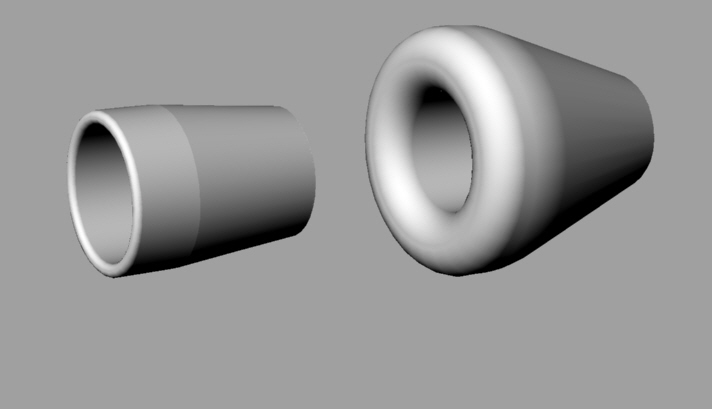
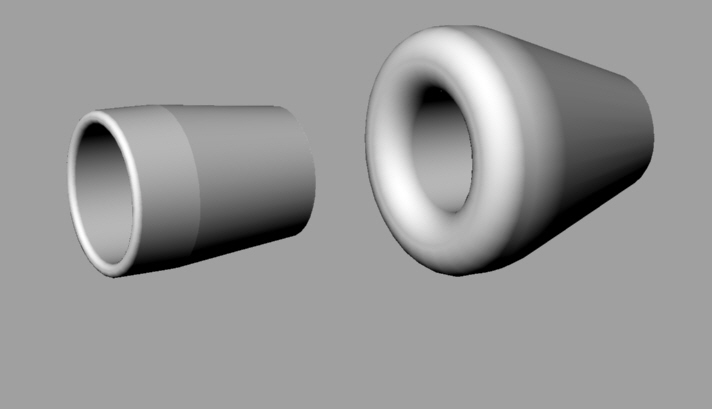
have drawn the two shrouded propeller systems below, the NACA system on
the left, the Raspet system on the right:

Raspet's system had two major advantages:
1. The propeller in the Raspet system was smaller, thus allowing a
higher engine rpm, and yet the system performed as well as an unshrouded
propeller with a diameter equal to the diameter of the outlet of the
duct. The duct was performing the function of a Propeller Speed
Reduction Unit (PSRU) by reducing the propeller tip speed and also
increasing the propulsive efficiency by affecting a larger cylinder of air.
2. Raspet's system also increased the static thrust because the inflow
of air into the duct when it was not moving forward caused a suction
over the forward part of the airfoil. In tests with the Anderson-
Greenwood airplane, Raspet was able to double the static thrust by
adding a properly shaped shroud and a propeller designed for the flow
velocities within the duct. The performance improvement decreased with
increasing forward speed until at about 200 mph the performance was back
to that of an unshrouded propeller. The duct system was then performing
the function of a variable-pitch propeller with no moving parts.

Mississippi State got an Army contract to build the XFV-!!A Marvel
Aircraft using this shrouded propeller system and a bunch of other
advanced ideas. Unfortunately, Raspet was killed before the airplane
flew. It was completed, but when flown with a free-stream propeller in
the duct (instead of the intended one with the twist matched to the
local flow velocities within the duct) the mismatch resulted in very
poor performance and the project was shelved. All this is documented in
reports by Mississippi State during the period 1955 to 1965.

The Anderson-Greenwood would be a better airplane with the Raspet shroud
system. Also, all of the gyrocopter, trike and powered parachute designs
would benefit from a Raspet shroud. I cannot understand why people do
not use it. Apparently no one has read Raspet's reports but me. If I
were more of a "doer" and less of a "thinker," I would have built a
Raspet shroud long ago.

Sincerely,
John E. Jenista, EAA 3470
A good part of the problem is the duct weight increase. A hollow carbon fiber
duct would mitigate some of that. Not available when Raspet was alive.

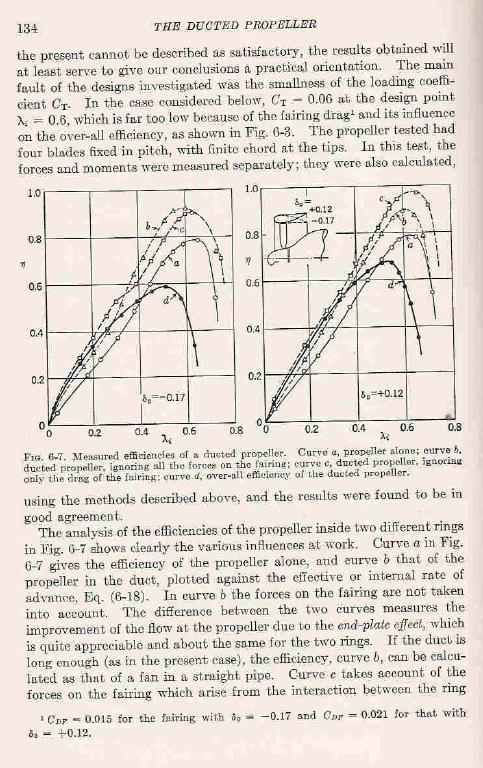
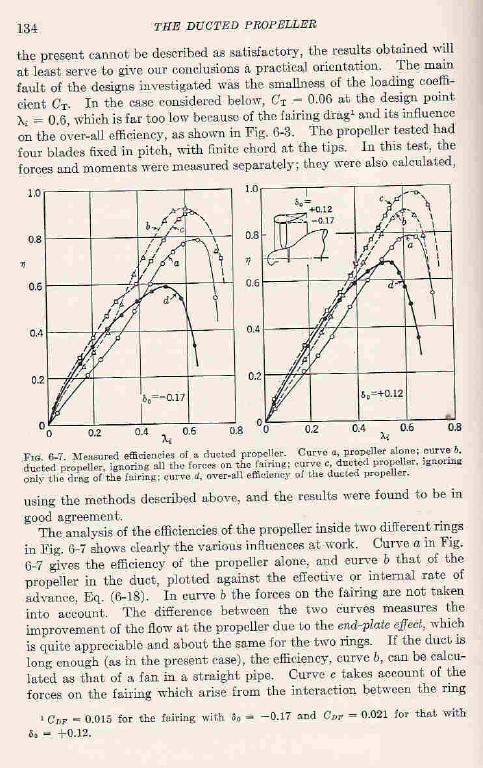
Here again is the data from K&M Aerodynamics of Propulsion with some of the
surrounding text. Note the drag contribution of the duct to the overall
performance. The data is plotted relative to the advance ratio on the x axis.
Very typical for propellors. A turbo fan on the other hand would have
advance ratios of well over one at low speeds and that is kind of what K&M
are referring to when they speak of disk loading. Also note that opening up the
exit area (the right side chart) increased the efficiency plotted on the y axis.
That is what Perry verified.

The DRAG of the duct DROPPED the OVERALL efficiency almost 30% at advance
ratios over .4 (high speed).

Note also the inverted airfoil shape of the duct. I am sure Raspet had this
book since it was published in 1953.

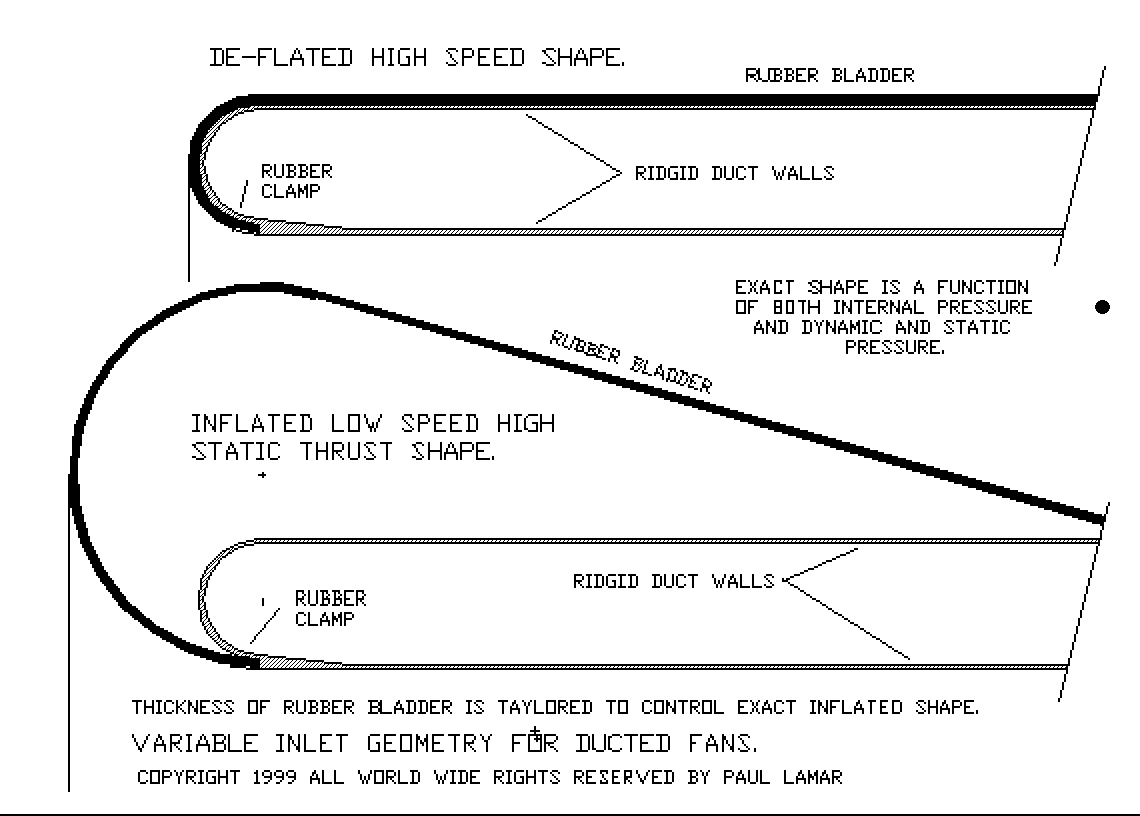
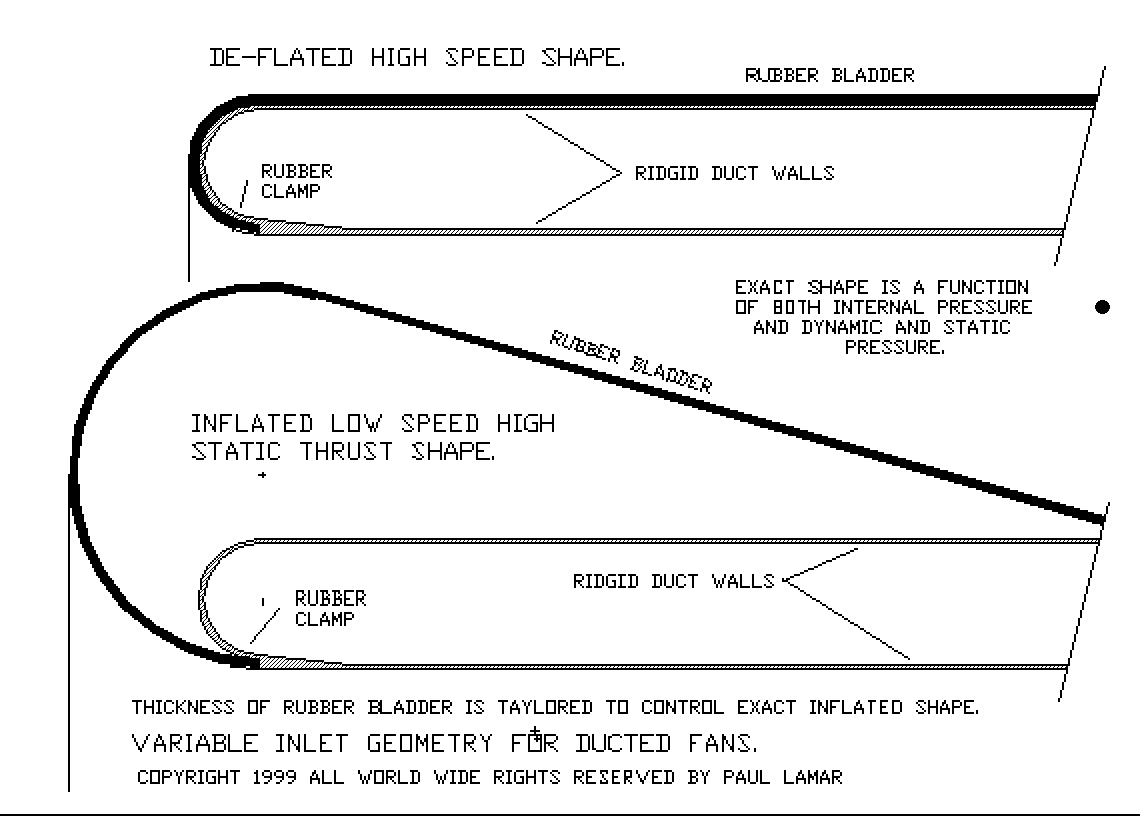
IMHO with a much larger radius on an inflated lip such as I am suggesting
low speed thrust would be greatly increased and the duct could then be made
thinner or smaller in diameter with less high speed drag. A smaller diameter
duct with a higher advance ratio, higher disc loading fan could allow the
rotary engine to rev higher and generate more HP and still have the same
low speed thrust advantages. In other words it would become more like
a turbo fan but have much better low speed thrust.

I also think with a pito tube placed behind the fan the consequent air
pressure might inflate the lip. Normal inflow into the duct would also
help inflate the lip. A two way valve could shut off the pito
tube pressure and vent the lip volume to the atmosphere collapsing the
lip. Better yet to a source of low pressure forcing the lip to collapse.
No compressor required. Patent applied for :)

BTW if you make the duct too short there will be reverse re circulating flow on the
out side skin of the duct drastically reducing the low speed thrust.

Paul Lamar

The AirCraft Rotary Engine NewsLetter.  Powered by Linux.
ACRE NL web site. http://home.earthlink.net/~rotaryeng/
Copyright 1998-2003 All world wide rights reserved.