Vance,
Jets are not constant thrust devices. it is just that their working
area
is
so small, and the delta V
so high that they do not drop off with forward speed as fast as a
classic
prop.
Correct jets are not constant thrust devices in the absolute technical
sense. From a layman's perspective they are, especially compared to
props,
ducted fans etc. Relative to aircraft speed, the thrust of a propeller
falls
off with increasing speed. If it were a constant speed prop slaved to
the
engines operating point it IS a constant HP device. HP equivalent for a
jet
can be calculated by multiplying thrust times aircraft speed. HP is not
constant for a jet. It increases with speed. For all practical purposes
the
thrust remains constant as long as the altitude remains the same and the
engine does not reach the limitations imposed by inlet efficiency (at
which
point the thrust is roughly the same as static, maybe a little greater).
Jets are different. They work by moving a mass of air the same as a
propeller, but they are thermodynamically very different. You are
compressing, then heating the bulk of the inlet stream. This gives you
much
more volume to deal with in the nozzle. It also allows you to recover a
great deal of the ram air pressure (stagnation temp etc) using good
inlet
design. People wishing to design a "cold" jet would have better luck
investing in the NASDAQ
Fans are also not
constant shaft power devices, the input power varies related to the
amount
of pump work.
Yes, but the available amount of power is fixed by the engine. It
reaches an
equilibrium point on the operating curve of the Fan/duct. You cannot
arbitrarily change the duct/fan/pump and expect the engine to put out
more
power. This is what I meant by constant shaft power.
It is possible that your divergent area does add some mass flow by
ejector
action on the
clearance between your fan tips and the duct inner wall, The big
increase
with the duct
is at slow/near static operation where they pump down a lifting
surface
(the
inlet bell)
You are still missing the point. I understand your analysis. You are
drawing
too big of a control volume around this thing. If you are doing a
"rubber
band engine" design study, where the hardware does not exist yet, your
approach would be correct. You ARE correct if the change in exit
velocity
did not effect the power required and the mass flow. It does. The
hardware
is fixed, this is "off-design point" analysis. The divergent area acts
like
a penstock on a turbine. It changes the discharge properties. It
controls
the operating point on the fan. The fan is a fixed device. The engine is
a
fixed device. The divergent section allows the fan to "see" higher
speed
air while acting like a much larger fan. I am leaving the equations to
you
because I know you are quite capable of analyzing this problem. I am
trying
to give a qualitative explanation that will benefit the rest of Paul's
subscribers.
So far as I know, there is no specific best point for
jet operation
(they stink everywhere, which is why they are almost extinct)
Now I know you know better than this Vance. Jets are the only thing
capable
of doing what they do. They do not stink everywhere. They stink at slow
speeds. They stink in our flight regime, historically. There is most
definitely a best point for a specific jet engine operation. They are
designed with an operating point in mind. The airframe and the jet must
be
matched closely to realize good efficiency. I will refer you to any
propulsion text to find the derivation of best cruise point Ve=2Va. As
far
as stinking, sit down and figure out that a modern turbofan has a TSFC
of
around .5 and can fly at 30K ft at M .8. Now figure out what Rare Bear
would
be doing at altitude and speed in terms of TSFC, not shaft SFC. Don't
like
that how about Turbo-shaft engines with compression ratios of over 20 to
1.
Specific fuel consumption numbers in the .45-.5 lb/hp/hr range. 2000 hp
in
something the size of a small block Chevy. The main problem is they do
not
scale down to our power levels very well, at least not with current
manufacturing techniques. Saying they stink in an unqualified manner is
a
bit harsh.

Short of some sort of gravity/electromagnetic alternative, I predict
that
jets will be with us for a LONGGGGGGGGG time.

As a post mortem on Perry's failed experiment I would say that you have
a
fan designed to operate in a duct, not in the open air. If you designed
a
fan to turn at 6000 rpm at 180 mph it would look a little different than
what you have. You also have an airframe that is not conducive to this
design. The Long EZ has a terrible aft body contraction problem. The air
going into the prop has been over the canard, canopy, fuse, gear,
engine,
wing....yuck. And the prop is not very far from the wing. Rule of thumb
is
at least one chord length behind the wing to let the air settle down.
Charlie Airesman moved the prop way back and had a nice faired
transition
into the hub. No offense Perry, your situation is not the same. Thanks
for
trying. Most people won't go out on a limb anymore. Remember it is the
EXPERIMENTAL Aircraft Association.

Monty
I think Vance was referring to pure jets Monty and not turbo fans
so you can't jump from one to the other in the same paragraph :)

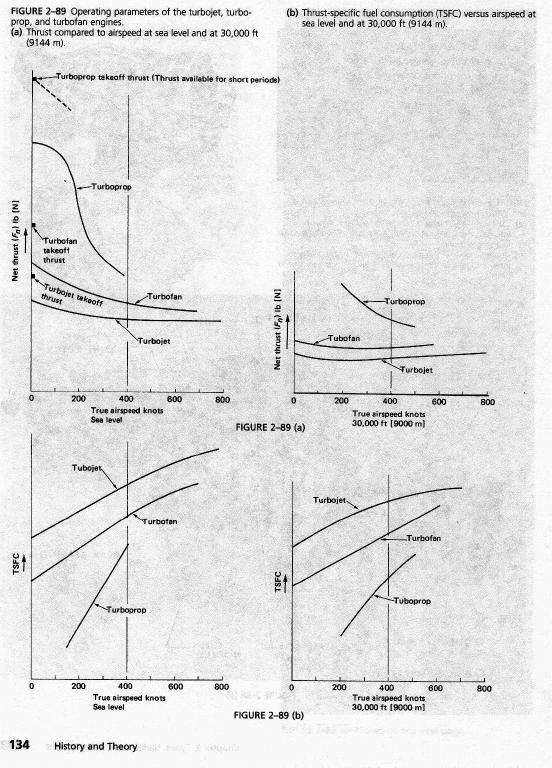
I took the liberty of adding a bunch of pictures and illustrations to
prove your other points the vast majority of which I agree with.

Paul Lamar
Sure I can jump between pure jets and turbo fans. The only thing that
matters is the speed range. The faster you go the lower the optimum bypass
ratio. Think of a prop as an extremely high bypass jet. (with a big heavy
mechanical compressor) optimized for low speed. ;-)

Monty
Take another look at that chart I sent. The turbo fan is better everywhere
in our speed ranges compared to the pure jet in both in thrust and TSFC. I
think that is what Vance was referring to. The turbo prop engine is
hardly a big heavy mechanical compressor :) It just sucks fuel when
scaled down to less than about 400 HP.

Paul Lamar

The Rotary Engine NewsLetter.  Powered by Linux.
ACRE NL web site. http://home.earthlink.net/~rotaryeng/
Copyright 1998-2004 All world wide rights reserved.