Paul Yaw,
     There has been a lot of discussion on ACRE and your name was mentioned.
     I've had a look at this (your) site ( very informative), a little confusing to the novice like myself.

     I'm working with a chap in the US and we are looking at aluminium housings with a steel wear plate.
     The problem is the ports and it would be much simpler to PP the rotor housings.

     I'm working on a !2A for a demonstration and test rig (cheaper) and was wondering if you would be kind enough to give some advice on a mild street
     port on a 12A and 13B.

     Everyone remembers you and your input to ACRE ( I wish you were still on there).

     Someone mentioned you were working on different ports that would be more suitable to our Aircraft applications.

     Mate any support would be appreciated !!

     George Lendich (down under- Australia)
********************************************************
     Hi George,

     Peripheral ports make great power because they flow well, and the overlap allows for scavenging of the clearance volume.  They also work horribly
     when there is vacuum in the intake manifold.

     I do believe that there may be some merit in an aircraft application, but if I were tackling the problem, I would plan for making several different
     versions, and testing each of them on an engine dyno.

     Until someone spends the time (With no guarantee of success) I believe that a side port is preferable.  My approach would be side ports with fairly
     late intake closing (60 to 70 after bottom dead center) and a large area, long intake manifold.  I think the intake dimensions would best be
     determined experimentally on the dyno.

     I think that there is much to be gained by spending some serious time on the dyno varying intake parameters, and injection timing and placement.

     When we build a racing engine, many of the details like port timing and intake/exhaust configuration have been worked out over the years, and we
     still spend a considerable amount of time on the dyno.

     The aircraft application is so different, that a lot of dyno time would be required to have a truly optimized system.  ACRE is full of great ideas,
     that somehow turn into "The right way to do it" after lots of discussion/arguing.  As far as I'm concerned, nothing is valid until it has by proved
     through experiment.  Until it has been proven experimentally, it is just an idea.

     Sooner or later, someone with a big checkbook will initiate a project that involves substantial testing (Proving) and if I'm the one to do it, I
     will make the information available to everyone.

     Until then, it may be best to go with what has been working well for people so far.

     Sorry, I don't have better answers for you.  If you were asking for details on a racing engine, I could be much more specific.

     Based on what I do know, building a PP aircraft engine could be more trouble than it's worth.

     Note that the above is opinion, not fact.

     I think you have two choices.

     1.  Follow guys like Tracy Crook who are having considerable success.

     2. Try a new approach (Like your peripheral ports) and know up front that the dyno will probably make you feel silly several times before you get it
     right.

     I don't know what Tracy is up to these days, but last I heard he was having great success.

     Paul Yaw
     Yaw Power Products
     21639 N. 14th Ave.
     Phoenix, AZ 85027
     www.yawpower.com
What Paul Yaw doesn't know is Allan Tolle went 238 MPH in the Sun 100 race
ten years ago with P-ports and Tracy Crook went 217 MPH with side ports
just this year. The Power Sport engine was dynoed many times by Everett Hatch.
Everett had  not just one, but two dynos. Furthermore the Power
Sport engine had a 2.4:1 gear box which limited the RPM to about 6200
while Tracy Crooks engine can now rev to about 7200 RPM. that alone will
generate more power all other things being equal. The latest dyno
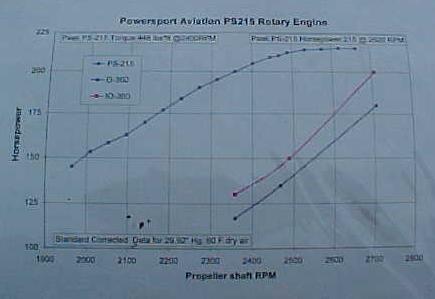
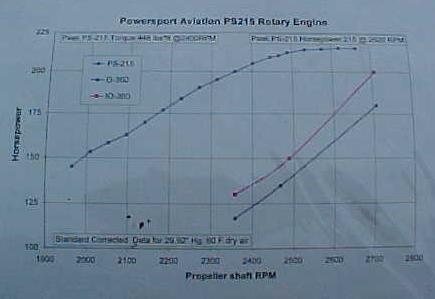
curves I have on the Power Sport engine show 215 HP over a wide prop RPM
range up to 6200 engine RPM. At 5700 engine RPM it is over 200 HP.

Paul Yaw is heavy into racing cars and knows little about aircraft engines.
Paul built a turbo 13B  he claimed had 250 HP for a sea plane but the sea
plane could not get on the step for take off. Perhaps Paul's dyno is lying to him.

Paul Yaw could also be using what we call the IBM FUD sales technique.
Fear Uncertainty and Doubt. In other words Paul wants to sell you some dyno time :)

Paul Lamar

The Rotary Engine NewsLetter.  Powered by Linux.
ACRE NL web site. http://home.earthlink.net/~rotaryeng/
Copyright 1998-2004 All world wide rights reserved.