It sure is not reciprocating. I am sure they know about and are
frightened
of the Mazda Wankel engine.

Paul Lamar
Vance W Jaqua wrote:
The Mazda Wankel is really a hybrid between a true
rotory and a recprocating engine. It has about a 1 inch
stroke (twice the eccentric offset) and the swept
volume is about half face area times reciprocation
and half true rotary - swept housing shape!!!
A WWI leRhone is a truer rotary than a Wankel/
Vance
There you go again Vance. The rotary does not "stroke". :) The rotor
rotates about
its own center while rotating about the the center of the e-shaft. That is
why
they call it a planetary engine.

The LeRhone rotary has reciprocating connecting rods therefore it is
not a true rotary like the wankel.

Paul Lamar
A true rotary would have no shaking forces, and have no need for
external   like a turbine, or the as yet unproven
vane engines,- the le Rhone almost does that -
the Wankel does not even come close -
Wait a minute. The four rotor needs no "counter balances". Does that make it
"true rotary" and the two rotor not a "true rotary"? The "counter balances"
are there to take out a minor couple in the two rotor.
That does not make it
a bad engine - specially since these are easily  and totally
balanced with external counterweights , but it fails a critical
test description for a true rotary
Where is this "critical test description" of a "true rotary" written?
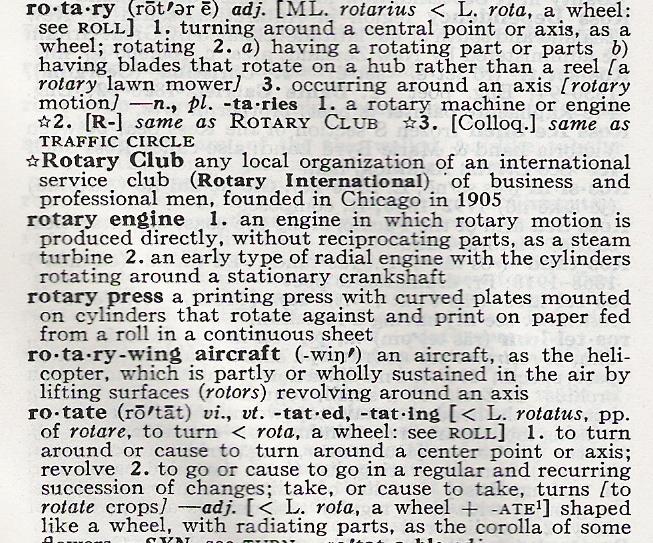
Certainly not in any dictionary. Here is the definition of a rotary
engine in the New World Dictionary. It says NOTHING ABOUT "counter balances".
It does say rotary engines have NO reciprocating parts. The Wankel
certainly qualifies while the LeRhone does not really qualify as the
connecting rods reciprocate back and fourth as the block rotates
as do the silly poppet valves.
Yes! I know some
Yama  somebody has a description for a rotary engine,
but you would have a hard time convincing people
that he was unbiased -Vance
Here too is  the "Yama somebody" description of a rotary engine.

Not to worry folks. Vance comes up with this outrages nonsense every
six months or so just to get a rise out of me :).

Paul Lamar

The Rotary Engine NewsLetter.  Powered by Linux.
ACRE NL web site. http://home.earthlink.net/~rotaryeng/
Copyright 1998-2004 All world wide rights reserved.
By Kenichi Yamamoto from his book "Rotary Engine" 1981

1.3     REQUIREMENTS FOR A PRACTICAL ROTARY ENGINE
        Although various types of rotary engines have been
developed to date, there are few that do not qualify as internal
combustion engines or do not qualify as a practical engine even
if they satisfy the qualifications of an internal combustion
engine.
        The requirements for a rotary engine to be qualified
as a practical internal combustion engine can be summed up in
the following five items. The practicality of various ideas on
rotary engines can be judged by evaluating them by these
criteria:

(1) Every moving part, including the timing mechanism, should
make a rotating motion. A mechanism having a reciprocating
inertia will increase mechanical noise and vibration, and will
work against high speed and high revolution.  Accordingly,
structures that require intake and exhaust valves and
mechanisms using the rotors oscillatory motion are not
desirable.

(2)     Gas seals or the working chamber should be three
dimensionally reliable.  The gas seal mechanism of a rotary
engine should be constituted by connecting the individual seals
three dimensionally. Among the many ideas we come across are
those that don't show such three dimensional thoughts.

(3)     Appropriate gas exchange of intake and exhaust should
take place. Together with having a mechanism that can correctly
open and close the ports, sufficient time for intake and exhaust
should be provided especially for high speed and high
revolution.  Among the ideas on rotary engines, there are some
that ignore this point.

(4)     Every component part should have the strength to endure
high speed and high pressure.  As the component parts are
exposed to high pressure, high sliding velocity and high heat
load, every part should have sufficient allowance in size and in
shape.

(5)     Sufficient cooling and lubrication should be provided.
In order to qualify as an internal combustion engine, although
this is related to above (4), durability against high heat load,
high sliding velocity, etc. are required. Therefore, the
structure should be simple, and the ideas on rotor cooling,
lubrication of seal parts, and oil seal structure should be
those that are given adequate thought.
        Also, it is desirable for a practical rotary engine to
have a simple and compact structure. When we evaluate the
various type's of rotary engines devised to date in view of the
above mentioned requirements, the NSU Wankel type rotary engine
is the engine that best satisfies the above mentioned
requirements.


The AirCraft Rotary Engine NewsLetter.              Powered by Linux.
ACRE NL web site.
http://home.earthlink.net/~rotaryeng/            http://www.linux.org