> > Tom Webber wrote:
Hello all,  I have a question and would like feed back on the use of
Mobile One engine oil.  Should the engine be broken in using a non
detergent for X number of hours then use Mobile One.  Or can the
synthetic oil be used right off the jump?  All comments are
appreciated.
T.W.
Tom,
I would absolutely begin the engine's life on petroleum after a
rebuild.
100% synthetic oils reduce friction so dramatically that engine
break-in
lasts a long time. This applies to products with 5-10% petroleum,
like
Mobil 1, as well.

The recommendation most often seen is to run a shortened interval on
petroleum to wash out anything left inside from machining or assembly,
then
run a second or third interval until oil use stabilizes (hopefully at
zero).
The second half is about ring seating, though. (This is an area that
I'd
like to hear about from a rotary builder - how do we know when the
apex
seals are seated?)

Many cars are shipped from the factory filled with synthetics - nearly
all
the European models (VW has had a synthetic-filled drive train since
at
least 1988), many Japanese cars, drive trains of many big trucks in
the US,
Vettes, etc. The initial fill of synthetic engine oil in these
vehicles
comes at a price, though. Corvettes with initial fills of synthetic
oil are
taking upwards of 45,000 miles before rings are seating and the engine
is
making good power. Same with big trucks. Cummins specifies running
20,000
miles on petroleum before switching to synthetics or blends (the best
blends
are only 20% synthetic). Running a single 10,000-mile interval on
petroleum
and switching to a synthetic blend stretches break-in (including lower
fuel
economy and elevated oil use) out beyond 80,000 miles.

Break-in, significant oil leaks, and very dirty/neglected engines are
not
the places for synthetic oil.  Break-in due to decreased friction and
lowered wear, leaks from recurring costs, and dirty engines due to the
significant cleaning effects of synthetic base oils (clean 'em first).

Make sure the petroleum used for break-in has detergents - at least
API
spec
SB (the current is SL). The engine needs the detergents and
dispersants to
keep things clean. The non-detergent SA oils should have been off the
shelf
in the late 40s...
Andy
<Mazda mag article snipped>

Just to be precise about it, "break-in" of an engine is referring to the
rings..as in PISTON rings.  Right?  There isn't anything in a rotary that
the engine oil will help "break in".  The shop I work with sends all new
rotary engines out with Mobile 1.

Tom, were you talking about a piston engine?

Mike McGee
VAF Home Wing/EAA Chapter 105 Flyin Coordinator
June 19th, 2004
Scappoose, OR
Mike,
   It's much more than just rings.  Anything that touches has a break-in
process.  All the bearings, all the gears, the seals, everything.  I used
the oil-consumption rule of thumb for a piston engine as an example - I
don't expect our consumption will be as obvious - and much harder to track
since we have an oil-loss system.  Oil analysis is a tool that allows us to
look inside and see how a piece of equipment is doing.  If you begin an oil
analysis process from day one and continue over the life of a piece of
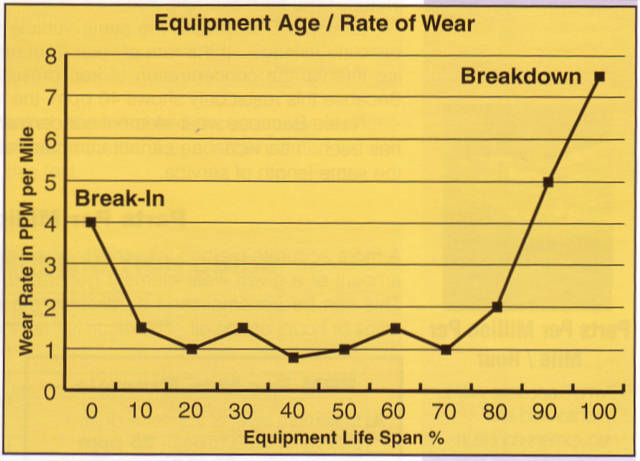
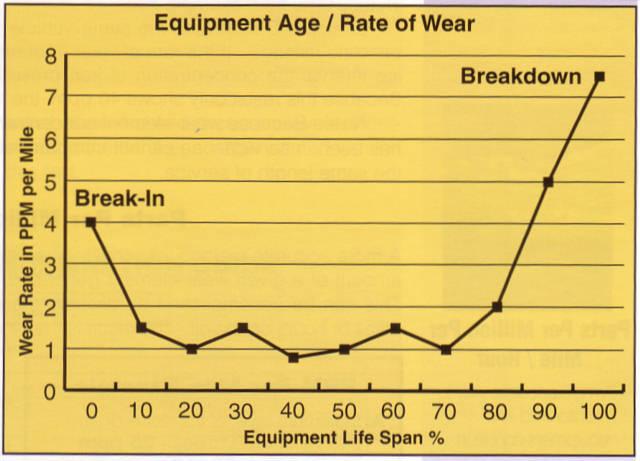
equipment, you'll end up with a graph much like the one attached.  This
holds for engines, gearboxes, auto transmissions, etc.  Synthetic use will
lower the slopes and could lengthen the life span; a really bad petroleum or
poor service will increase the slopes and shorten the service life.  But the
trend holds.  This is another reason why I wanted to collect some wear data
for our engines.
Andy
ahecker@satx.rr.com
 Not much info there. Actually I don't buy it.
there is no part in the rotary that wears like that. For all practical
purposed the bearings in a rotary last for ever. The apex seals
have a linear rate of wear and then the seals must be replaced
and perhaps the apex seal slots in the rotors reground for  a wider
apex seal. That might hold for a monkey motion piston engine where slop
causes one part to impact another or its bearing in the block. The more
the slop the greater the impact. Typical for reciprocating mechanisms.

Paul Lamar
Ops for got the chart.

Paul Lamar

The Rotary Engine NewsLetter.  Powered by Linux.
ACRE NL web site. http://home.earthlink.net/~rotaryeng/
Copyright 1998-2004 All world wide rights reserved.