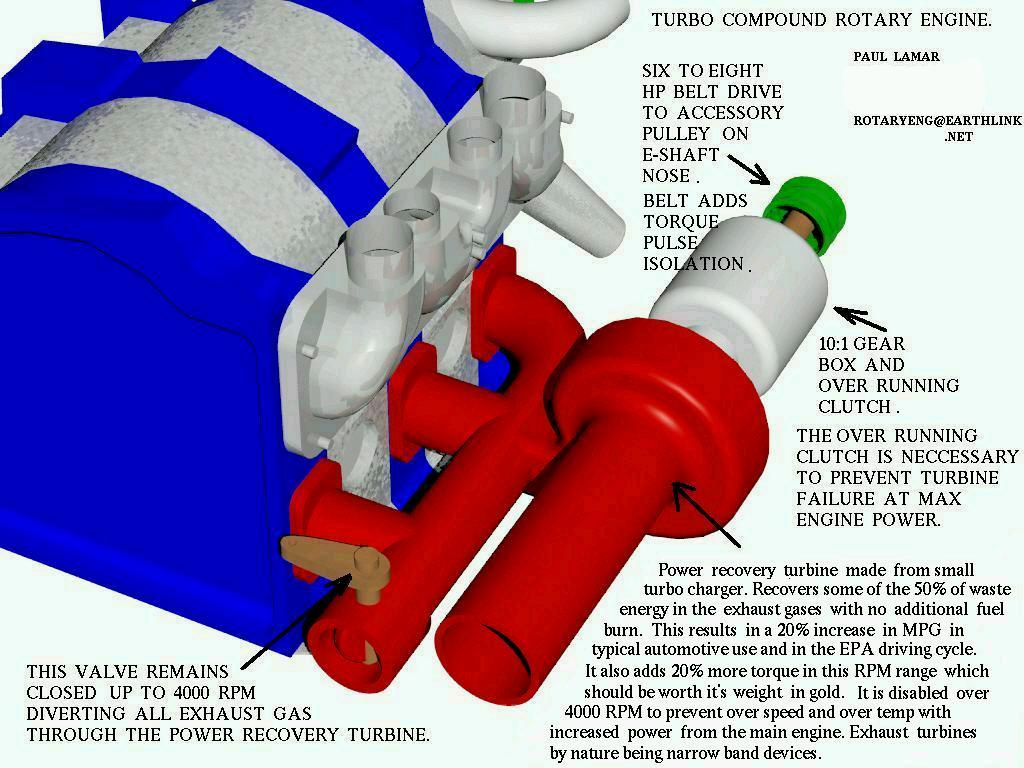
One always must keep in mind the cost. That would  not be the lowest cost
solution
for a low buck sports car like the Miata. Even an all aluminum 13B rotary
would be a major investment on the part of Mazda. Probably a wider rotor
and rotor housing for more displacement would be one of the lowest cost ways
of increasing the torque and HP. The question is; can the EPA mileage
numbers be maintained with more displacement? Always a factor. The
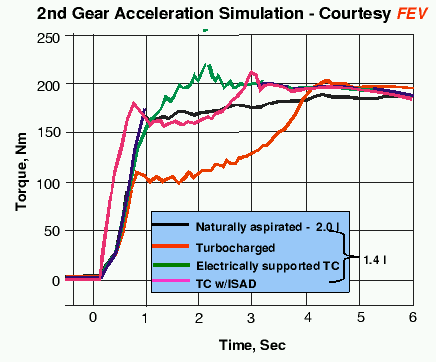
electric assisted turbo charger can do wonders for instant torque
but I doubt it could improve the EPA mileage numbers. My vote
is still the turbo compound configuration. 20% more torque AND
20% better mileage in the same engine. Proven technology that
works.
snips...
The main thing IMHO is, Mazda is falling behind in the current HP race
here in the US. The engine lacks the low speed torque Americans expect
in their cars. High HP and a six speed gear box is not enough. They
need some sort of higher torque rotary. That historically meant more
displacement. The 13B has not been increased in displacement since 1974.

They also need a rotary in an up market low volume status vehicle
such as a 4 rotor Jaguar XK capitalizing on the publicity from their
win at Le Mans. This I feel will synergistically add sales in the
RX8 price segment of the market. Much as the Corvette does for Chevrolet.
snips ...
There is some engineering opinion that a large turbine connected directly to
the e-shaft is not the way to go. I would like to see it tested however.
It is certainly the simplest way of building a turbo compound engine.

Paul Lamar
OK Paul
I will
present your 'wish list' concerning the auto engine market.  My contact is
part of the new blood (the founder's grandson) but as you can well imagine,
being in your thirties is considered inexperienced in large family owned
corporations here.

As an interesting side note, Mitsubishi Auto and Truck is getting pounded
daily in the news  concerning their cover up of defected cars for many years
now. Minor things like wheels falling off and brakes failing:)  Clearly a
case of a fossilized management with an arrogant attitude. I doubt Mazda
will become that way.  They are considered a 'ronin' company.  Ronin are
master less samaraii. These companies like  SONY  and HONDA are free of all
the intertwining government and banking staff in house.

I'll be very oblige with talk about rotaries in aircraft.

Doug in Japan
BTW I forgot to mention this Doug. An RX8 with 30 MPG  in the EPA highway
driving cycle would make a monumental impact in the automotive world.
Currently the RX8 is rated at 25 MPG. 20% better would put it over
the magic 30 MPG. The shock wave would be heard in every major auto
manufacturers board room around the world. A 20% improvement in fuel
consumption is totally unheard of in the automotive industry.
Automotive engineers would sell their grandmothers for only a 2% improvement.

This would be easy to achieve with 60 year old turbo compound technology.
Paul Lamar
Vance Jaqua wrote:
IMHO neither the turbo compound nor the turbocharger is the answer to
the torque perception of the rotary in automobiles. The turbines are square
law devices, and provide vitually no power at "road load" cruise points.
Something like the Eaton supercharger would fill this hole in a much more
satisfactory manner. Airplane use - the turbocharger wins hands down.
Vance
I think you missed the point of my tuning the turbine for road
load and bypassing it for higher powers. Please study this 3D again Vance
and get back to me. Perhaps I am missing something. Please read the note in the
lower left corner.

Paul Lamar
I'll explain it another way. A small turbine is chosen to optimize
the exhaust power available when the engine is generating HP below 4000 RPM
and partial power. We are looking for only six to eight HP here or 20% of
the engines 30 to 40 HP with commensurate torque. Typical of the RX8 cruising down
the highway at 80 MPH in sixth gear. At 3000 RPM the RX8 is doing 60
MPH in sixth gear. So from 3000 to 4000 RPM is the range we are interested
in improving the MPG. We don't really care what it does WOT.

This tiny turbine would be rapidly destroyed by over speed and/or excess heat
if we increased the power of the engine by running it WOT above 4000 RPM.
Therefore the waste gate is opened by the computer at anything above
4000 RPM and moderate intake manifold pressure (partial throttle).
If necessary the passage to the turbine can be blocked as well.
I hope this clarifies the situation.

Does everybody get this concept?

Doug print this out and take it with you as well. This is obviously
a subtle concept not immediately clear to every one. Heck it
took me 30 years to come up with the idea as I discussed turbo compound
rotaries with professor David Cole U of M (Ed Cole's son) 30 years ago.
Ed Cole was a past CEO of GM.

Paul Lamar

The Rotary Engine NewsLetter.  Powered by Linux.
ACRE NL web site. http://home.earthlink.net/~rotaryeng/
Copyright 1998-2004 All world wide rights reserved.
Vee 's for Victory

E-27: In many ways this was a very unique engine, and way ahead of its time.
This was the first turbo-compound, or "power feedback" engine built by any
manufacturer. Based on the E-22 power section with Auxiliary Stage
Supercharger, it added a General Electric CT-l power turbine, driving the
crankshaft through 5.953:1 gears. Allison built a mockup of the
configuration in September 1944, followed by a series of component tests,
including a complete compound engine development series run in June 1945.
The first complete engine was produced in September 1945.49 The turbine was
adapted from the CH-5 turbosupercharger and driven by exhaust gasses
collected by P-38 type collector manifolds. Compression ratio was reduced to
6.00:1 to accommodate very high manifold pressures up to 100 inHgA,
consequently Grade 115/145 was specified. The 12-counterweight crank-shaft
was used allowing ratings at up to 3200 rpm. The engine was in-tended for
the Bell XP-63H, where it would have been able to deliver a WER rating of
2980 bhp at up to 11,000 feet from 100 inHgA, using ADI injection.
Considerable running of related components and complete en-gines was
accomplished during 1944/45. The engine was able to demonstrate a 19%
improvement in cruise specific fuel consumption due to the contribution of
the power turbine. The aircraft never flew because the turbine was limited
to inlet exhaust gas temperatures of 1725 F and at full power this
temperature could be easily exceeded. As a consequence, Allison undertook
a project of their own to design and develop a suitable power turbine with
air-cooled blades, though that occurred only after the V-17 I 0-127(E27)
project was canceled.