George, (down under)
I would love to talk to you about hydrogen development. Please send me
your new e-mail off newsletter. The rotary is the engine for H2 use, but
there are many
other potentials as well. Australia is a perfect area for developing
the
technology as well.
Bill Jepson
Burning Hydrogen in any conventional thermal engine is "throwing pearls
before swine"
or like using $100 bills to kindle your wood stove. Back when it was
electricity
it cost a bundle but was still worth something. - Vance
Perhaps Vance,

You are right as to the efficiency issue.  Most ICU engines aren't
designed
to take advantage of pure hydrogen.  When comparing costs though I am not
so
sure the argument holds up. Looking at the big picture of finding,
extracting, processing, transportation and marketing of other hydro carbon
based fuels, the energy costs of making making pure hydrogen on site is
starting to become to make more sense (cents) as well.

A this point in time rotaries running on ethanol seems more appropriate
then
other fuels.  Perhaps then its like throwing corn before the swine :)

Doug in Japan
Doug, other than electric methods are there bio methods of extracting
hydrogen?
Since storage of hydrogen is volume intensive perhaps it is more practical
for an airplane with a lot of unused volume in the aft fuselage as compared
to
say a car. I think you might still have a range problem.

Paul Lamar
Paul yes now some processors in Japan are drawing H2 from algae. Perhaps not
practical unless the algae is also used for food  somewhere. Space station
applications no doubt.  Bio gas, methane gas or CH4 can be cracked fairly
easily to extract the hydrogen.

Storage for H2 is the challenge.  Storing it in a an airplane doesn't make
sense because it either has to be super cold and/or compressed which equals
heavy tanks, or obtained by splitting water using some interesting ultra
high frequency electronics. Another way we are pursuing is to obtain the gas
on demand (just in time) from reacting a alkaloid metal with water in an
controlled airless chamber. We test it in a car this autumn. I hesitate to
fly with this mechanism though. Zoom zoom, Boom boom.

The 'from water' method makes some sense but the only trouble is that the
inventor suddenly died last year about the time he was negotiating to
license the technology to some people on this side of the pond. If you like
conspiracy theories this is one story with made for movie material.  I have
done some research in ultrasonics for air cleaning and can understand how
water can be disassociated this way but in my experience I had accurate
control over the water surface level. I can't verified that the particular
inventor in question actually succeeded in his work so don't expect to fill
your gas tanks with water anytime soon.

Perhaps Mazda is injecting hydrogen directly into the upper part of the
combustion chamber in addition to gasoline may have some benefits.
Hydrogen's burn velocity is very rapid.  I still have a lot to learn about
the rotary so I'll stop making any speculations.  Now I am searching for
info on how to make a well instrumented dyno get a not so used 20B to test
and start trying to answer some questions about fuels and fuel burn rate.

For Jesse

The refractory metal info. was found on this site.
www.mpif.org/design/refractory.pdf

Doug in Japan
Do you have the Mazda tech paper on the hydrogen powered rotary.
Japan SAE C389/233  US SAE 925011 I think.

"Hydrogen fuelled rotaty engine.  T Teramoto, Y Takamori, & K Morimoto.

Paul Lamar
Doug, here are a few graphs from that hydrogen tech paper I mentioned.
Note how the efficiency gets better as the mixture gets leaner.
Tracy Crook discovered the same thing burning gasoline.

Mazda is struggling here for a few percent improvement in the efficiency.
In the mean time half the energy in a pound of fuel is going out
the exhaust as waste heat. Typical for all IC engines.  Besides turbo
compounding there are other avenues to be explored. A thermal pile converting
the waste heat directly to electricity to charge a hybrid battery is
one possibility. Another is; generate steam for a small steam turbine.
Commonly done with gas turbines in stationary power plants
yielding over 50% overall efficiency.

Paul Lamar
Yes I am aware of the drawbacks in using hydrogen in an ICU engine. Mazda is
as well of course. They are chasing after performance where they can find
it. Some of the research methods in this part of the world would drive the
typical American researcher crazy though. Endless and meticulous. They leave
no paths (even obviously impossible ones) unexplored. And then they do it
all over again.

A small thermal pile  downstream of the turbo is a good way to pick up
enough energy to charge the battery. Good cost performance idea for a
back-up alternator. Why didn't I think of that? :)  Energy Conversion
Devices Inc. in Michigan did a lot of the initial work on these devices
about 25 years ago. They are selling different sizes now.  Perhaps through
Uni Solar Inc.  They work best with a high temperature differential. Great
for airplanes at altitude. Too bulky and pricy in sizes needed to produce the
8 hp boost we are looking for.

Since we are discussing nukes, hydrogen, zinc cans and 'what ifs' on this
thought stream, did you have a chance to look at the Bowman website address
I sent awhile back?

http://www.bowmanpower.co.uk/turbo_alternators.html

At present they manufacture high speed turbo-electric generators over 25 kW
but the concept looks possible for a hybrid rotary. The turbine drives a
high speed generator supplying energy to a electric motor (about 80mm thick)
that replaces the flywheel and acts as the starter motor as well. Most of
this technology has been driving around the road for a 5 years now.

For an airplane the present bottle neck would be the weight disadvantages.
Sure we could carry less fuel but.....
The alternator and flywheel elimination is weight traded for the electric
motor but the generator even a 7kW unit combined with a  small buffer
battery, and controller weight is added.  Ah well. Perhaps someday....

At this point in time, Paul's turbo compound idea connected to the flywheel
through some sort of clutch (ferro fluid?) has the  best weight, and
simplicity of installation.

Doug in Japan.
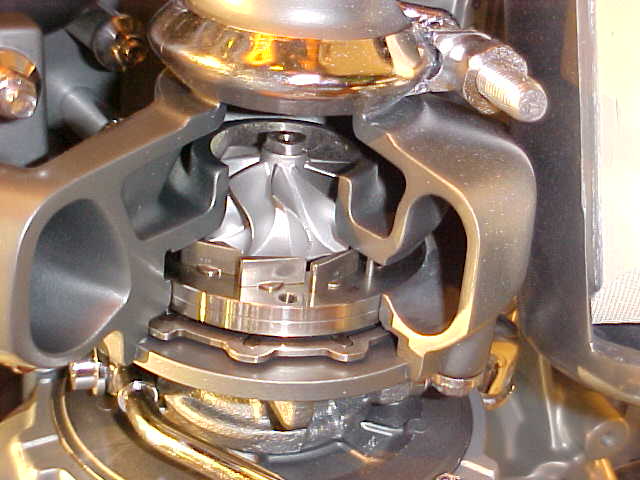
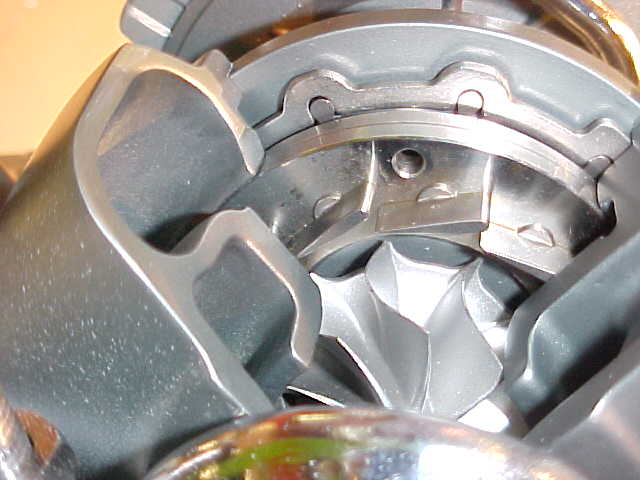
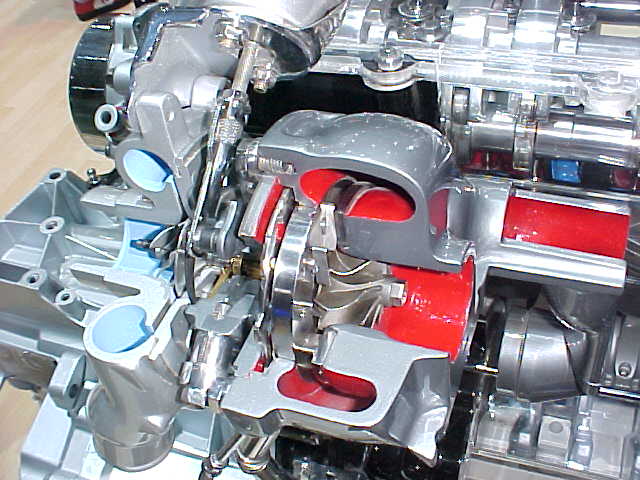
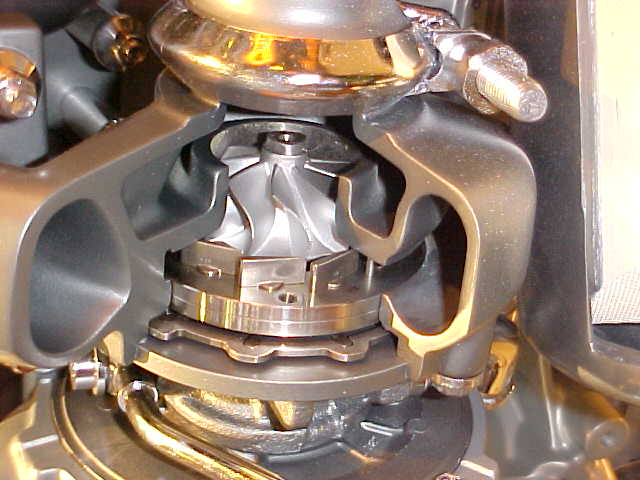
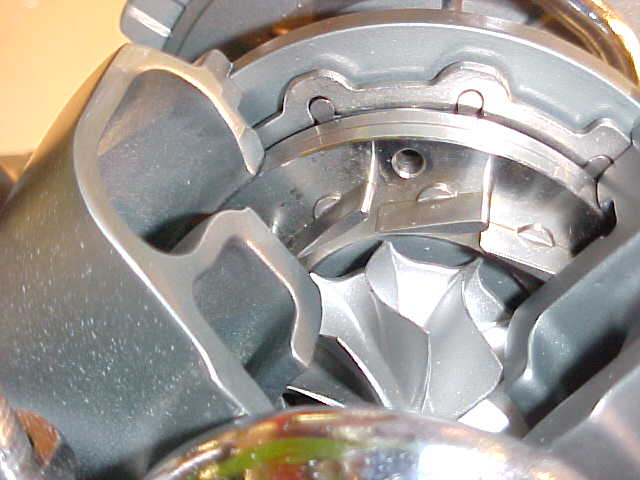
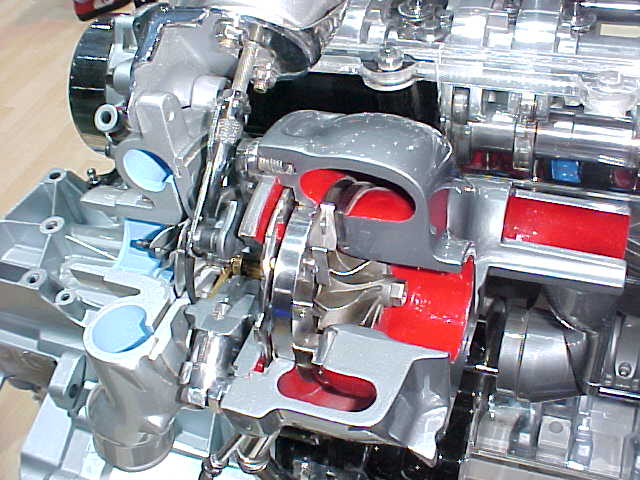
BTW Doug these variable vane turbo charger are very popular in Europe right
at the moment and they should broaden the band over which the turbo compound
will work. Say from 2500 RPM to 4500 RPM. Here are some pictures I took
at the Geneva auto show this spring.

Paul Lamar

The Rotary Engine NewsLetter.  Powered by Linux.
ACRE NL web site. http://home.earthlink.net/~rotaryeng/
Copyright 1998-2004 All world wide rights reserved.