Is anybody running a Turbine Inlet Temperature sensor and gauge?
Even aircraft
turbo's have TIT gauges and you are limited to a TIT number. We
just don't know
what that number is for the stock turbo. As I recall it is somewhere near
1400 F for an aircraft turbo. Since the current Mazda engine is known for
exhaust temps up to 1700 F it is kind of remarkable the stock
turbo lasted
for two hours at MAP 38.

38 MAP for two hours is pretty high manifold pressure  and way
over flat rating.
29 MAP at 11,000 feet would be flat rating. It is all well and
good to experiment
but you need some numbers to know what it is you are experimenting with.

Paul Lamar
I don't have a TIT because there is no good place on the stock manifold and
I wouldn't want to crack it anyway.  But I do have a TOT which has been
quite high.  500c (930F) at about 22MAP, and over 900C (1650F) up around 30
in. MAP.  You know my TIT is significantly higher than that.

Dave Leonard
Thanks for the TOT turbine temps Dave.

You can get thermal couples that go under a nut on an exhaust manifold stud.
Might be a good idea. On the other hand it might be worth the risk to drill
a hole in the exhaust manifold because it is cheaper than a turbo.

Just because the rotary engine will tolerate 40" MAP does not mean the turbine
will live at whatever exhaust temp that is. I have always maintained the
engine will outlast the turbo.

You guys flying turbos are going to have to come up with
some sort of lean mixture cruise map that lowers the TIT while still not causing
detonation. I think both a TIT gauge and a detonation sensor are essential
to achieve this. The side exhaust port RX8 engine will make this more
viable because the EGT is 200 F cooler but we are a year away from
low compression RX8 rotors.

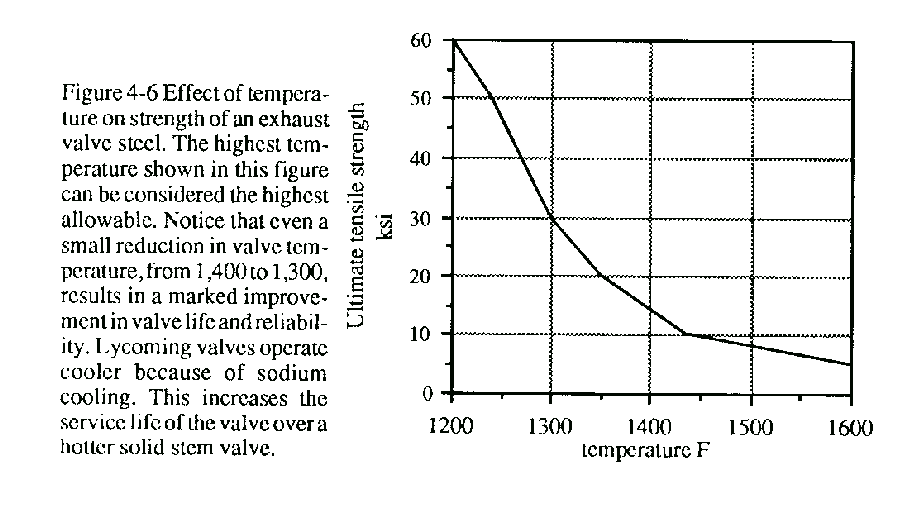
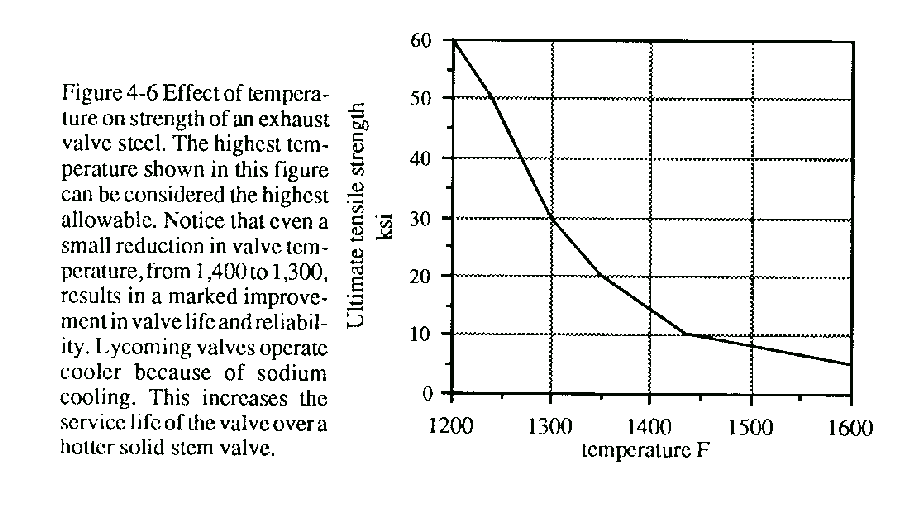
At first glance 1700 F does not look that bad relative to 1400 F but
unfortunately high strength high temp materials lose a lot of strength
from 1400 to 1700 F. Here is a chart for exhaust valve steel.
Strength is near zero at 1700 F. Turbine steel is probably similar.
Max take off (short term) TIT for a Lycoming turbo is 1600 to 1650 F.

I consider a TIT gauge essential. In the mean time and in the absence of
TIT I would cruise the TOT at 1300 F to save the turbo.

Francois do you have a TIT gauge on the Piper's instrument panel? If so where
did you drill the hole in the exhaust manifold?

Paul Lamar

The Rotary Engine NewsLetter.  Powered by Linux.
ACRE NL web site. http://home.earthlink.net/~rotaryeng/
Copyright 1998-2004 All world wide rights reserved.