I don't have a TIT because there is no good place on the stock
manifold and
I wouldn't want to crack it anyway.  But I do have a TOT which
has been
quite high.  500c (930F) at about 22MAP, and over 900C (1650F)
up around 30
in. MAP.  You know my TIT is significantly higher than that.

Dave Leonard
Thanks for the TOT turbine temps Dave.

You can get thermal couples that go under a nut on an exhaust
manifold stud.
Might be a good idea. On the other hand it might be worth the
risk to drill
a hole in the exhaust manifold because it is cheaper than a turbo.

Just because the rotary engine will tolerate 40" MAP does not
mean the turbine
will live at whatever exhaust temp that is. I have always
maintained the
engine will outlast the turbo.

You guys flying turbos are going to have to come up with
some sort of lean mixture cruise map that lowers the TIT while
still not causing
detonation. I think both a TIT gauge and a detonation sensor are
essential
to achieve this. The side exhaust port RX8 engine will make this
more
viable because the EGT is 200 F cooler but we are a year away from
low compression RX8 rotors.

At first glance 1700 F does not look that bad relative to 1400 F
but
unfortunately high strength high temp materials lose a lot of
strength
from 1400 to 1700 F. Here is a chart for exhaust valve steel.
Strength is near zero at 1700 F. Turbine steel is probably similar.
Max take off (short term) TIT for a Lycoming turbo is 1600 to 1650
F.

I consider a TIT gauge essential. In the mean time and in the
absence of
TIT I would cruise the TOT at 1300 F to save the turbo.

Francois do you have a TIT gauge on the Piper's instrument panel?
If so where
did you drill the hole in the exhaust manifold?

Paul Lamar
OK then, we are all doomed.  There is no way that I could have a
reasonable
climb or cruse performance at 1300 TOT.  That thing just wants to
run hot.
Leaning and enrichining will give me 100 deg either side of peak,
but I
would have to run in the low twenties of MAP to keep that temp.

Maybe it is time to install PP instead of a turbo... where is
Powersport
now?  :-)

Dave Leonard
Don't panic :) I don't think so Dave. I think with a detonation
sensor and a bit of
work on the fuel mixture map you can cut the TIT with some judicious
leaning
and still have modest boost at altitude. Perhaps Francois is ahead
of us
on that and he can provide a few tips.

A few years ago Linden Blue, current CEO of GAT Aviation Division
and also
former CEO of BeechCraft, built a Prescott pusher with a turbo three
rotor ducted fan. Linden Blue is a confirmed rotor head. This
airplane
is still stored in a hangar at Ramona as far as I know.
It had a water cooled exhaust manifold and turbo. At the time both
Jeff Spitzer and I were dumb founded about this. Jeff is no dummy
being
chief engineer on the GAT Aviation Division Predator UAV and designer
of the Moller two rotor. We were both concerned with the loss of
exhaust
energy being converted to yet more waste heat to be dissipated by
the cooling system.

Now it makes more sense.

Also I might add the P47 had a remote mounted turbo in the aft
fuselage
which is bound to run cooler than a close coupled turbo.

Paul Lamar
This might be a stupid question, but does anyone make a turbo with a
real alloy
hot section, like HMS-1011, or the cheaper Rene-80 ? ( Nickle -
chrome - cobalt
alloy) These metals are very strong at 1800 F, although do cost more
- like $100
per pound when I worked with then at Howmet.

If someone had molds, induction furnace, maybe we could have them
made and send
to a turbo shop for machining and balancing?

--
-dave
mailto:dave@arb.net
http://arb.net
The best material I have heard of for turbo's is Inconel. Inconel is
an option
on a lot of turbo's now adays. I have no idea what the stock Mazda
turbo uses.

Machining that stuff is real hard..... pardon the pun.

Paul Lamar
  First,  I don't know a thing about turbos.  But the turbo rotary seems
dangerous to me because even in  the best designed installation the
turbo is operating  close to the limits where it will self destruct.
Maybe the RX-8 side exhaust will lower the temps to a safe range but I
doubt  it will ever happen in a peripheral exhaust engine.    I  used
to have a turbo charged Suzuki engine that had a water cooled turbo.
Is that a possibility?  I assume that the turbos being tried are not
water cooled as no one mentions it.   Or, could the air cooled
tangential muffler concept might be employed in some way to bring the
temps down to safe levels?   Ever since I decided to go with the P
port,  the rotary installation, in my mind, has gotten simpler, and
safer.  During the same time,  the turbo installation, has gone in the
opposite direction: more complicated and scary.  If my comments are way
out of line, just chalk it up to ignorance.    Jerry
A lot of turbo's have water cooled bearings as does the stock Mazda 2nd gen
that most people are using. I was referring to the water cooled exhaust
manifold and turbine housing. It might be possible to weld tubes into
the manifold similar to the air cooled tangential muffler concept
for air cooling the exhaust gas somewhat.

Paul Lamar
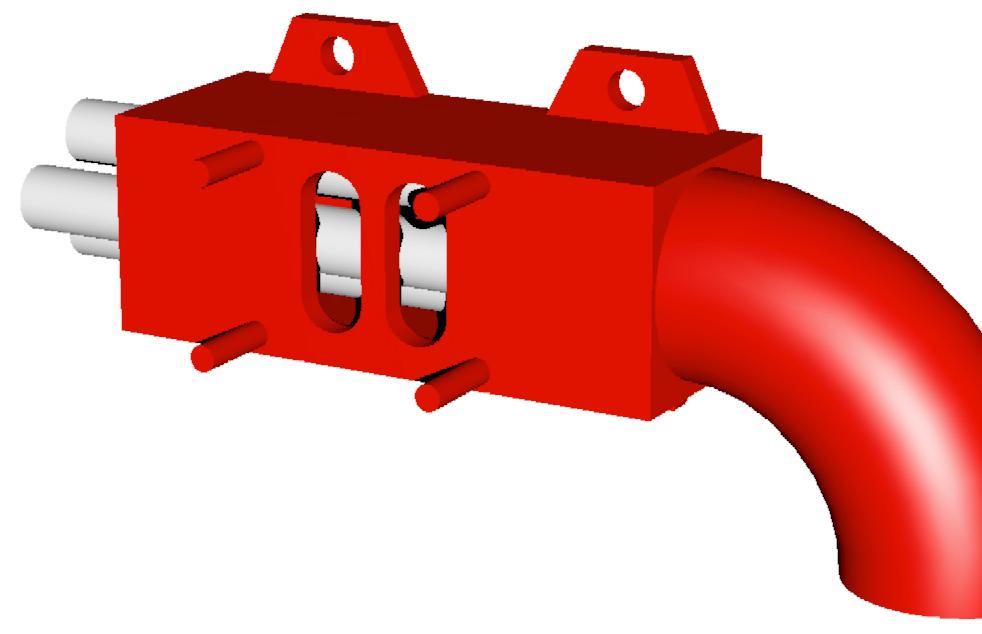
Here is Jerry's idea in 3D. I used three one inch dia. thick wall
SS cooling tubes welded only to the front bulkhead. There are three one inch  holes
in the back bulkhead so the tubes can expand and contract independent of the
box. Any exhaust leakage is captured by a three inch down pipe and dumped
over board with the heated cooling air.

Dimensions are more or less the same as the stock 91 turbo manifold.

All we need is a couple hundred degrees F reduction in exhaust temp to greatly
increase the life of the turbo.

Paul Lamar

The Rotary Engine NewsLetter.  Powered by Linux.
ACRE NL web site. http://home.earthlink.net/~rotaryeng/
Copyright 1998-2004 All world wide rights reserved.