Where would be the highest speed /lowest pressure in Perry's duct?

Anyone able to run a caculation exercise on the merrits of using this
speed/pressure as a suction pump to suck air through the regular radiator?

The max speed in the duct should be quite a bit higher than the actual
aircraft speed. Would be great if you could use it! With a clean circular
augmenter/extractor one might get away without losses and a net gain with
the resulting smaller intake needed. If there is suction, a Naca intake
might have a place there too.
On a previous discussion it was mentioned, that this typ of intake was
designed for a suction typ airflow, wasn't it?
Well here we might be able to get that requirement!

Thomas J.
Thomas you need Rhino :) I am not sure I follow what you are proposing.

Paul Lamar
For my currently flying duct2, if the exit pressure (p4) is sea level
standard 14.70 psi, the pressure just aft of the fan plane (p3) is 14.51
psi and the pressure just in front of the fan plane (p2) is 14.35 psi.
This is all theoretical. Not very large "vacuums" there. This is with a
cruise speed of 115 knots and an airspeed of 156 knots in the fanplane.

But because of the location of my rad exit near the duct inlet, I get
the suction you are talking about through my rad, it eliminates any
ground cooling issues for me.

Perry
What is the pitch and width of your blades Perry? RPM?

Paul Lamar
There are 3 blades, an 8" diameter hub, blade chord at the root is 4",
pitch at the root 50", straight taper to 2.5" chord at the tip, pitch at
the tip 38". Fan diameter 37.5".
Thanks Perry. I'll try to figure out what angle of attack they
are running at unless you already know.

Paul Lamar
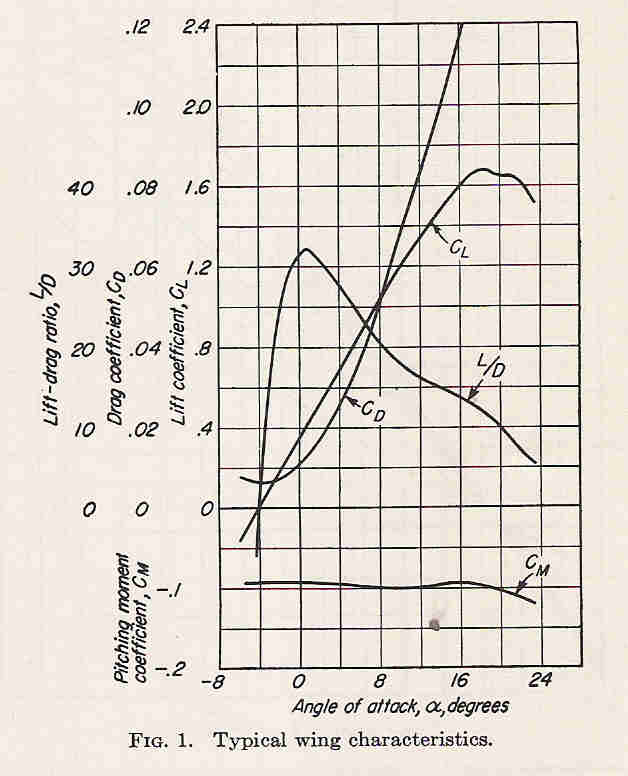
Here are some plots from the duct2 design file. The blade angle
information is correct for the clarky airfoil I used and that is how I
built fan3. The angle of attack information is probably only "relative",
as the design file had 267 mph airflow in the fanplane and 6100 RPM,
where actuals are more like 200 mph fanplane velocity and 5500 RPM.

Perry
That is interesting Perry.  I'll see if I can correct it for 200 mph
and 5500 RPM to get a handle on blade cord verses pitch.

Paul Lamar
This is what I am driving at Perry. If the angle of attack is greater than
3 or 4 degrees at top speed and max RPM the blade is probably too narrow.
The same HP could result in more thrust with a wider blade running
at a lower angle of attack. I have evidence of this by looking at
highly optimized turbo fans.

Paul Lamar

The Rotary Engine NewsLetter.  Powered by Linux.
ACRE NL web site. http://home.earthlink.net/~rotaryeng/
Copyright 1998-2004 All world wide rights reserved.