I was thinking about my radiator arrangement, since I am looking at putting the oil cooler and radiator next to each other, I got to thinking. I could have a C& R radiator built to a size equal to twice the size of the stock gen two oil cooler, since we are thinking that the coolant takes out twice the heat that the oil does. Then the thought struck me- why not just get two more gen 2 oil coolers and use them as radiators. I could plumb them in parallel like Tracy does. Certainly would be cheaper than a custom radiator. Any input, obvious or not so obvious flaws in this idea?

Brian Trubee
It would work but it is a waste of two good oil coolers :)

Paul Lamar
It's not a waste of oil coolers if they are flying on an airplane rather than sitting in two cars somewhere. A big consideration is price-compare the price of 2 oil coolers(used) to the price of one custom rad.  The other consideration is that the airflow through each of the heat exchangers would be equal( or at least the resistance to airflow) if the ductwork is designed correctly. I just wonder if there is something about the design that would make them unsuitable for running coolant. Another consideration is perhaps having to put bigger fittings on to run enough volume through them. Maybe have to remove the thermostats and plug the bypass holes.

Anyway, are there  any glaring  drawbacks that anyone can think of?

Brian Trubee
There could be. Oil coolers are designed engineered and  optimized for the heat transfer characteristics of oil. The same thing goes for evap cores in regard to
freon gas or
freon liquid whatever the case may be. Radiators on the other hand are optimized for
PE coolant. You also wind up with a four pass system which IMHO is less than
ideal as the delta T is continually decreased as it make it way through the
two oil coolers. Each one being double pass. I am willing to go with a two pass
rad as it is a compromise with the plumbing simplicity. In theory it is not
as good IMHO as a single pass rad. The main thing about heat exchangers is they
are complex interactive compromises. One factor may be worse while another
factor may be better. A good example is the two pass rad verses the single
pass rad. Delta T is adversely affected with two pass while velocity in the
core is doubled which improves the turbulence which improves the heat
transfer from the coolant to the metal. Is there a net gain or loss?
Perhaps. It may be better to use a one pass rad and a larger water pump.

Auto manufactures spend tons of money coming up with the cheapest
solution. In this case it is also the most efficient solution.
A slightly smaller water pump gives slightly better gas mileage
and is slightly cheaper. A slightly more efficient rad is smaller
and cheaper. You will NOT find ANY two pass rads in cars. That is
strictly an invention of the amateur (when it comes to scientific R&D)
racers. When you ask them what is the delta T they usually respond with
"duh" :)

I guess what I am trying to say it is technologically risky. Why mess
around just to be different when there are no clear cut advantages?

Paul Lamar
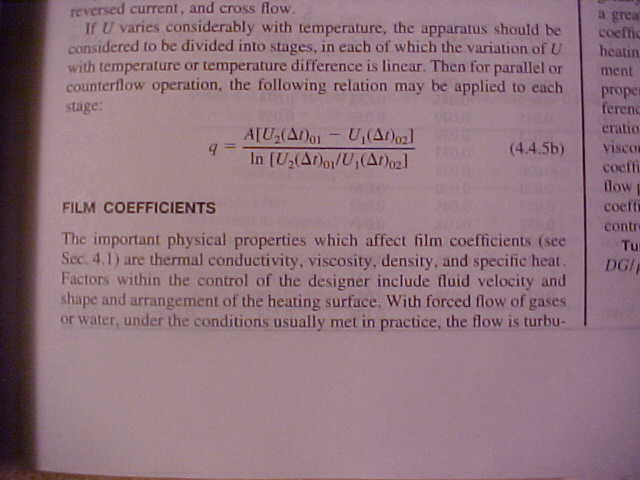
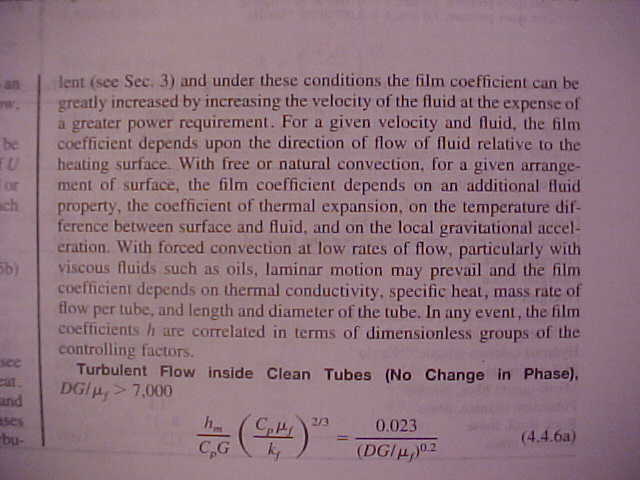
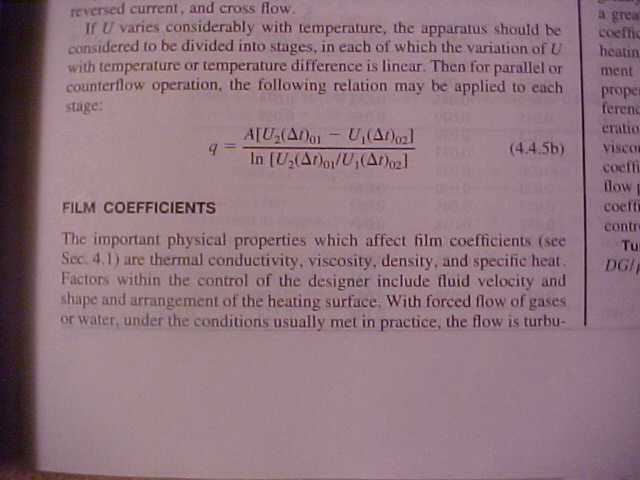
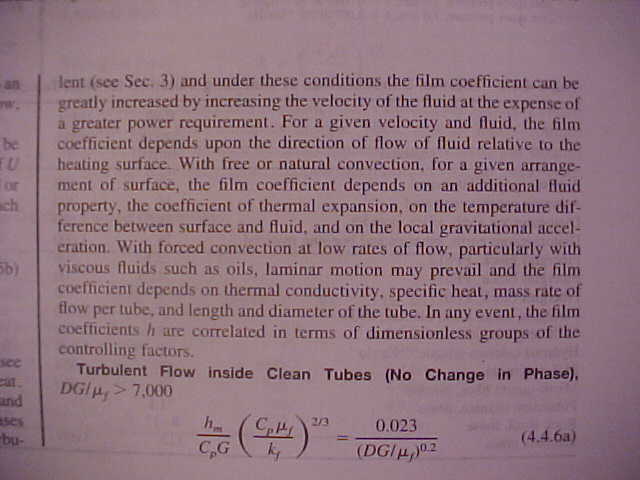
Here is a brief overview on what Marks  has to say on the subject.

I suspect one of the reasons the Mazda oil cooler works so well is it
is optimized for the rotary. The oil pressure is much higher than most engines
so the double pass feature can pay off in higher oil velocity and higher
turbulence. Not to mention the existence of turbulators inside the tubes.
These are not found in radiator tubes. A double pass oil cooler in a passenger
car is a rare occurrence.

This is a very complex subject. Data on specific configurations
is hard to come by. IMHO Mazda empirically developed the oil cooler
(by trial and error) specifically for the rotary.

Paul Lamar

The Rotary Engine NewsLetter.  Powered by Linux.
ACRE NL web site. http://home.earthlink.net/~rotaryeng/
Copyright 1998-2004 All world wide rights reserved.