As we have seen from the Allison experience the internal spur gear
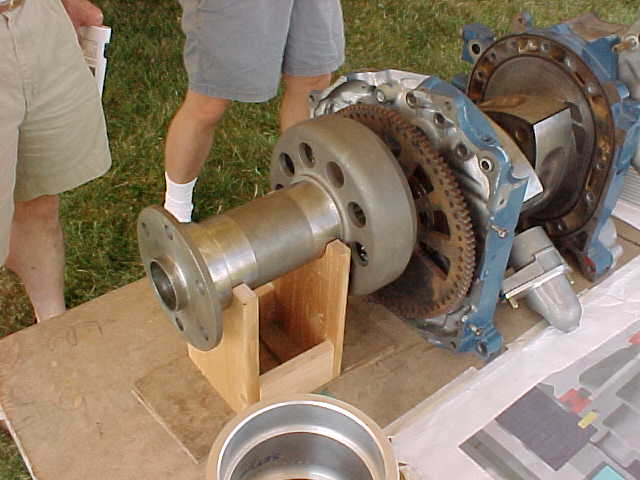
has two main problems. The spur gear is cantilevered off the end
of the engine shaft resulting in high cyclical bending loads on the
crankshaft and high side loads on the rear main bearing. This led to
fatigue failures in the crankshaft.

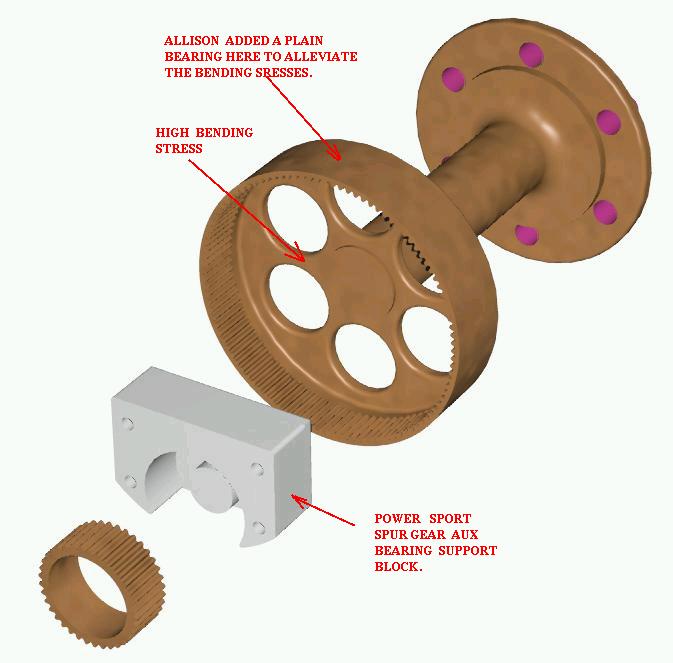
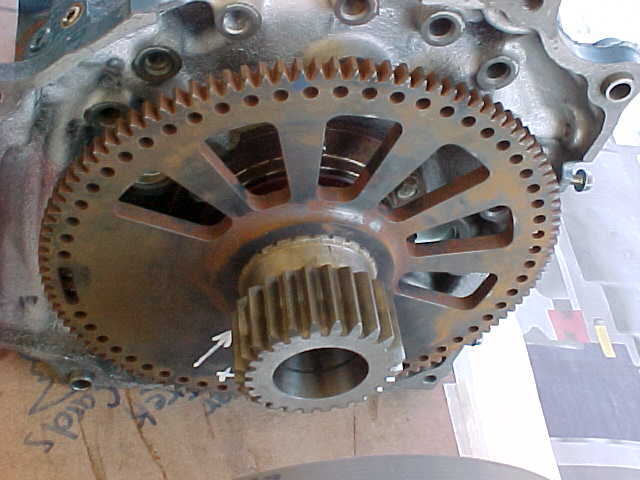
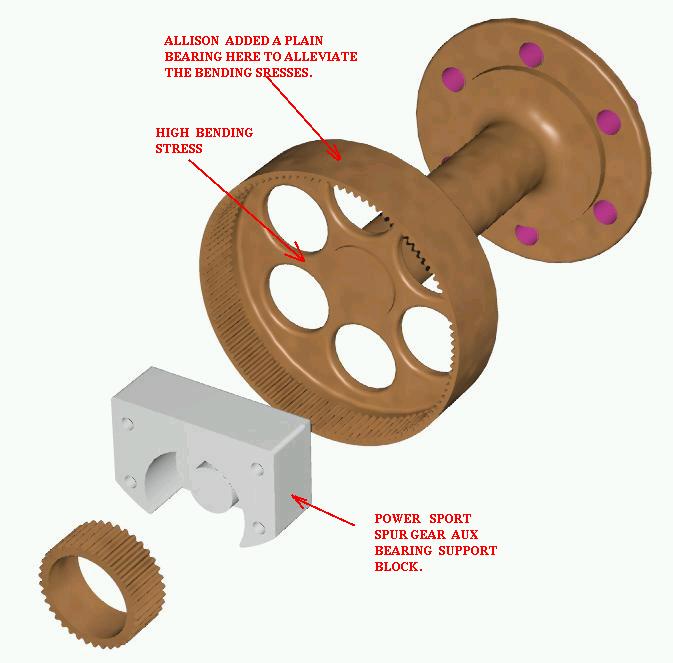
Main problem two: The bull gear is cantilevered off the prop shaft causing
high cyclical panel bending loads where the bull gear attaches to the prop
shaft. Allison addressed this problem by installing a large plain bearing
around the outside of the bull gear. This was less than satisfactory as it
required 1/3 of the engine oil supply at 75 psi. Mainly due to inadequate
width (IMHO) and high surface speed (154 MPH).

Both of the problems prompted the US Army to request that Allison redesign
the box for a conventional straddled mounted external spur gear which they
eventually did.

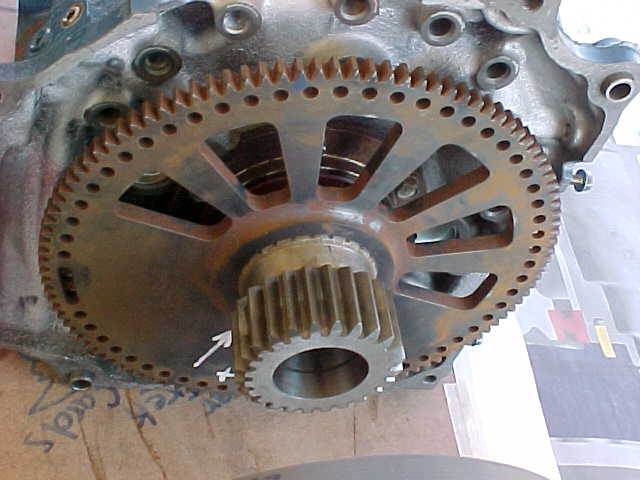
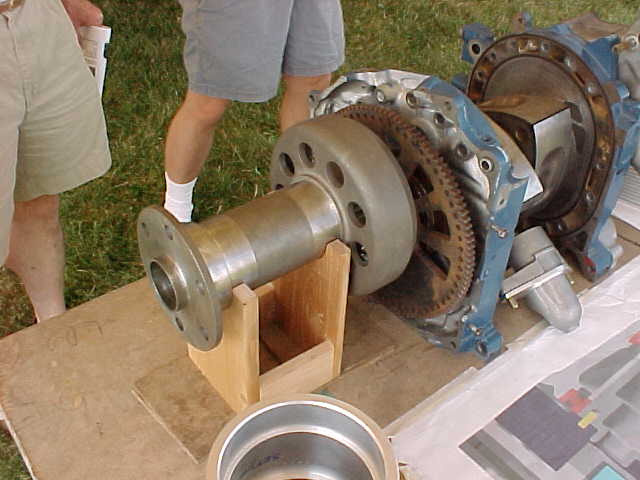
Power Sport addressed the e-shaft bending load problem by using a mounting
block and internal bearing inside the spur gear. There are at least two
problems with this. The first problem is the bearing is not a pressure fed
plain bearing so its rate of wear will be different than the plain rear main
bearing on the 13B. As time goes on the clearances will differ. A plain bearing
type shaft does not run concentric with its bearing. It moves off center slightly
to develop a dynamic oil film. It would be better if Power Sport used a engine
oil pressure fed plain bearing in this location.

The second big problem is this bearing support block actually adds to the cantilever
lever arm on the bull gear. Power Sport did not use the large bearing on the outside
of the bull gear to address this problem like Allison did. They added a much thicker
bulkhead than Allison used. All of these kludge type fixes add to the overall weight
of the box.

The planetary on the other hand has all the gear tooth separating loads contained
within the ring gear itself. There are no cantilever loads whatsoever in a planetary
gear box.

The other main consideration on what type of box to use is the fundamental
wear factor in any gear set. That is called the line contact length.
In other words when two gears mesh there is a high compressive stress, line
contact between the two teeth. This is similar to a valve lifter on a cam shaft.
If the stress is too high it leads to spalling or pitting on the gear teeth.
For a given bull gear width a planetary has six times the line contact length
and hence one sixth of the compressive stress. A planetary box properly
machined automatically balances the load between all pinion gears.
The R4360 36 cylinder corncob radial engine had 18 pinion gears.

These are the main reasons why a planetary gear box is far lighter for a
given torque or HP capacity than any other type of gear box. Planetary gear
boxes have been widely used in aircraft engines since 1912. When V engines
were used a prop shaft off set from the crankshaft was called for to reduce
the frontal area (maximum cross sectional area) of the fuselage and the length of
the landing gear. In that case an external spur gear was specified. The RR
Merlin and late Allison's are good examples. If I were forced to use
a V engine (and it would take a lot of force) I would invert the engine
and use a planetary gear box to save weight.

Interestingly V and inline engines are much heavier than horizontal opposed
engines. This is now widely understood in the aircraft engine industry and by
Subaru, old VW  and Porsche. A V or inline engine is trying to shove its crankshaft
out the bottom of the block and that leads to a heavy main bearing support structure.
Bombardier is about to find this out when Honda introduces their water cooled
flat six with a planetary gear box. The Wankel is similar to a horizontal opposed
engine in this regard as it's shaft is well supported in the center of the engine.

The next installment will discuss the torsional resonant problems of both gear box
types.


Paul Lamar

The Rotary Engine NewsLetter.  Powered by Linux.
ACRE NL web site. http://home.earthlink.net/~rotaryeng/
Copyright 1998-2004 All world wide rights reserved.