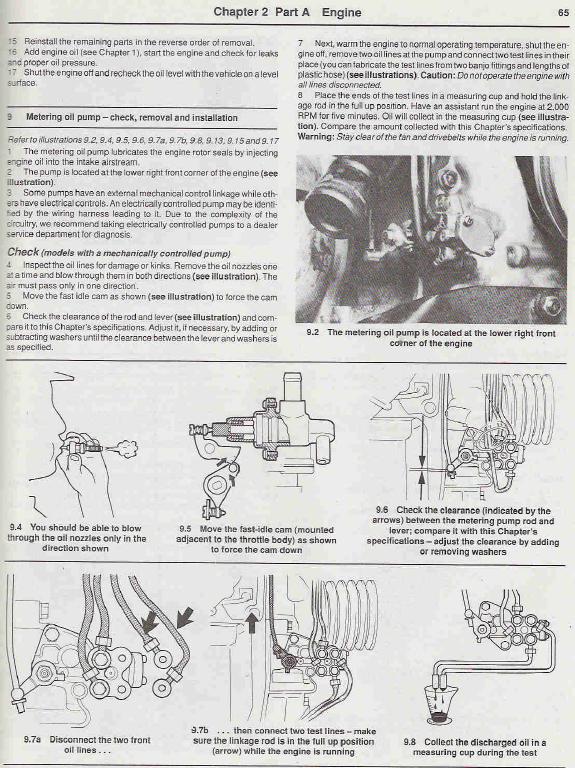
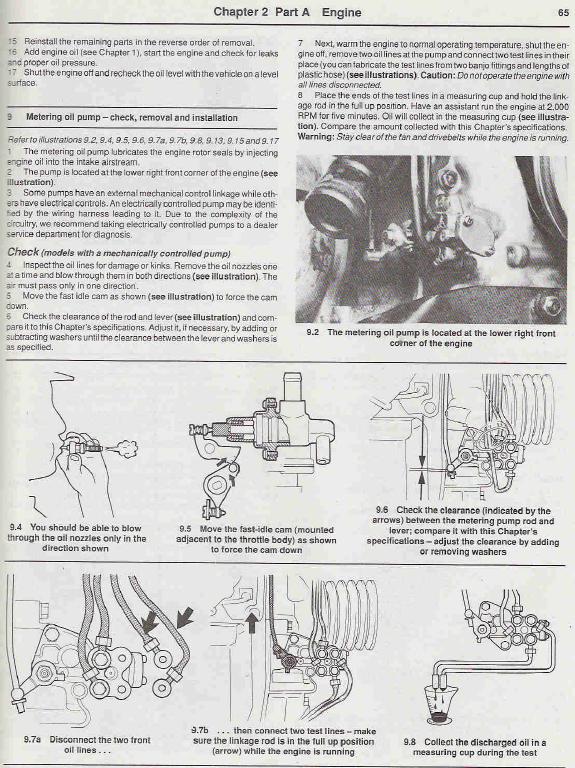
I am pretty sure it is not there Bill. The shop manual says nothing about checking it.

Paul Lamar
Paul,
If you check the Oil Feed Line at the banjo fitting I am almost certain that you will find a small check valve. It has a very low break-away pressure of about
2-3psi. This was used in all the motorcycles very effectivly. It would also prevent the chamber pressure from backing the line up. The check valve doesn't
have to be built into the pump itself. This system was used in piston engines in the intake tract so it had to deal with pressure reversals there too.
Bill Jepson
     > Al Gietzen wrote:
     > >
     > > OK; I have studied the diagram of the metering pump, and I'm pretty
     > sure I
     > > understand how it works.  It meters and pumps; it is essentially a
     > positive
     > > displacement pump.  The pumping results from the vertical motion of
     > the
     > > shaft.  No check valves necessary because the inlet port is closed by
     > the
     > > shaft as the shaft drops and forces oil out the outlet.  New oil is
     > drawn in
     > > as the shaft rises while the outlet port is closed.
     > >
     > > The flow adjustment lever determines the amount of up and down travel
     > of the
     > > shaft by varying the space between the stop pin and the adjusting pin,
     > which
     > > determines the vertical movement driven by the wobble plate.  Rather
     > clever,
     > > really.
     > >
     > > My conclusion is that it is altitude independent.
     > >
     > > Al

     > > No check valves Bill. It is a piston ported pump something like the
     > old
     > > Bristol sleeve valve radial engines. I still think it is
     > > possible. Also most the more recent engines had some sort of air
     > > pressure assist on the apex seal oil nozzles.
     > >
     > > Paul Lamar
The Rotary Engine NewsLetter.  Powered by Linux.
ACRE NL web site. http://home.earthlink.net/~rotaryeng/
Copyright 1998-2004 All world wide rights reserved.