Mark Wrathall wrote:
     >
     > Mark wrote:
     > When Paul and I visited Diamond and had a tour from Martin, it was clear to
     > us that Sachs, Norton, Mid west, Diamond started with a flawed design and
     > have stuck to it until it was forced to work through force of engineering.
     > The problem is the needle rotor bearing (a design requirement due to the
     > decision made nearly 50 years ago to pursue air cooled rotors rather than
     > the oil cooling Mazda choose). This bearing runs fast, hot and with very
     > little lube (being a total loss system, you optimise the oil injection
     > system to min consumption).
     >
     > The solution is an e-shaft, rotor, bearing which have to be hand selected to
     > a matched set with some ridiculously tight tolerance if the engine is to
     > return decent reliablity. This is expensive on a 1/month production rate. It
     > is out of the question if the engine was ever to be produced in any numbers.
     >
     > Dispite this need to select a match set, the rotor bearing is still the
     > limiting component on RPM and reliablity.
     >
     > Martin was very proud of his engine, and cited enough examples to indicate
     > that the reliablity is very good. At the end of the day you have a light
     > powerful engine, with good reliablity which is simply not competitive on
     > price.
Mark and Group,
The needle bearing fit is not a problem. Virtually all 2-cycles use needle or roller bearings. The rod small end is needled using the piston pin and the rod
as the surfaces. The use of ground ouside diameters in less than 50 MIllionths of an inch variance is quite common in the bearing industry. The needle bearing
is the best for conditions that are "fast, hot and using minimal lubrication." The plain bearing does have higher maximum load capacity. The BSA/Norton
limited the power needed for cooling by drawing the intake charge through the rotor. The heat did cause some problems. An aftercooler might help, while
increasing complication.
Bill Jepson
I think that load capability might be the key. It is kind of strange that both
the small wankels by Midwest and Wankel Gmbh Germany were limited to around
6500 RPM while the larger Mazda engines  have been 7500 and 8500 RPM lately.
This affects the HP to weight ratio. Needle bearings don't do well at high
RPM because in theory those needles are really zinging around in there.
They are like miniature pinion gears in a planetary gear set.
If you look in any bearing engineering catalog needle bearings are
rapidly derated as RPM increase. Even more so than ball bearings.
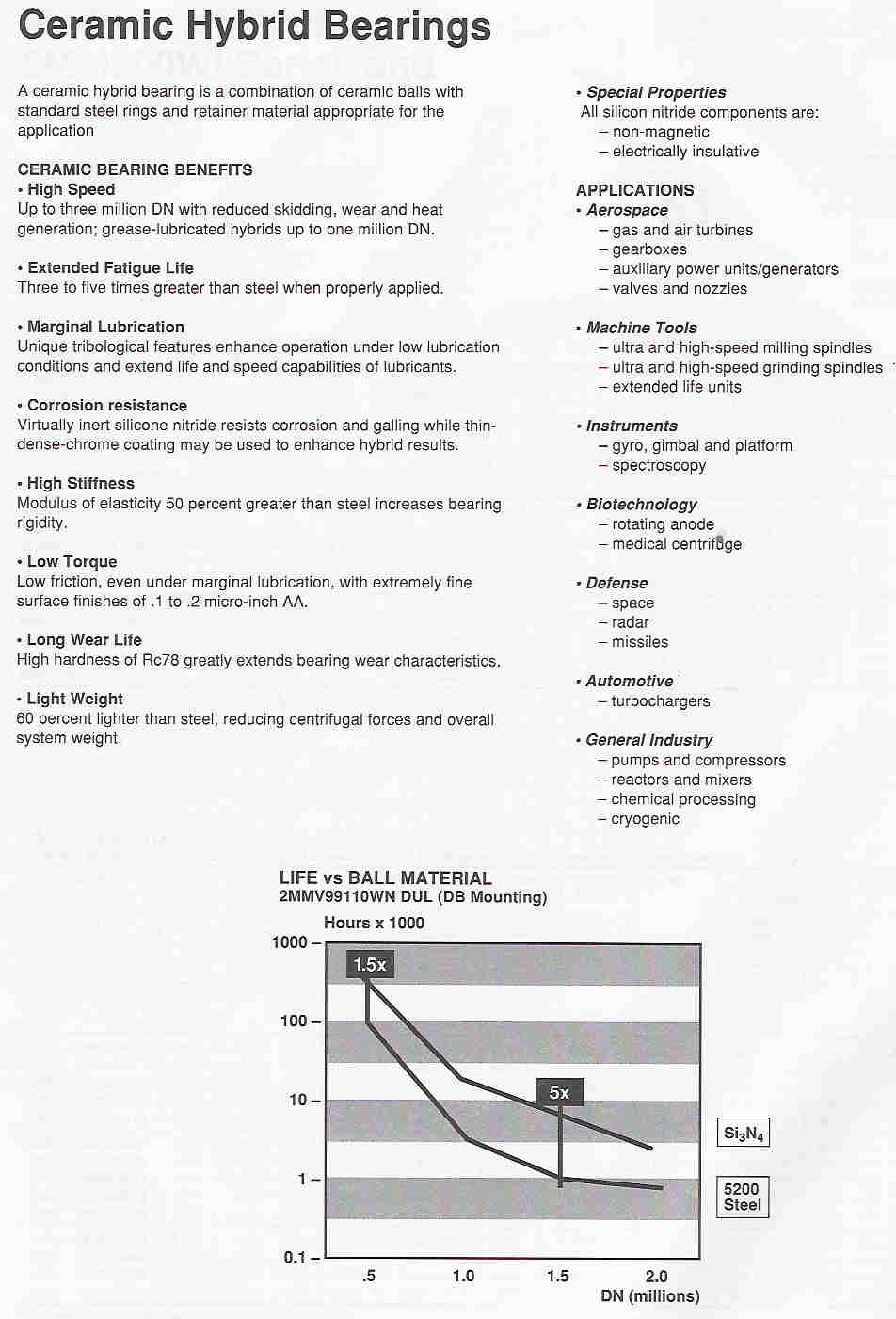
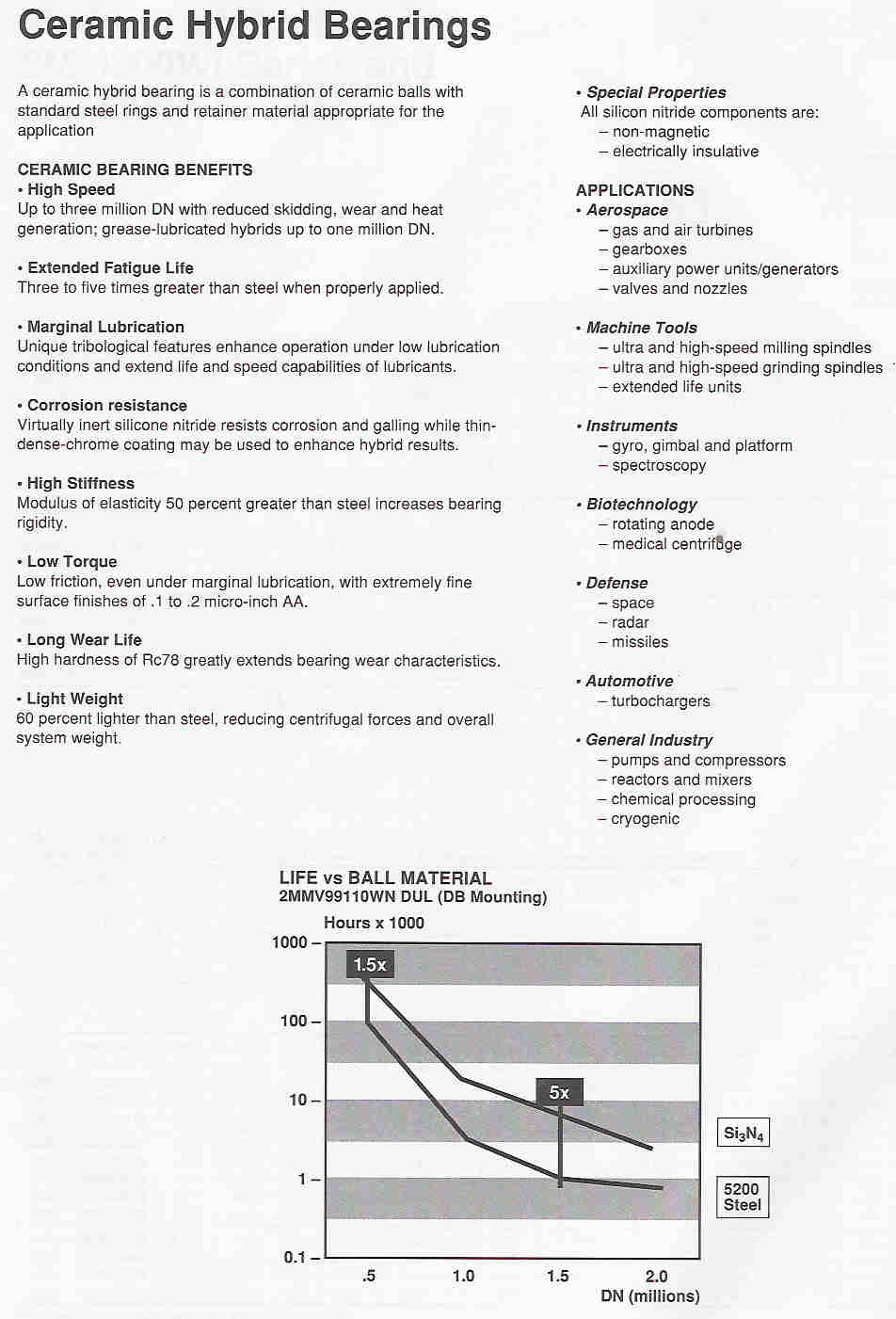
That is one of the main reasons silicon nitride ball bearings are used
in high speed machine tools and turbo chargers. The silicon nitride
is half the density of steel so the centrifugal loads are half.

Midwest/Diamond would do well to replace that bearing with a plain journal bearing.

Paul Lamar
Actually, I believe Silcon Nitride is used due to the hardness of the ball leading to longer life.  In my 5 years in the bearing business, I have never heard of weight being an issue but that may be true also.

Ron Milligan
Well what happens is the centrifugal loads on the balls tend to force them
outward at high RPM losing contact with the inner race. The lower the weight of the
ball the less effect this phenomena has on the bearing. The other problem
is steel ball bearings are limited to an operating temp of around 500 F
while silicon nitride is good to 1000 F.
Scan from the Torrington service catalog.

Paul Lamar

The Rotary Engine NewsLetter.  Powered by Linux.
ACRE NL web site. http://home.earthlink.net/~rotaryeng/
Copyright 1998-2004 All world wide rights reserved.