Joseph M Berki wrote:
Paul,
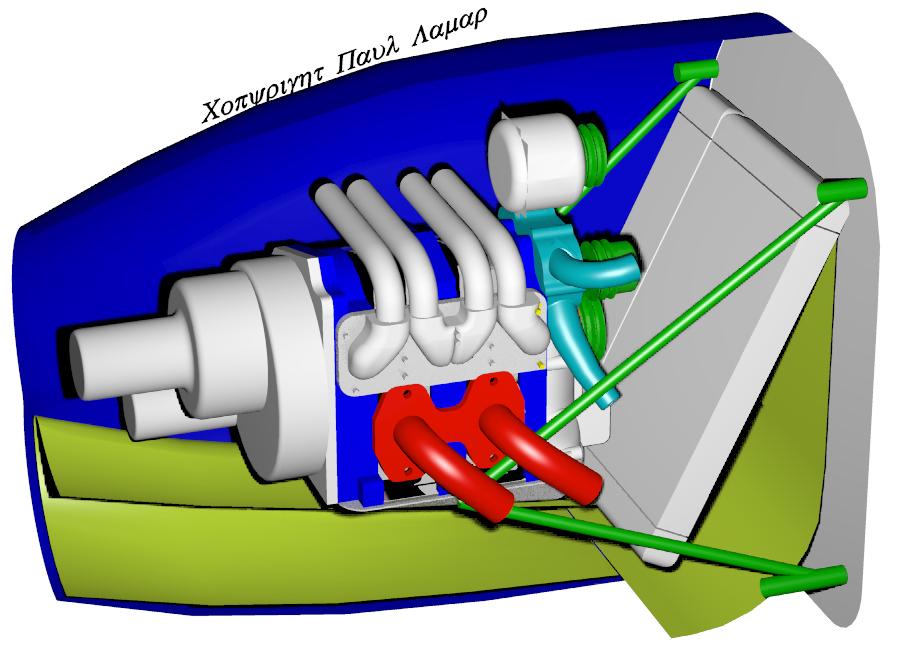
        Here are some pics with cowl off.  This was not the Velocity that
had the pipe wrapped.  I heard it fly at the homebuilt parade at the
beginning of the airshow.  It did not seem louder that Dave's RV which
also flew.  Talking to Joe, the owner, he said that the sound seems to be
reflected off of the prop disc and he is looking into a muffler.  The
convoluted path that the air takes going through the rad and the oil
cooler would make one think that this configuration would not cool but it
does.  He said the firewall is curved in front of the rad K&W.

Joe Berki
Limo EZ
Thanks for the pictures Joe. They are great.

I could have predicted it would cool well. Here is a recent message on the subject.
I wrote this before I saw this airplane at OSH. The owner of this Velocity obviously beat
me to the idea. It will also work great on the tractor powered Power Sport
airplanes. Super compact for a pusher. Just reverse the scoop 180 degrees
from what is shown in this 3D. The drawback for a pusher is the P51 type
scoop required. It adds to the frontal area but that applies to all liquid
cooled pushers.

Meets all the requirements. Large frontal area, thin radiator core, great K&M
or K&L diffuser. Some back pressure from the engine but nowhere near as much
as a restricted exit duct such as feeding the air in from the back (pusher)
of the rad with the rad mounted on the firewall. This is just the sort of cooling
configuration break through we need.

BTW the air ejector does not meet the NACA requirements for proper ejector geometry.
A proper ejector geometry would further improve the cooling.

Paul Lamar

______________________________________________________________________________
Subject:  Powersport installations
       Date:  Sun, 25 Jul 2004 08:46:17 -0700
       From:  ACRE <rotaryeng@earthlink.net>

Theodore James wrote:
Paul,
All of the testing seems to be going well for Jim & Jerry. Jerry's
plane will not be out of the paint shop in time to make the trip to
OSH, and Jim probably will not make the trip alone. Even so they both
expect to make the rounds this summer; Vans homecoming and other west
coast fly-ins. The cooling system is very much the same as the
Powersport installation you are familiar with already, and the cowl is
the one you seen on the James Aircraft web site. There are a few
"tweeks" that are being made and we expect to be able to give everyone
more complete reports soon. We are also sure you will soon get an
opportunity to see first hand.
Regards,
Powersport -Tedd James
Tedd, I have the ultimate solution to your cooling problems. It is so
ridiculously simple I don't know why it did not occur to me six years
ago when you guys first got started with this program. On the other hand
it took me six years to get to where I am now :)

Your current set up has at least two major problems.

One; the back side if the rad is too close to the firewall for an
adequate exit duct. Read Kucheman & Weber chapter 12 COOLING.

Two; the air is heated by the exhaust and the engine BEFORE it flows
through the rad. One degree increase in F is a 1% reduction in cooling
capacity and this rule of thumb also applies to the ambient air temp
entering the scoop.

Simply  use a constant area, SEALED duct to carry the cool air to the BACK side
of the rad and oil cooler. The rad already forms an ideal Kays & London wedge
shaped diffuser with the firewall.

NO changes other than some minor ones to the exhaust system will be
required. Put some louvers in the top side of the cowl above the rad
to let the hot air out.

This is guaranteed to work under all ambient temperature conditions.

Paul Lamar
_______________________________________________________________________

The Rotary Engine NewsLetter.  Powered by Linux.
ACRE NL web site. http://home.earthlink.net/~rotaryeng/
Copyright 1998-2004 All world wide rights reserved.