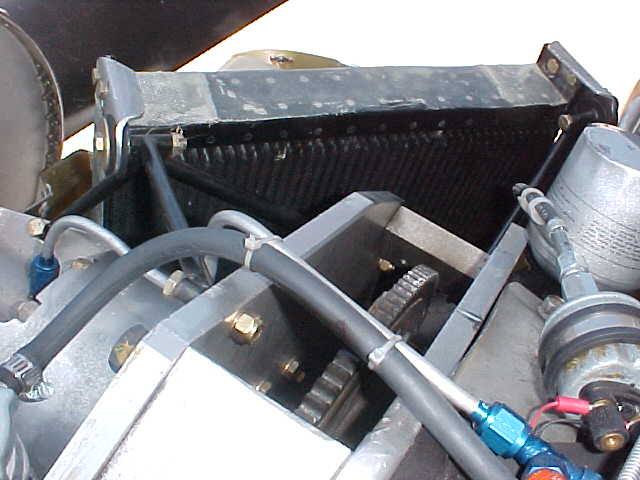
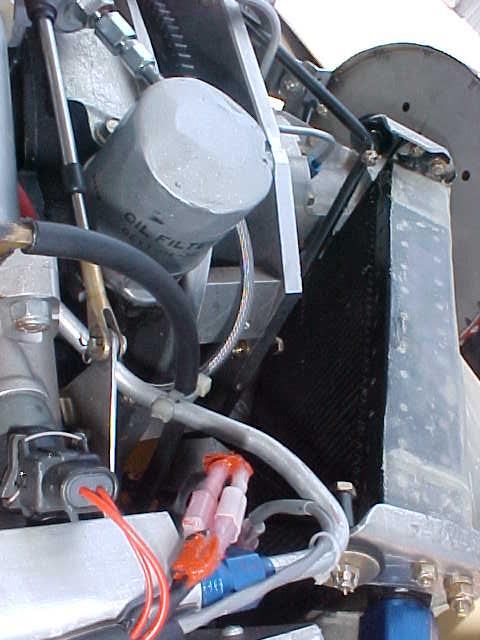
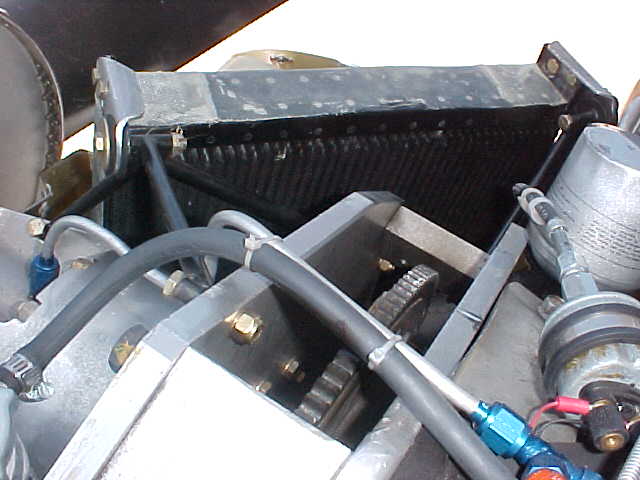
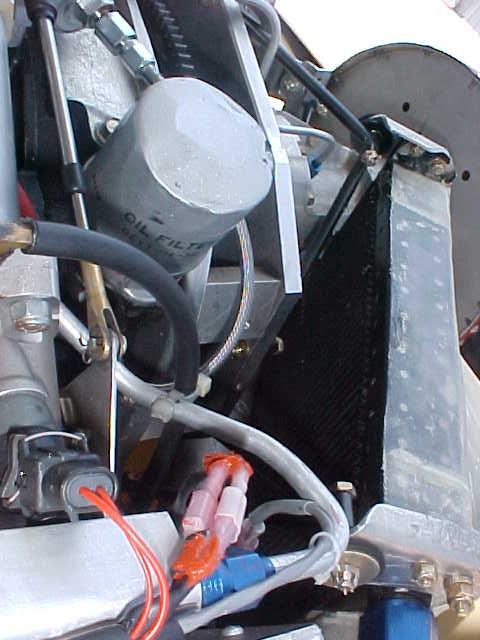
We have had nothing but trouble with non Mazda oil coolers.

Paul Lamar
I have not seen Dave's installation so I don't know what precautions he
took, but the Setrab instructions state that the cooler  should be
isolated from all  vibration.  Mine is rated to 600 psi. If Setrab's
claims can be believed,  I don't think  dynamic pressure blew the
cooler.  I  have not worked on mounting the oil cooler yet.  But I am
going to proceed with great care, even more so after Dave's experience.
Ed knows quite a bit about isolating radiators and oil cooler from
vibration.  Maybe we can talk him into writing about this for ACRE.
Ed.  are  you listening?       Jerry
DaveLeonard wrote:
My cooler didn't "blow", but rather sprung a leak.  Thinking back it had
actually been there for more than 10hrs of flying but was so small I
couldn't tell where it was coming from.  Even when it got worse I still
thought it was coming from the AN fittings.

I'll take some pictures of my mount today.  I do have rubber isolation
mounts, although not as thick as some of the OEM isolators.  My real
problems was probably allowing for some give in one of the mounting points.
This allowed the mounting flange on the cooler to flex with engine vibration
or dynamic pressure.  I now believe this caused a crack to develop at the
base of the mounting flange.

I should have made the mount STIFFER, and provided some re-enforcement to
the wimpy mounting flange of the cooler.

Dave Leonard
There are lots of Mazda cooler ridgly mounted. Mostly to the cowl or
firewall I would guess. One point is you add 10 psi to the pressure
differential when you climb to 18,000 feet or so:) Another factor
could be we idle our engines at 1800 to 2200 RPM when the oil is
still cool.

The 2nd gen Mazda cooler is extremely robust with about 1/8 thick
header tanks.

Mistral had their share of oil cooler failures until
Griffin came up with their new extruded oil cooler tubes.
Griffin is working with Mistral on the problem.
Unfortunately the Griffin extruded tubes are still too wide which
makes the cooler too thick IMHO. Thin coolers will work better
at slow climb out speeds where the dynamic pressure is low.

You might be able to talk Griffin into cutting the width of
the tubes in half and making a thinner cooler  with more frontal area
much like Dave's Settrabe. One good thing about Dave's thin Setrabe
is it is cooling the oil extremely well when it is not leaking :)

Paul Lamar


The Rotary Engine NewsLetter.  Powered by Linux.
ACRE NL web site. http://home.earthlink.net/~rotaryeng/
Copyright 1998-2004 All world wide rights reserved.