Paul

As an ex pat I get a lots of news of what is happening in European research
as well as USA.  It  surprises me that USA doesn't have more diesel cars.
Must be the smell:) Diesel, biodiesel and ethanol aren't the answer but they
are a good  transition fuel until electrics get it together.

So  how to make it work efficiently in the rotary?  The mega/joules/kg. of
diesel equals 45.3.  Gasoline equals 45.8

Can you advise me on my approach?  I am thinking of picking up a cheap 13B
engine next month and making a test stand. This will be the initial test be
for the turbo compound ideas and the merits for increase in power as well as
BSFC.  I'll need to find a C/S prop if anyone out there has one to lend me
for a year while testing.  All my test data will be available to anyone who
desires it and be posted on ACRE.

I think there is merit in waiting awhile to test alternative fuels because
Mistral is embarking on that route presently and it is my hope that they
will reciprocate with data in kind.  In the second year of testing I will
obtain a RENESIS engine and start testing it with ethanol at first and then
move to an ethanol/ biodiesel mix and finally on to straight biodiesel.

By waiting  year perhaps RENESIS low compression rotors will be available if
needed. At the end of the second year of testing it should be feasible to
build up a 3 rotor RENESIS. I may have to  cast and machine my own
intermediate housing though.

Would think that the P port or side port would have different burn
characteristics and advantages for biofuels. I just learned that a diesel
needs 20,000 liters of air to burn one liter of fuel. Or said another way
1cc of diesel would need 20 liters of air. A N/A 13B rotary can displace in
one revolution  1308 cc (654 x 2) of air or 1.3 liters. It would take 15.3
revs to effectively burn the one cc of fuel.one half  if the system had two
atmospheres..  At 6000 rpm the engine can displace 7848 liters of air a
minute.  One cc could be burned in 1/6 of a sec.  Two cylinders

But injector only squirt a wee bit of fuel into the combustion chamber for
each cycle.  How many ml are in a squirt? Ok how many  Have to find which is
better.  Hope to hear Mazda's engineers at the end of August and anyone else
at anytime..

Doug in Japan
In Europe it is strictly driven by tax policy. The Europeans would not
put up with diesels either if they had a real economic choice.
Gas is six bucks a gallon and diesel is only three bucks a gallon.
Something like that.

The spend happy politicians are reeling from the loss of tax revenue in
Europe so they are trying to figure out ways of taxing the diesel cars
without raising the tax on diesel fuel. The overall economy would
probably be affected greatly if they raised the tax on diesel fuel
because of all the other uses of diesel fuel from farm tractors
to canal cargo boats on the Rhine.

Here in the states the farmers get a tax break on diesel fuel
so we see a few of them flying turbo prop airplanes.
The end cost of diesel fuel here in the US including tax is about
the same as gasoline so people prefer quiet, non smelly gas powered
cars.

Mistral has their engine running on diesel with modest amounts of HP
generated so far (as of OSH). Wankel Gmbh made a few turbo diesel burning
engines. HP was almost as good as gasoline but BSFC was not a lot better.

I have here a bottle of wine from a vineyard across the road from
the Wankel factory. Note the heavy fuel direct injection label.

When the fuel to air ratio is in the range you indicated the engine
is idling and generating little or no power. The power is directly
related to the fuel burned just like a gasoline engine. At max power
the fuel to air ratio is more or less the same as a gas engine.
When the diesel is generating max power there is little difference
in the BSFC between a diesel and a gas engine. A diesel scores big
at part load very lean mixtures. Automotive type service.

This I think had a lot to do with the demise of the diesel aircraft
engine in the 30's and early 40's. Junkers built a lot of them. The slightly
lower BSFC was not worth the increased weight of the diesel engine
in aircraft service.

Ironically the rotary exhibits somewhat the same characteristics
to a much lessor extent because, unlike the piston engine, it will
run 200 degrees F lean of peak.

I highly recommend Charles Fayette Taylors books on The
Internal combustion Engine Theory and Practice vol. 1 and vol. 2

ISBN 0-262-20051-1 and 0-262-70027-X Mit Press.
Will save you a lot of money on this project.

Paul Lamar
Here is an interesting chart I found in Marks. You are unlikely to
do better than CW unless of course you go with mechanical turbo
compounding. The V8 data is a bit pessimistic IMHO. V8's are bad
but not that bad :) I think the reason the Sulser ship engine is
so good is it runs at 100 RPM. HP lost to friction is friction
drag times RPM square or some such. However you pay big time for HP to
weight ratio with a low RPM engine. Notice the BSFC of diesels
gets worse as they approach their RPM and HP limits.

The GM 4-71 was, as I recall, a roots blown two cycle similar to
the Delta Hawk only better. The Delta Hawk is loop scavenged and the
GM is uniflow scavenged as was the Junkers opposed piston diesels.

Jeff Spitzer who was on here for while built a scaled down Junkers
engine and had it at OSH one year. GA Aircraft Division Jeff's employer
and builder of the predator UAV decided not to go ahead with it after
it was tested. They choose a Rotax 914 turbo instead.

IMHO the only gasoline aircraft engine that ever equaled a diesel engine
.38 BSFC was the Continental liquid cooled Voyager engine in the Rutan
around the world un refueled aircraft. Honda is going to play hell
following that act.

Notice that the real BSFC varies between .38 and .45 or so.
A pilot is hard pressed to measure the difference as slowing down
just a little bit makes a large improvement in the MPG. That is about
15% one way or the other. How cheap are you?

BTW my wife just bought a PT Cruiser and despite the fact it is
a dog as far as acceleration is concerned it gets less gas mileage than
the RX8. Tracy Saylor has one too and he confirms this.

IMHO I think you could come up with a wankel aircraft engine that was lighter
and more efficient (around .43 BSFC) using mechanical turbo compounding
rather than electric turbo compounding  as an aircraft engine is a
narrow band device.


Paul Lamar
Paul,

Whoops,
I thought I stored this note so as to finish it today.  I was surprised to
see it on the list and already answered. So much for late night
contemplations and foggy shut downs:)
Thanks for the straight information. The magnitude of the project is
starting to make a little more sense now.  The project is not about trying
to save fuel cost though. Geez!!  I just want to see if it is possible to
fly around the world making my own fuel as I go. If turbines weren't so
thirsty and in the hp. power range I needed I would already be there. Making
up a batch of biodiesel is easiest, ethanol is a wee bit more troublesome,
and gasoline out of the question. Obviously this won't be a speed record.
It takes time to sample the different qualities of ethanol you know. Before
I say  much more I'll buy the books.  I'll check with Amazon. com. today.

BTW What is a PT Cruiser? Sounds like something JFK commanded:)

Doug in Japan
It is  a miniature  retro woody sold by Chrysler.

Paul Lamar
I knew I had this around somewhere. It is from Heinz Heisler's book
Advanced Engine Technology ISBN 1 56091 7342 SAE

A good explanation of why the gas and diesel BSFC's converge at
high HP levels. Also why a diesel does not make a good aircraft engine.
In an aircraft engine, unlike in a gas car engine, the throttle is wide
open most of the time. I'll let Heinz explain it further.

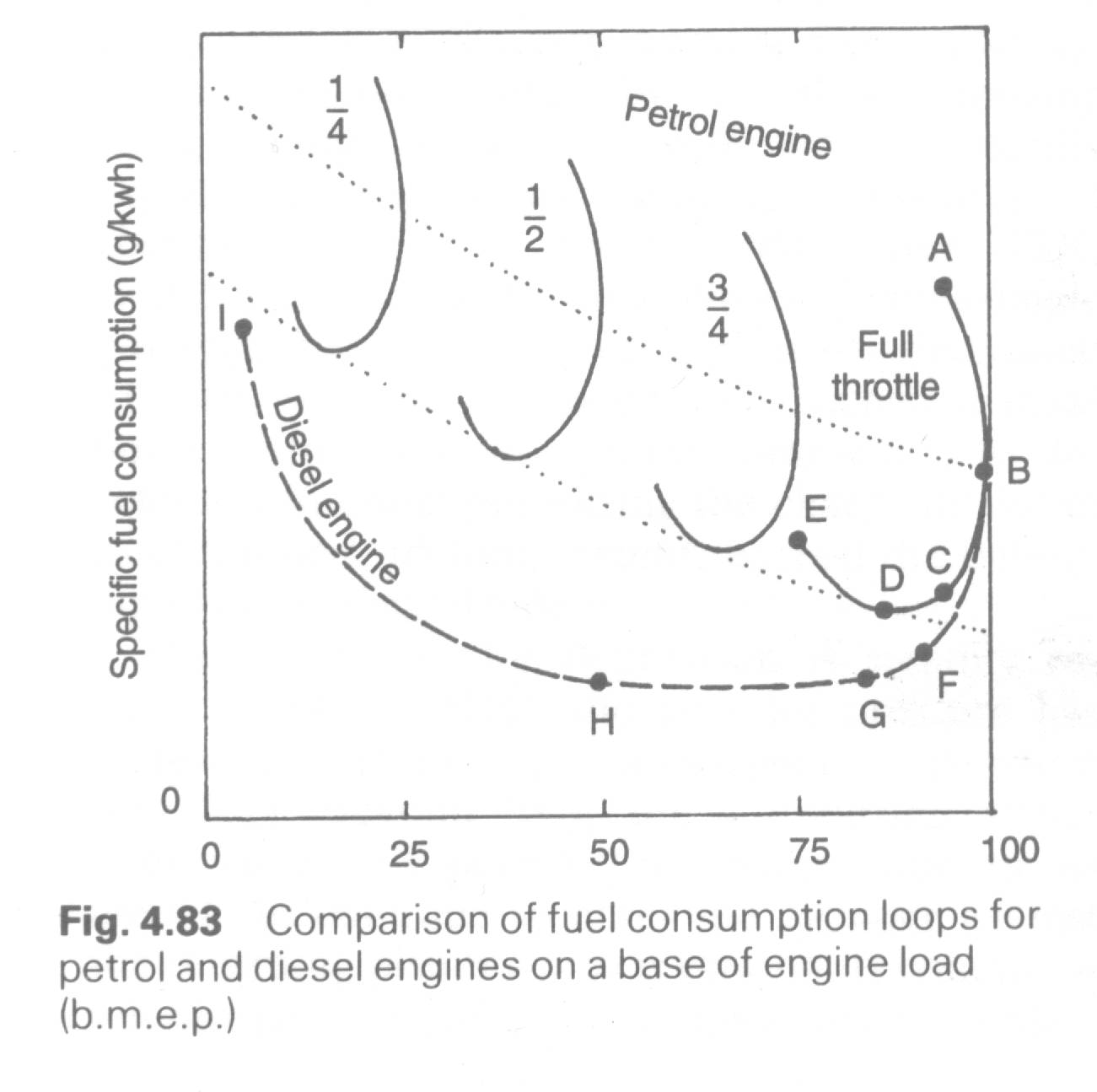
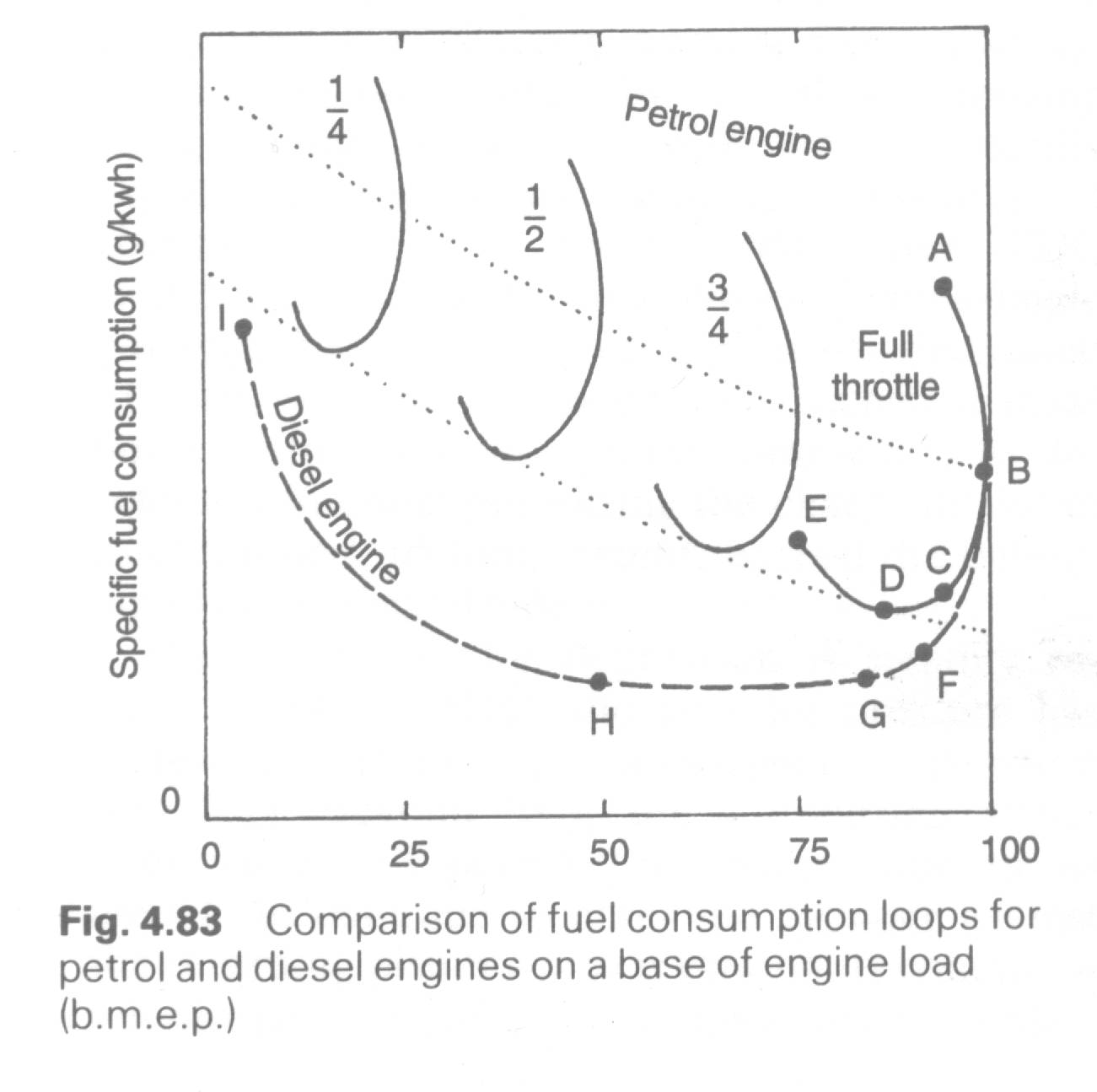
"The pumping losses from the diesel engine remain reasonably constant from
full load to no load whereas the pumping losses for a petrol engine
progressively rises as the b.m.e.p. is reduced due to the increased
throttling. This is reflected in the petrol engine by the mechanical
efficiency reducing as the b.m.e.p. decreases which causes the consumption
loops to take up higher and higher levels of consumption as the intake
becomes more throttled (Fig. 4.83). In contrast with the diesel engine, as
the load is reduced the single consumption loop only begins to rise when the
b.m.e.p. drops below about half the engine's maximum b.m.e.p. (Fig. 4.83).
A petrol engine can operate effectively under steady conditions over a
mixture strength ranging from 20: 1 to 10: 1, whereas a diesel engine which
can normally only utilize 80% of its air charge with a reasonably clear
exhaust, will operate from 18: 1, that is 20% weak at full load to 100: 1 at
no load. Consequently, the petrol engine will always have a 15 to 20% higher
maximum b.m.e.p. than a similar diesel engine (Figs 4.83 and 4.84)."

Paul Lamar

The Rotary Engine NewsLetter.  Powered by Linux.
ACRE NL web site. http://home.earthlink.net/~rotaryeng/
Copyright 1998-2004 All world wide rights reserved.