Don and I stayed up till the wee hours of the morning discussing
some of the current automotive issues. He also gave me a couple
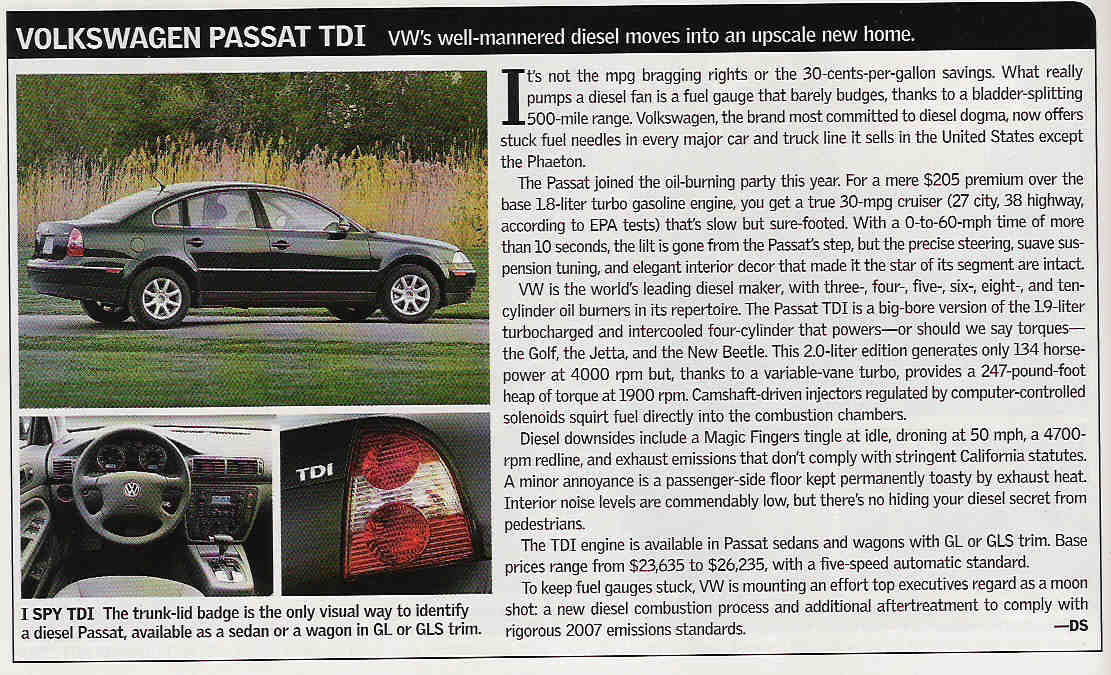
of mag articles. The first he wrote for Automobile magazine and the
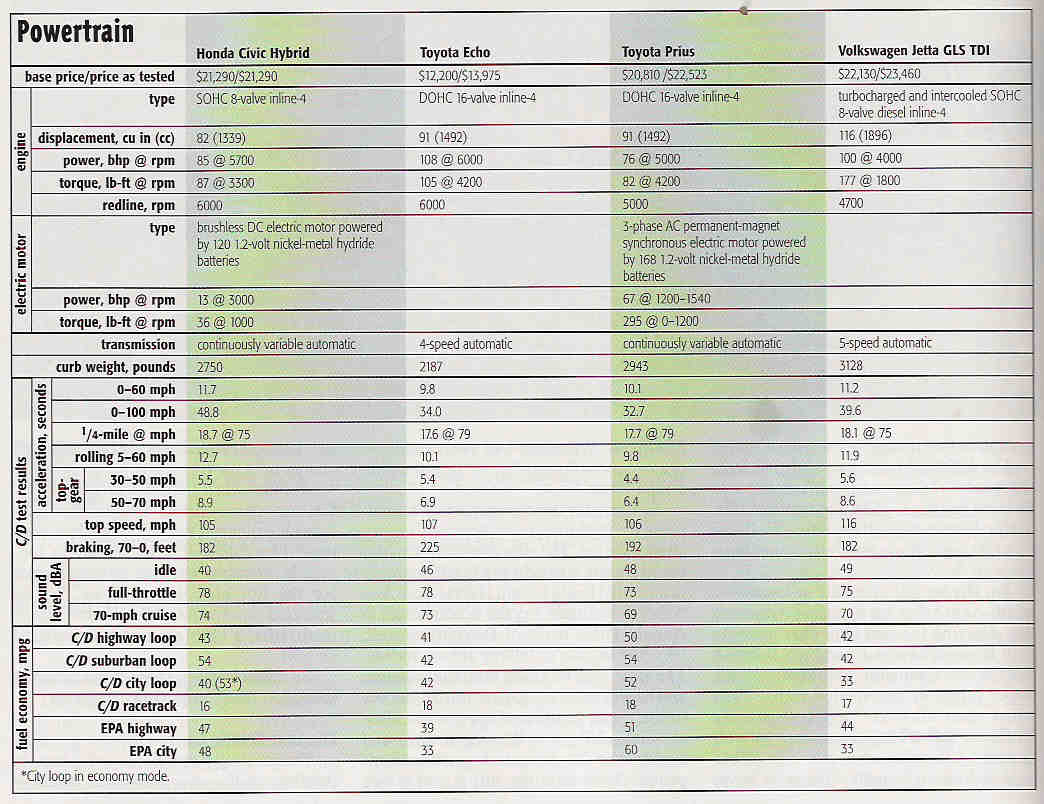
second, along with the table, was written by Patrick Bedard
for Car & Driver. Look down the table, third line up from the bottom,
and note that all these cars get about the same mileage when driven
hard on a race track as an RX8 does when driven hard on the street.
Of course none of these cars are in the same league with the RX8 when
it comes to performance. (I am also not saying the RX8 will get 17 MPG
on the race track either.) How can that be? Well first as I said before
when you use the full power of the diesel the BSFC rises to nearly
the same  level as a gasoline engine. The Echo in this list is a simple
gasoline powered econo car. The two hybrids in this list are hauling
around about 700 pounds of additional weight in the form of precious
natural resources  and that hurts when the batteries are dead and the
puny hybrid gas engine is doing all the work. The batteries are only large
enough for a few accelerations and then they must be charged from the
main gasoline engine. Also note the Echo did about the same MPG as
the diesel in all of the tests due to its much lighter weight.

Clearly this should point the automotive industry in the right
direction. Namely reduce the weight of the car and improve the BSFC
of the gasoline engine in the low power automotive driving cycle using
tailored turbo compounding. The main engineering challenge is lowering the
weight while maintaining a quiet car with a good ride.


Paul Lamar

The Rotary Engine NewsLetter.  Powered by Linux.
ACRE NL web site. http://home.earthlink.net/~rotaryeng/
Copyright 1998-2004 All world wide rights reserved.
Dr. Diesel's Dreamboat Back in simpler times, diesel cars squeezed more mileage from a fuel that cost less. If you were wi11ing to look for filling stations that were scarce, and had the patience for torpid acceleration, a diesel was the cents-per-mile champ.
Today diesels are prestigious in big pickups and mostly shunned in cars on American roads. Government standards are intolerant of diesel exhaust, and few auto makers see much opportunity until after low-sulfur fuel arrives in 2006. We hear of diesel's great popularity in Europe. Don't be misled. Those folks don't love diesels any more than we do. It's the fuel cost, stupid. Although diesel fuel prices in the U.S. have been well above gas prices over most of the past few decades (they happen to be lower now), many

European countries have tax incentives for diesel fuel. As a result, in April 2004 diesel cost 41 percent less than gasoJine in
Poland, 34 percent less in Belgium, and 21 percent less in Germany and Italy. So 0f course diesel cars are popular where fuel is cheap. In the British Isles and Switzerland, where diesel fuel costs a shade more than gas, gasoline cars remain dominant..
Currently, Volkswagen is the leading diesel supplier in the U.S. Representinf that choice in our Frugalympics is a VW Jetta GLS TDI powered by a 100-hp turbocharged four.

84 www.CARandDRIVER.com