I was thinking again Doug and I decided if Paxton does not need gears neither
do we. At first I rejected the idea as the balls would be too big and heavy
for the reduction ratio we need then I realized they don't need to be balls.
They could be disk with radiused edges. We already have a source of force to
keep everything in high pressure contact. No springs needed. Namely the
engine
oil pressure annular clutch throw out cylinder. This means it does double
duty
by keeping the CVT in contact and the friction planetary in contact.
Also when the engine oil pressure is released the planetary is disengaged
along
with the CVT. This reduces the inertia load on the turbo charger allowing
it to spin up faster in automotive use.

I suspect the oiling will work better as you don't have a bunch of teeth
zinging
around in several circles at supersonic velocities.

This should cut the cost greatly. No need for expensive high precision gears.

Paul Lamar
This series of Paxton blower curves says it all. Notice the max HP capability
of this drive
is 21 HP. Right in the ball park for what we are looking for.

This is an excerpt from the book called Street Supercharging by Pat
Ganahl 1984 and 1992 ISBN 0-931472-17-3 S-A Design Books North Branch Mn

By removing the Paxton impeller and feeding the output of a turbo charger into
this device
through a small shaft you would have a complete turbo compound unit with
variable speed
belt drive to the e-shaft. At a power level of 150 HP out of a 13B you could
up
the HP to 170 HP at the same fuel burn. The BSFC would go from the current
.47 to .42 right up there with the best of any aircraft engine on the market
today. It would do much btter than this when optimized for our needs.
After all this is a 50 year old design.

BTW The efficiency island is rather poor for this compressor because of
the crude impeller design. A modern impeller with inducer could up
this to 70 or 80%.

Paul Lamar
 Paul,

Funny about timing.  The Paxton blower is a good start.  Great.  I can
probably sell their impeller to the ninja warriors over here:) Looks a lot
like the "shirukin" they throw. I understand the performance curves well but
I am little confused on how you intend to use the device for a power
turbine.  Run it backwards?  I need more info about what you mean about
metal balls

You your enjoyment:

I am still concerned about the amount of friction in all of the 'full
contact' reduction drives.

Last night I found this US patent # 50130409 granted to Mr. William Mabe Jr.
who made a planetary transmission  out of permanent magnetics on a wheel.I
had been playing with the concept two days ago and noticed how our wind
generator rotors when spun in close contact to one another would transmit
torque and behave in  much the same way as gears do.  I have ordered some
bearings to do a simple test to determine the torque limits between and two
of them.   Mr. Mabe was through enough to provide formulaes and charts on
how to size the different magnet ratios though.
The 7:1 looks reasonably easy to mock up with the materials I have at hand.

BTW here is the site for the patent assignee Sundstrand Corp.

http://www.hamiltonsundstrandcorp.com/generic/0,3626,CLI1_DIV22_ETI2766,00.h
tml

Doug in Japan
Yes. Instead of the power going in through the belt end and into the compressor
we can run it backwards and put the power in the compressor end and take it
out the belt end. I'll bet you can find one of these things on E-bay.

BTW I neglected to mention that with a shallow taper angle on the ring "gear"
(for lack of a better term) and the pinion "gear" not much axial force is required
to get this type of planetary to work. The wedging action magnifies the effect of
the axial force.

See the attached gif below.
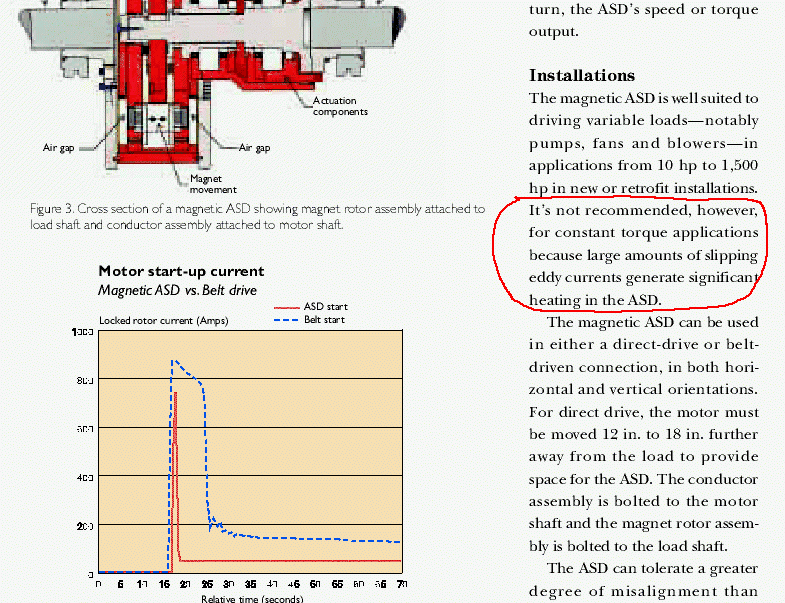
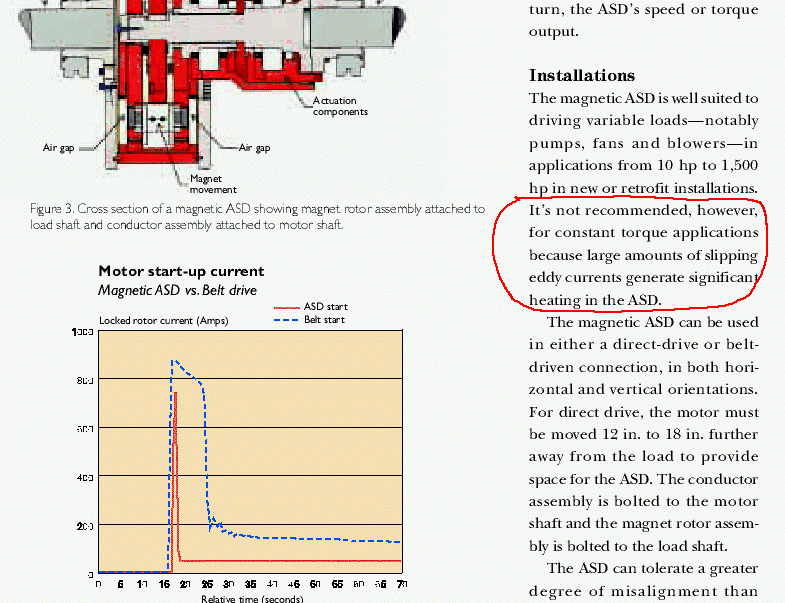
As I understand it the problem with magnetic coupling is, when there is a large
discrepancy in the speeds heating occurs due to eddy currents. Any time you have heating
in a device that implies a loss of efficiency. This statement is rather confusing
because I thought the whole idea of the magnetic device was to transmit torque. Unless of
course they are using a mechanical lock up clutch when the speed of the driven
member approaches the speed of the driving member. Then things start to make more
sense as it is a soft start. The web site smells like a stock scam to me.
I seem to have a nose for this sort of thing.

Steel on steel traction drives have been around as long as the locomotive
on iron or steel rails. What is remarkable about dry steel on dry steel
is the well proven coefficient of friction being about .78. Heck a gear would
only  have a coefficient of friction of only one so to speak :)

Paul Lamar

The Rotary Engine NewsLetter.  Powered by Linux.
ACRE NL web site. http://home.earthlink.net/~rotaryeng/
Copyright 1998-2004 All world wide rights reserved.