A lot of magazine writers are bad mouthing the RX8 if not out and out
slandering it. These jerks must not know how to drive a six speed. We filled
up in El-Centro, ran three or four max acceleration runs to
90 or 100 MPH at Agua Caliente airport and then drove home to West LA on one tank
of gas. That roughly works out to about 20 MPG. Part of the time we
were just keeping up with traffic on I-15 at 90 MPH cruise. Sorry Ernesto.
We had several max effort high speed passes on two lane roads between Agua Caliente and
Temecula. The rest of  the time 70 or 80 MPH was typical. We had to climb
from sea level up to about 4000 feet and back down to sea level.
Also we drove from west San Diego up over a 4200 foot pass and down
to sea level again in El Centro right around 100 miles on 4 gallons
or right around 25 MPG.

It is real easy to forget you are in fourth or fifth instead of sixth
gear in the RX8 as the engine is so smooth and quiet. If you do that
the engine goes into a low intake manifold pressure, high RPM mode that
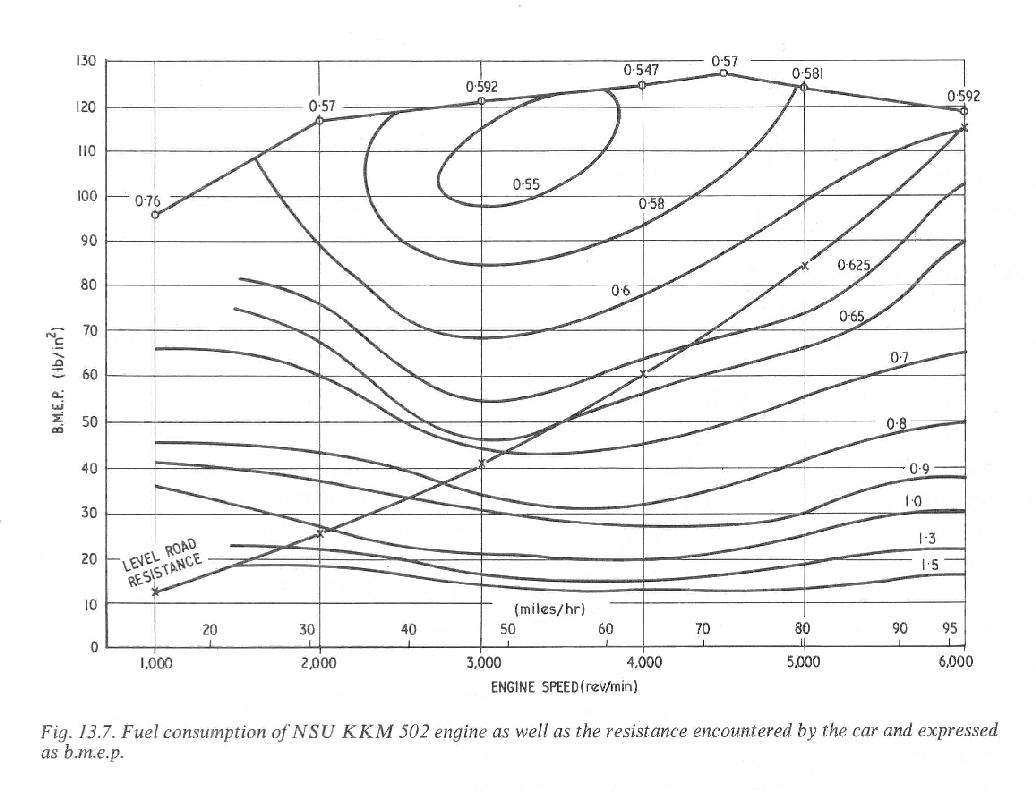
results in operating the engine in a high BSFC part of the fuel consumption map.
See a typical BSFC  map below.

If you drive it around at 5000 to 6000 RPM... yes you will burn lots of extra fuel.

Paul Lamar
One thing though Paul is, that when driving on a stretch with high hills up and down again,
you always burn less fuel on average for the total trip as the extra fuel for climbing is
less than the fuel you save going down hill.
See also the note on the chart provided: "Level-road requirement".
I know, when you apply physics and calculate it, it does not make a difference, however in
reality that is the case.

Regards, Rolf
Possibly. It is kind of hard to accept that at constant target speed unless
you put the gear box in neutral and coast down the hill at less than target speed.
If you don't the engine is working in a less efficient point on the BSFC
map going down hill at target speed. The aerodynamic drag
coefficient is a large factor.

I do know the best way to max MPG is accelerate to max speed and shut
the engine off and coast to a stop. Towards the end it gets kind of boring
as the car is going very slowly indeed. That keeps the engine operating
near the best BSFC island. One of the premises for the hybrid.

BTW that chart is rather old and with modern rear axle gearing and six speed
transmissions  the road load curve is moved up on the map closer to the
best BSFC island. This also explains why small hard working engines get
better MPG than larger loafing engines with the same road load. On the
other hand a large engine with the right OD gearing can come close to a
small engine BSFC because engine friction losses are lower. This is one
reason it is hard to beat a direct drive large displacement AC engine
on BSFC with a geared high RPM engine.

If you apply physics and it does not relate to realty your physics math
model is inaccurate.

Here is another very old and very early BSFC map for a rotary.

Paul Lamar

The Rotary Engine NewsLetter.  Powered by Linux.
ACRE NL web site. http://home.earthlink.net/~rotaryeng/
Copyright 1998-2004 All world wide rights reserved.