Harold Kovac wrote:
I appreciate your reply, but I may not have made myself clear, I
would
also
tee the tanks to the on/off valve, thus drawing fuel from both
tanks...would
this make a difference?
Harold Kovac
If one tank inlet becomes uncovered for what ever reason the pump will
draw air and the engine will quit.

This is a schematic of a low wing system that is safe.

Green is the feed line. Red is the return fuel.
Each pump has a one way valve built in.
One pump is used as the main pump and the other as the backup.
The fuel pressure regulator is on the end of the fuel rail.

Fuel systems seem simple but many people have crashed by not getting
it
right.
ANY deviation from this system and you take your life in your hands.

Paul Lamar
-------------------------------------------------------------
Paul,
You are absolutely correct and your diagram is how my Cruiser is being
plumbed. There is a recurring desire to have the "both" function in
airplanes, and although it can work for high wing aircraft, it can be a
disaster for low wing planes.

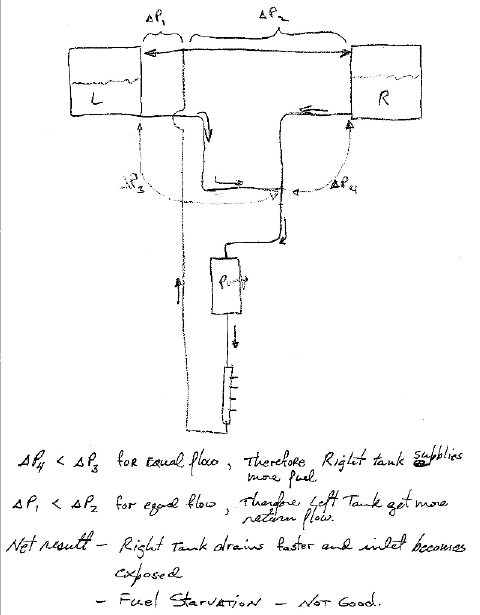
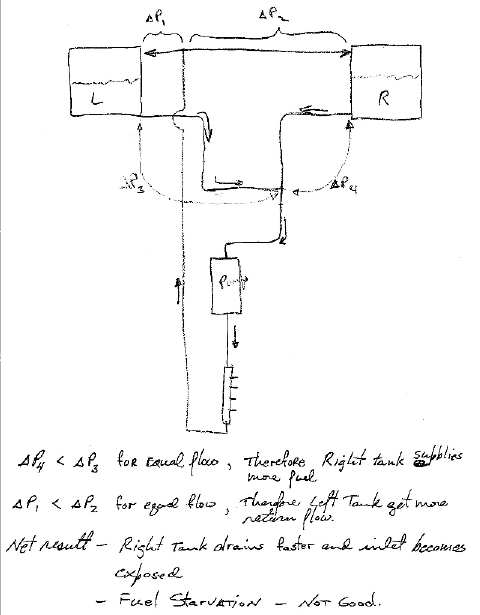
I am attaching a sketch, to try to explain why two tanks plumbed into a
'both' configuration can lead to problems.

The crux of the problem arises from two factors, 1) the fuel head in a
low wing aircraft is very low, maybe only 6-9" of fuel head, and 2) it
is almost impossible to ensure that the pressure drops in the plumbing
system are absolutely symmetrical. The net result is that you don't
necessarily know where the fuel is going.

Flow through a pipe is proportional to the pressure drop across the
length of pipe. If one of the tubes is longer, then flow through the
longer tube will be a little less than through a parallel connected
shorter tube. Also, if one of the tubes has a little 'kink' or
restriction during the fabrication, then the flow will be reduced.  What
can occur is that the flow out of one tank may be preferred, due to
pressure drop effects, and the flow back to that tank may be restricted,
due to the same reason. The net result is that fuel is gradually drawn
preferentially from one tank, resulting in the possibility of exposing
the inlet to air, which then cuts off all pumping.  People will argue
that liquid 'seeks its own level' and the tanks will equalize. This is
only true for a STATIC situation.  When the pumps are running, the delta
p in the tubing may be several psi due to flow restriction, whereas the
head available in the tanks is only a few inches of water pressure. The
static head gets completely overwhelmed by the flow-pressure drops.

William Schertz
Kis Cruiser #4045
The Rotary Engine NewsLetter.  Powered by Linux.
ACRE NL web site. http://home.earthlink.net/~rotaryeng/
Copyright 1998-2004 All world wide rights reserved.