Did you get that thrust bearing 3D Doug? I am sure you will have some
questions
about it.
Yes Paul
I got it.
It seems the bearing 'sandwich' purpose is to handle the thrust (clamping
force of the CVT) right?   In principle your idea will work though in
application and assembly the part count seems high.  Ten bearings?

Excuse my attitude.  I am always looking for ways to lower part counts and
simplify design. Design process takes longer though.  Making it work is
another matter though. Couldn't  we find a way to lower the clamping force
and get away with a high speed ball bearing?  Some of the  designs can
accommodate a thrusting action as well.
I will try to find my NTN bearing catalog.

On the 16 and 17th I will be in Hiroshima. First meeting is with the fuel
mileage champion.  Mr. Hisanori Nakane used to be in charge the rotary
engine fuel economy design team at Mazda. I'll

Next I will be going to headquarters to say hi to Mark S., and meet with a
few engineers  Mark and  Hisanori have arranged  for me to meet.

My main thrust :)  of the discussions will be to discuss the turbo
compounding application and see if I can obtain any data. BSFC Maps, exhaust
kinetic energy, turbo map, etc. for the 1990 turbocharged engine model I
will be testing with. Since the technology is old perhaps perhaps my wish
will granted.  Paul please suggest any specific data you think we may need.

Trying to improve the BSFC of the 13B using a turbo compound system is the
only the first stage of the research project. Proof of concept so to speak.

I'll also asked a few questions on who has or is presently doing research on
the use of heavy fuels, or light fuels like ethanol in the rotary.

I'll ask about the RENESIS development as an aside but don't expect any
concrete answers. I believe Jim M. of Racing Beat could tell you more about
how to make an all aluminum 20B electric assisted turbocharged engine.

Doug in Japan
I expected you would have reservations about this design.
Yes the part count is high but the part cost are low. If you explore the life
characteristics of needle bearings you will find the life drops off exponentially
with RPM. The smaller the diameter the less the less this effect. Therefore
you choose the smallest diameter bearing that will have the required dynamic
thrust load. The max RPM on this size is only 20,000 RPM and the life would
be short if we ran it at its rated load and that RPM. to extend the life you
must drastically lower the RPM. By using 10 bearings back to back
the 100,000 input RPM is reduced to 10,000 RPM per bearings. This is not a new
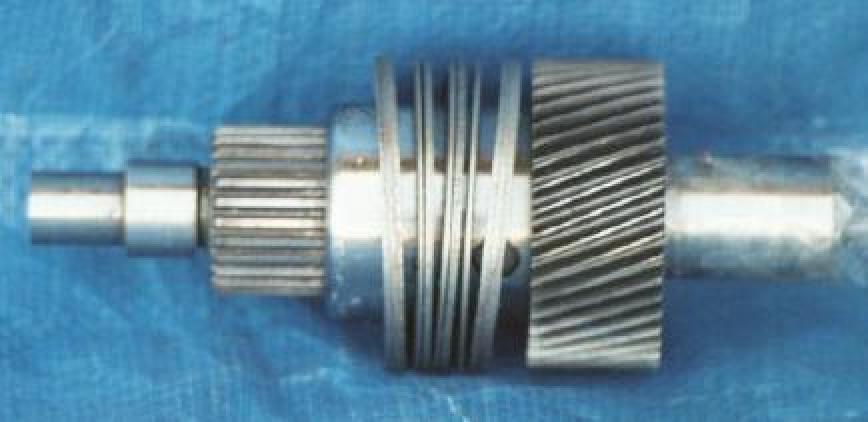
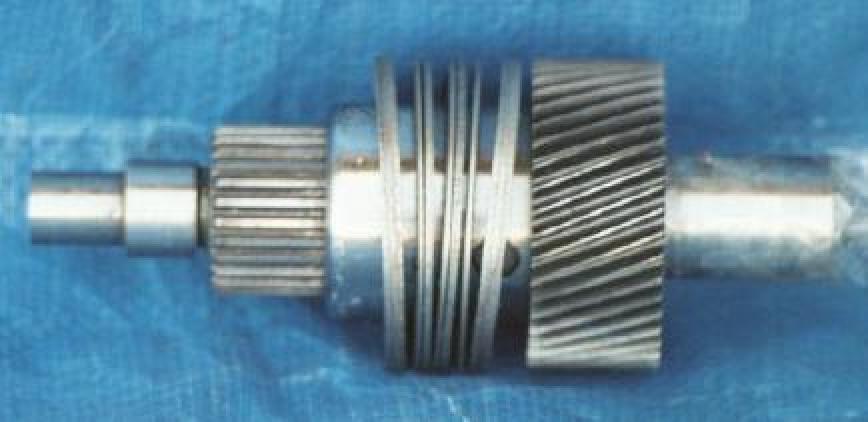
idea. Here is a shot of a Ross PSRU with three needle thrust bearings back to back
for the same reason. Tracy Crook's first design on a PSRU sun gear thrust
bearing failed for similar reasons. We also went through this exercise with
Perry Micks direct drive ducted fan and the stock Mazda e-shaft needle
thrust bearing. I would not want to use a ball bearing anyway as the
pinion shaft needs to find it own center relative to the planet wheels.

If I knew of a better way of doing this I would use it needless to say.
As far as I can tell there are no ball thrust thrust bearings that will take
this load at this RPM. If you use ball bearings back to back to take thrust
you risk overloading just one as both outer races are stationary.

I am wide open to suggestions on this. If anybody has a better idea I would like to
hear about it.

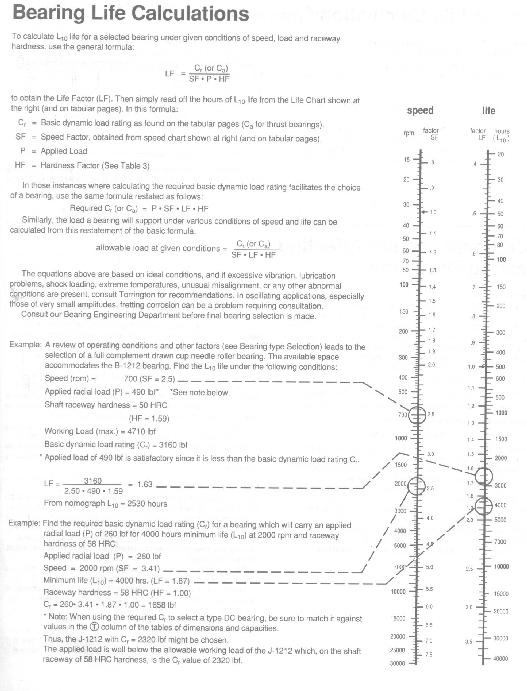
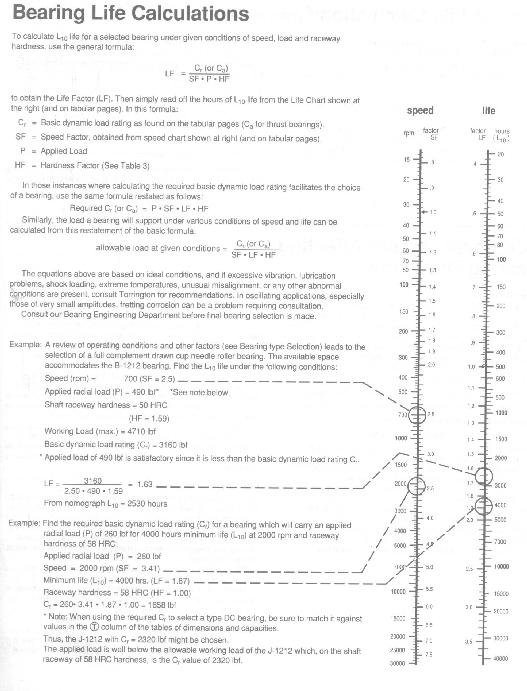
Here is an old message on the subject that will explain the process of calculating
the bearing life.

_______________________________________________________________________________
Subject:             E-Shaft Bearing
       Date:             Fri, 02 Apr 2004 20:00:16 -0800
       From:             ACRE <rotaryeng@earthlink.net>
 Organization:             ACRE
> > > > >Fred Osborn wrote:
 >>  > >>
 >>  > >>  Paul,
 >>  > >>
 >>  > >>  I understand that the rear journal e-shaft bearing is not suitable
 >>  > >>  for the side load imposed by a cog belt drive. For a single rotor
 >>  > >>  engine how about a needle bearing which would run between the
 >>  > >>  e-shaft and a reworked or redesigned rear synchronizing gear
 >>  > >>  replacement part. Could that arrangement provide an adequate
 >>  > >>  side load capability? Rotor sync would be maintained by the front
 >>  > >>  sync gear.
 >>  > >>
 >>  > >>  Fred Osborn
 >>  > >
 >>  > >Ken Welter uses an outboard support bearing with simple oiler.
 >>  > >Needle bearings have severe RPM limitations. I would use a precision
 >>  > >ball bearing in that application.
 >>  > >
 >>  > >Paul Lamar
 >>  >
 >>  >    I use a needle roller, Torrington # HJ-202820 which has a speed
 >>  > limit of 14000 rpm.
 >>  >
 >>  >    Ken
 >>
 >>  Yes it does but that is at zero load :)
 >>
 >>  Lets see an HJ 202820 has a Torrington basic dynamic load
 >>  rating of 7400 pounds. That is what they call C sub r
 >>  You use that number to enter this chart with the real load and
 >>  the RPM and figure the life. What is the diameter of the lower
 >>  pulley. I need that to figure the radial load at 300 HP take off
 >>  and at 150 HP cruise.
 >>
 >>  I also need the RPM at 300 HP and the RPM at 150 HP cruise.
 >>
 >>  It helps that the bore of an HJ 202820 is only 1.2500 inches
in diameter.
 >>
 >>  I assume the shaft is Rockwell C 58.
 >>
 >>  Paul Lamar
 >BTW as a ball park number since the speed factor at 7000 RPM is 5 a belt
 >tension of 1480 pounds will yield a life of 500 hours. 10% of a
 >batch of bearings
 >will fail and 90% will live to 500 hours.
 >
 >Paul Lamar
The Rotary Engine NewsLetter.  Powered by Linux.
ACRE NL web site. http://home.earthlink.net/~rotaryeng/
Copyright 1998-2004 All world wide rights reserved.