Del Johnson wrote:
After reading the Cafe Foundation research report on "Aircraft Exhaust
Systems IV" http://www.cafefoundation.org/aprs/EPG PART IV.pdf and after
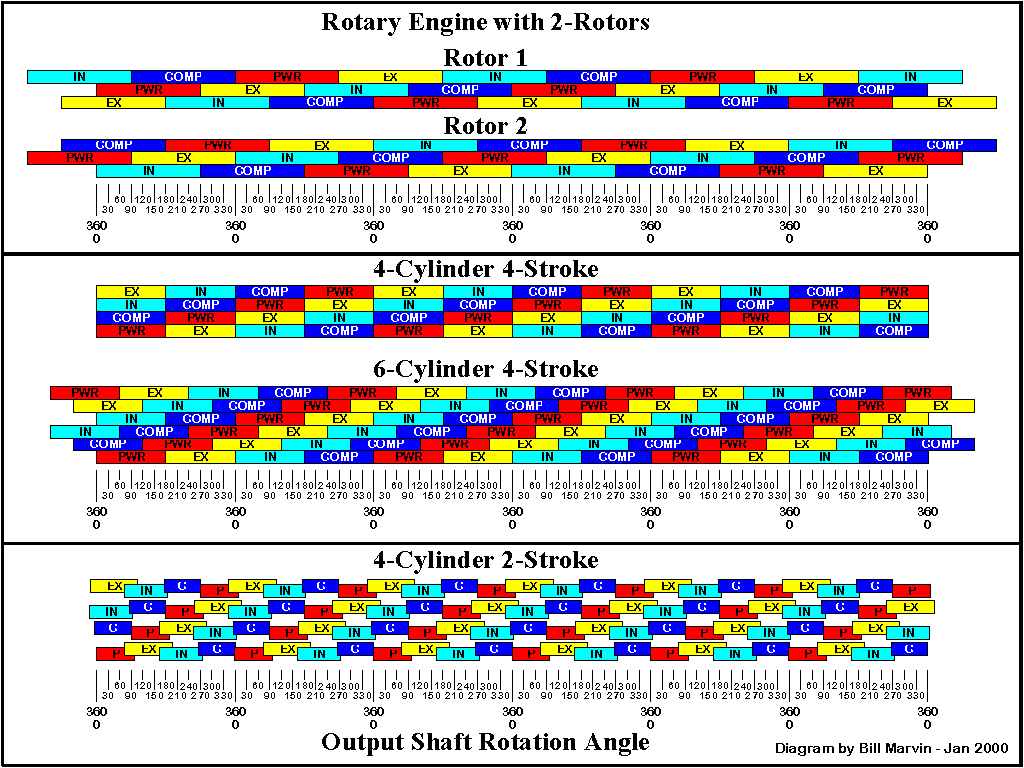
looking at the chart that Paul has posted on the how the wankel works
http://home.earthlink.net/~rotaryeng/Bill-Marvin-timing-diag.gif it would
seem that merging exhaust stacks into a collector and/or single muffler
would be detrimental to performance.

The Cafe Foundation report shows a vacuum created at the end of the exhaust
pulse which aids in scavenging.  The low pressure wave draws air in from the
intake runners if you have overlapped openings in the intake and exhaust
cycles ( should apply to RX7 engines).  It also shows the positive benefits
of the reflective pulse from the cylinder that is 180 degrees out of phase
(4 cylinder Lycoming engines) in a tuned exhaust system and the detrimental
affect if not tuned.  If the reflective wave occurs after the exhaust valve
closes it results in lower exhaust stack pressures just prior to the time
that the exhaust cycle starts in the opposite piston.  If it comes too
early, before the exhaust cycle ends, in the opposing piston, it increases
the pressure thus destroying the scavenging effect.

When you look at the intake, compression, pwr and exhaust cycles of the 2
rotor engine,that are posted on Paul's site, you can see that there is
always an exhaust cycle, in the opposite rotor.  This exhaust cycle begins
2/3 of the way into the ex         haustcycleoftheotherrotor.Itwouldseem
that, unless you are running extremely long exhaust stacks, the reflective
pulse would occur near the end of the exhaust cycle of the other rotor when
you are attempting to achieve some scavenging effect.

Paul, do you have any similar intake and exhaust pressure charts that would
that could help with designing a tuned exhaust system?

Thanks
There is some overlap but it does not seem to affect a collector type exhaust
with 32 inch pipes.  At least I don't think it does.  Racing Beat sells a header
like that and it was tuned on RB's dyno. I can't say how much it improves the
HP nor does Racing Beat make any claims for it. The main pulses are 180 degrees apart.
The 32 inch number was determined on several dyno's. The velocity of the pulse
depends on the temperature of the gases so it is a bit hard to calculate it.

The bible on this sort of thing is a book called the "Scientific design of
exhaust and intake systems.

http://www.bentleypublishers.com

Paul Lamar

The Rotary Engine NewsLetter.  Powered by Linux.
ACRE NL web site. http://home.earthlink.net/~rotaryeng/
Copyright 1998-2004 All world wide rights reserved.