"Powell, Ken" wrote:
I say again - a Renesis rotor weighs 8.2 pounds.  I can't verify this
off a Mazda site but found this number on both the RX8 forum and
www.automotiveforum.com plus read it in one of the magazines when the
RX8 was first introduced.  This msg off 'automotiveforum' follows (note
item 4a):

"The renesis works much like other internal combustion engines by
igniting an air-fuel mixture and using the expansion to do mechanical
work. How can engines make more power?

1. More displacement - Is there no replacement?

2. Better volumetric efficiency - How much air can we get in the engine?

a. Stuff more air into the engine (ie. turbocharging, supercharging,
Nitrous, Miller cycle?) More air is good. Compressing air also heats it
though.
b. Cool the incoming air (ie. intercoolers, nitrous) Cool air is good
because it is more dense.
c. Let more air into the engine. (ie. dual intake valves, tuned intake
manifolds) More air is good.
d. Let exhaust leave the engine easier - (ie. dual exhaust valves,
headers, high flow exhaust) More bad air going out means more good air
can come in. More air is good.

3. Better use of the air/fuel mixture for power (Thermal efficiency)
a. Higher compression ratios. The air-fuel mix will be more prone to
detonation & will need higher octane gas though.
b. Better thermal efficiency
c. Improved fuel atomization
d. More powerful spark
e. Better combustion stability

4. Less friction / resistance to movement (Mechanical efficiency)
a. Use lighter weight moving parts - waste less energy
b. Improve pumping losses (ie. Miller cycle with shorter compression
stroke than expansion *huh?*)

How and why does a renesis make more power than previous rotaries?

1. Larger displacement - No.

2. Better volumetric efficiency
a. The side exhaust allows an intake port approx 100% bigger than
previous production rotaries.
b. The side exhaust allows an exhaust port approx 30% bigger than
previous production rotaries. Unfortuately, the port is not open as long
as previous production rotaries and the exit path for exhaust is not as
straight.
c. The intake manifold has been greatly improved to provide laminar
airflow and uses 3 different length paths to tune the dynamic effect of
the intake air pulses. This improves the supply of air to the engine for
the entire powerband.

3. Better thermal efficiency
a. Better atomization of fuel due to ultra fine fuel injectors
b. More powerful spark due to higher power coils
c. Higher compression (unknown how high?) - [limited by sealing
improvements and reliability]
d. Improved combustion stability/efficiency at low speed & light load
due to no overlap.
e. Better thermal efficiency due to longer power stroke (exhaust port
opens later)
f. Better thermal efficiency due to possible use of cermet
(ceramic/metal hybrid alloy)?

4. Better mechanical efficiency
a. 14% Lighter rotors. Rotors will be approx 8.2 lb (9.54 * .86) leading
safely to higher revs.
b. Shorter and lighter driveshaft. Carbon-fiber driveshafts are cool. :)

What else am I missing? I believe the side exhaust design was never used
in the past because the peripheral exhaust offered a straighter path and
led to greater power. While I'm sure that peripheral port rotaries with
port jobs are capable of at least as much power as the renesis, we
should congratulate Mazda on their R&D of the side exhaust port renesis
since we can now have a rotary with larger ports AND greater fuel
economy and emissions.

Brian"
Ken,

Well said. You forgot the better cooling factors.  Say is the e-shaft
actually shorter?   What's this about a carbon fiber driveshaft. Something
on your wish list?:)  BTW I'll try to stop in and say hi when  pass through
your area mid Nov.   I think you are about 40miles south of Portland right?

Doug in Japan
The carbon fiber drive shaft is on the RX8.

Mazda published SAE paper 950454 on the side port engine.
It focused on the low power low RPM emissions characteristics of the engine.
1500 RPM or less.

Here is one of the charts from that paper.
The way you interpret this chart is think of the fuel consumption
axis as really mixture strength. In other words the side port
engine will idle smoothly with a leaner mixture hence less unburned
hydrocarbons.

Here too is the heat balance at 80Km/h or about 50 MPH. The power required
here is probably less than 25 HP. It is not clear from the paper if this
is the RX8 engine or an earlier engine. I suspect it is an earlier
engine. Notice the high ratio of unburned hydrocarbons.

The third chart illustrates why the RX8 engine pulls so smoothly
under load during low RPM operation. This is very noticeable when
driving the RX8 car. Rather remarkable in fact for a 2.6 liter 240
HP engine. Your average 2.6L 240 HP piston engine won't do this.

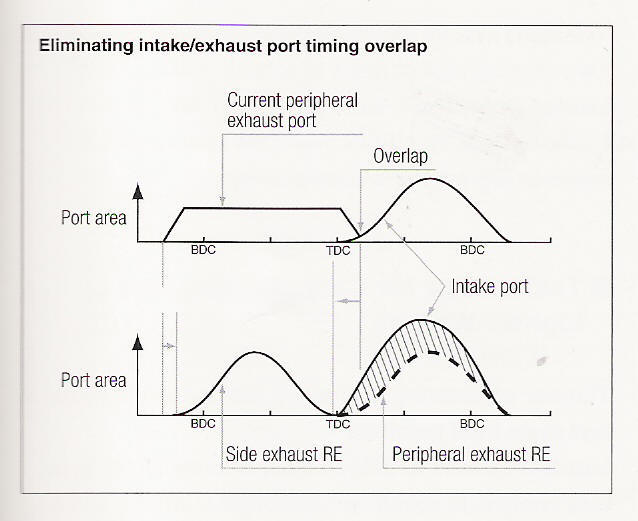
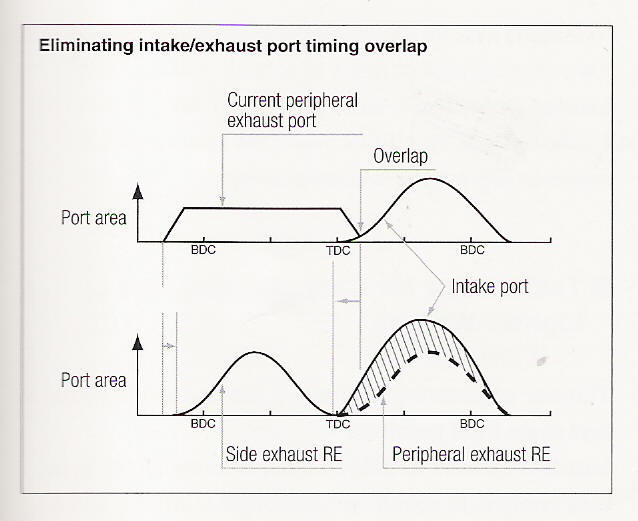
Here too is the side exhaust port timing but the port areas are not
representative of the production engine. Note the much later
exhaust port opening.

Paul Lamar
This is from a Mazda RX8 2003 technical press release. Some reports have the side exhaust
port area twice the peripheral port area. That number, like the RX8 rotor weight,
is still up for speculation. We will know eventually.

Paul Lamar

The Rotary Engine NewsLetter.  Powered by Linux.
ACRE NL web site. http://home.earthlink.net/~rotaryeng/
Copyright 1998-2004 All world wide rights reserved.