Richard wrote:

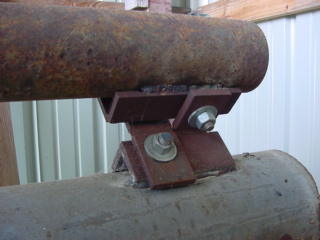
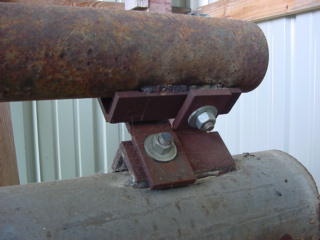
I build my test stand entirely from materials I had laying around, except for the flex mounts.
The flex mounts are used to mount the part of the test stand, which holds the engine, to the base structure. I use the flex mounts istead of bearings to avoid the possibility of vibrations. It also
is much simpler to make than bearing mounts. Also, bearings are not needed when a load cell is used for measuring torque.
Generally, the biggest issue on a test stand is loading the engine in order to produce torque. If one wants to tune an engine with known characteristics for aircraft use, a propeller load is totally
sufficient.
I am using a small direct drive prop because the setup is simple and small compared with using a full size prop and gear box.
A similar situation is power measurement. It would be nice to measure torque for accurate power calculation. However, it is equally valid for all practical purposes, and much simpler, to measure
fuel flow and calculate power with that.
I have not used torque measuring capabilities at this time, and may not use it until the engine is ready to go in the airplane, and than only for confirming results based on fuel flow. The main
reason why I am not using torque measuring is that this usually turns out to be a project by itself until everything works. I am mainly talking about mechanical issues in this regard. A load cell
has the capability of picking up all and every vibration an rattle in the test stand. All this will have to be eliminated in order to get useful data.

It would always be nice to have a full size dyno to play with, including the man power to run it.


Richard Sohn
N-2071U
unicorn@gdsys.net
The Rotary Engine NewsLetter.  Powered by Linux.
ACRE NL web site. http://home.earthlink.net/~rotaryeng/
Copyright 1998-2004 All world wide rights reserved.