<< Jerry Hey wrote:
 > >
 > > Would it be possible to combine the p port and turbo?  Since it never
 > > comes up, there must be some good reason for not doing it.   Jerry
 > Only if you want over 400 HP per rotor.
 >
 > Paul Lamar
 Paul Carey wrote:
 >
 > Hi Paul
 >
 > We recently had to strip our blown alcohol 20B down due to a blower
backfire
 > shearing the eccentric shaft keys again (even though we double keyed it 180
 > apart). I am purchasing a billet eccentric shaft new from New Zealand, as
 > ours was damaged. The billet shafts are harder, straighter and lighter than
 > stock, for about $2,000AUS.
 >
 > We are going to PP the engine whilst we have it apart, to get more power.
 > Using 52mm round ports, in a position to give power from 4500 to 9000. One
 > injector as close to the housing as possible on each runner, then one about
 > 6 inches back, then injectors in the hat above the blower (this is
 > mechanical constant flow injection) and different pressure check valves
 > bringing in each set at different revs. The butterflies are in the hat at
 > the top. Each runner will be 55mm ID at about 18 inches long to the plenum.
 >
 > Any comments or advice would be appreciated.
 >
 > Regards PC
 >
 > Paul Carey
 > Aero Group Pty Ltd
 > 226 Railway Parade, Bayswater WA 6050
 > P.O.Box 119, Maylands WA 6930
 > Ph: (08) 9371 5205  Fax: (08) 9371 9644  Mob: 0418 959 892
  >>

When the turbo kids start pulling giant HP numbers, their biggest problem
seems to be that the rear housing warps a bit and the alignment dowels either
shear off or break the rear iron through the dowel hole area. They add a number
of additional dowel locations to help with that.

All of the torque produced appears where ever the engine is being mounted to
the chassis. Usually the rear iron in a bulkhead mount, or the center iron
stock mounts. I would also suspect that crank index and stiffness would suffer as
the load is just on the flywheel end.
Porsche would put a clutch on both ends to keep the rotors and crank in index.

Adkins and Racing Beat would be the people to ask about most of the problems
with extreme output engines.

Should be 1,400 or 1,500 HP minus the blower load. Expending a legal
refrigerant gas through a thin intercooler under the blower would work wonders for
charge density.
Lynn Hannover
As does an air to fluid intercooler using acetone and dry ice as a cooling fluid.

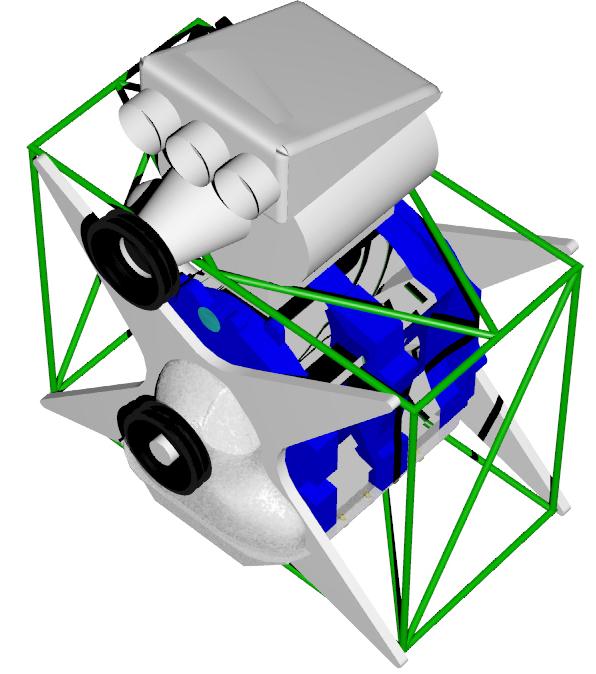
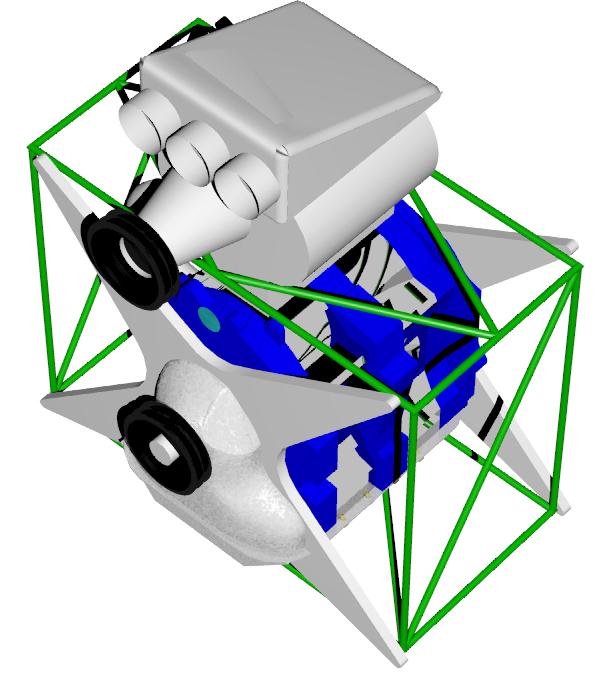
Here is my solution to the engine torsional stiffness issue. Can also serve
as part of the chassis.

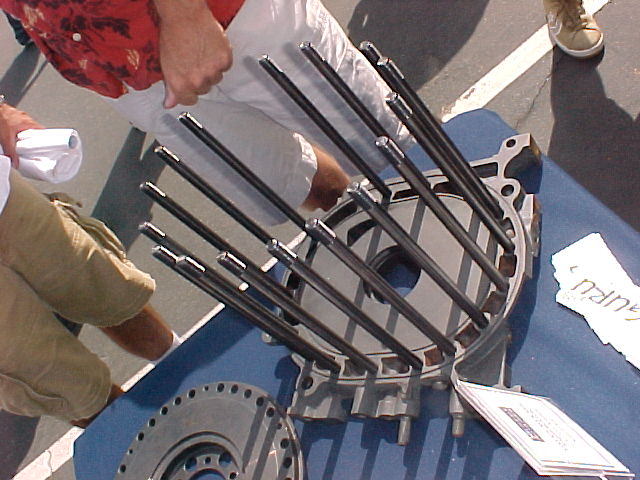
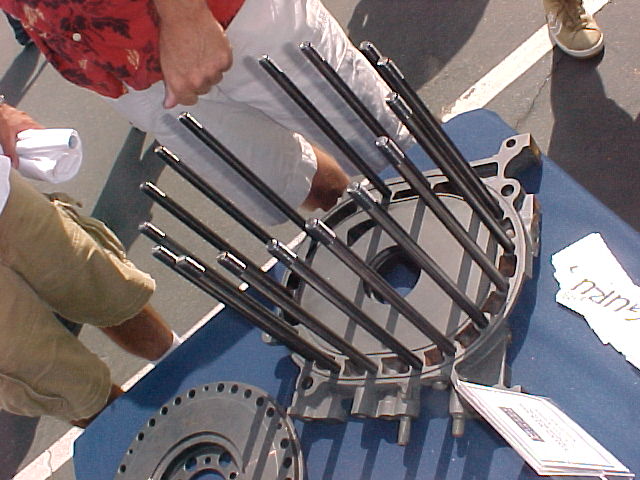
Here too is something else they are doing and using larger tension bolts.

Paul Lamar

The Rotary Engine NewsLetter.  Powered by Linux.
ACRE NL web site. http://home.earthlink.net/~rotaryeng/
Copyright 1998-2004 All world wide rights reserved.