More pictures.

We need to bug the Diamond owner on a regular basis to put the two
rotor back into production.

Doug, if your friend in Japan is designing a small rotary I have
a few suggestions. Scale down the Mazda but use detonation coated
aluminum end housings. One of the problems with the Diamond
is the air cooled rotor. That sucks a lot of power so the BSFC
is worse. The other major problem it has is the lack of
a pressurized oil system. That leads to the needle rotor bearing
and the air cooled rotor.

Needle bearings don't like high RPM so they skid. That limits
the RPM of this engine to about 6500 while it should be turning
over 12,000 with twice the HP if it had plain journal bearings
like the Mazda. Also the needle bearings require super precision
in the rotor bearing diameter and the e-shaft.

Paul Lamar
Diamond was also in the process of scaling the engine up about 50%
as I recall. That would give them around 150 HP or so ideal for
the Katana. Apparently this project is on hold unfortunately.
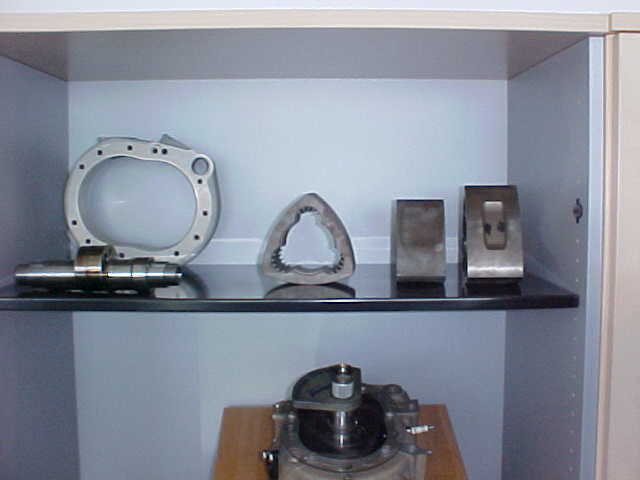
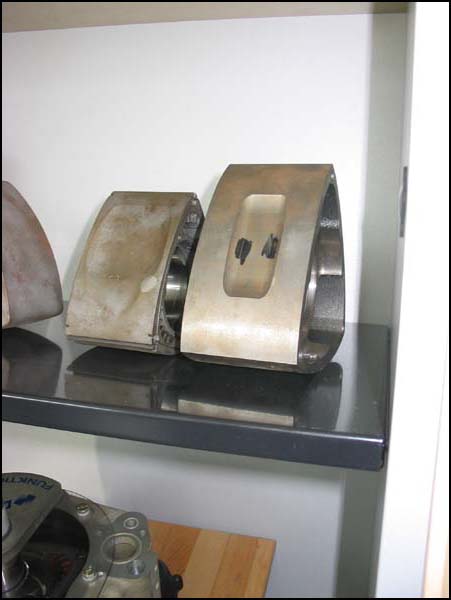
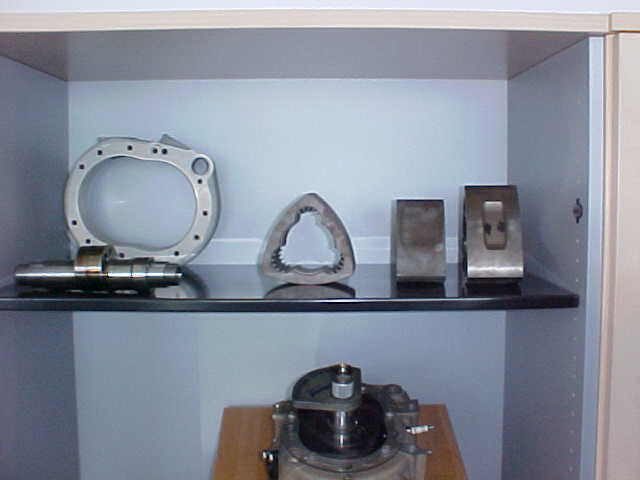
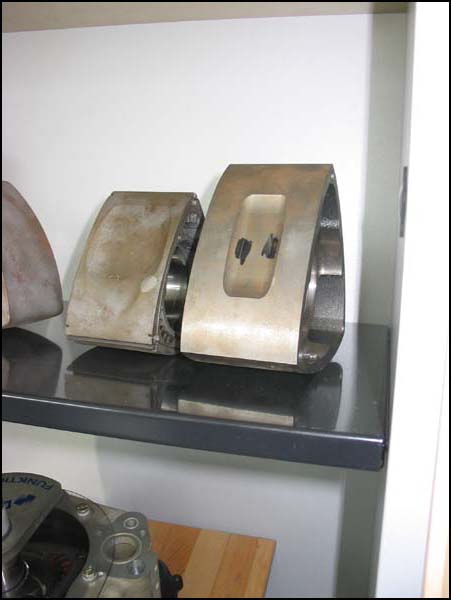
Here are a few pictures some of which Mark Wrathal shot.
Also a summary written by Mark of our trip to the factory.

Paul Lamar

The Rotary Engine NewsLetter.  Powered by Linux.
ACRE NL web site. http://home.earthlink.net/~rotaryeng/
Copyright 1998-2004 All world wide rights reserved.
True Rotorheads - A visit to Diamond

MarK Wrathall - 14/MAR/2004A

Paul Lamar organised a trip to Wiener Neustadt, to visit Diamond Aircrafts
new rotory engine facilities. Luckily I got to tag
along.

                          (No Link) Paul Lamar with Martin Rühe, the manager
of diamond engines. Martin is a
true Rotorhead. He proudly showed us his Hercules W2000 which he has been
riding for years. Powered by a Sachs KM
914, the internal parts are interchangeably with the Diamond Engine
components. A chemist by profession, he joined
Mid-West Aero about seven years ago, and made the move to Wiener Neustadt
when Diamond decided to take it over.

                    Richard Negus has been a rotorhead about as long as I
have been alive. He joined BSA in
1964, and after the merger of BSA, Triumph and Norton, got involved in the
Rotory powered Norton racing team in 1972.
This project peaked with over 100 people involved in 1991-92, by which ime
Richard was burnt out. He left the company,
but after only a few months was drawn back to the rotory to work for
Mid-West Aero. He has been involved ever since,
having bought the spare parts assets of Norton a few years ago, and
consulting for Diamond.

Richard gave us a fascinating overview of the family tree of the Sacks KM
914 derivatives.


                          A completed R2 (The internal reference to the
100HP two rotor), ready to go out the
door to some lucky home builder. Mid West production was slow but pretty
consistant. The main customer was Schliecher,
who used the R1 in high performance self launching gliders.

                          This R2 will go to a UAV helicoptor. Note the
drive belt pulley. The main feature here is
the blower used to cool the rotors, bearings and side housings. Consuming
about 3-5HP, it is the price you pay to avoid a
recirculating oil system. Best economy peaks at 260g/kW/h, with average fuel
consumption around 300g/kW/h.

                          An off the shelf oil injection pump is used to
provide metered oil flow. Oil to fuel ratio
works out at about 1:110. Although the engine has a total loss oil system,
actual consumption is less than the falls within
the normal range for a Rotax 912.

                          About half the oil is sprayed in a port in the end
housing, where is mixes with the
cooling air to lubricate and cool the main rotor and e-shaft bearings.

                          The rest of the oil is injected into the throttle
bodies for apex seal lubrication. As the
rotor bearing temperature is the critical limiting parameter on TBO, the
engine has been certified for use only a select few
oils, which interestingly enough are not two-stroke oils.

                          A balanced assembly. Rotor, E-shaft, Flywheel,
Counterweight and bearing become a
matched balanced assembly.

                          The Balancing machine used. This engine is still
set up for low volume production.

                          Here is a rotor which has been quarantined due to
unattractive balancing by a
sub-vendor.

                          A batch of raw rotor housing castings. These
housings are water cooled, with the
waterjacket enclosed (The end housings are air cooled). There is no need for
O-rings between housings. These were
previosuly ground on a cam driven rotor grinding machine at Norton (the one
built by Sachs in the early sixties). With the
final termination of the Norton factory building leases last year, this
machine was sold for 45GBP, to a fellow who didn't
even try to haul it away once he saw how massive it was.

They have just had a trial batch CNC ground, which have come out the most
accurate rotor housings ever.

                          This housing is out of an engine which has run for
~400 hours in a Diamond Katana,
and was removed for engineering analysis. The highest time engine that they
know of is an R2 in Italy which was last
reported as having 780 hours. The vast majority of the R1's used in the self
lauching Schleichers will never accumulate
many hours due to the nature of that operation. One of the Schleicher motor
gliders has flown from Europe to South
America three times!!! (Sore butt!)

                          As you can see it has a very light chatter pattern
in the Nikasil, but it is bearly
perceptable to touch. There were rumours of issues with the Mid-West Aero
engines Nikasil coatings. Martin informed us
they had used two different vendors in England, one of which was dropped due
to an unsatisfactory batch.

                   Diamond have designed a new engine with a displacment of
just under 400cc/rotor (up from
294cc for all Fichtel and Sachs KM914 derivatives). Here you can see the
difference between the rotors.

Martin and Richard were very gracious hosts, who generously gave us three
hours of there saturday. They were very
open about the engine and obviously proud of it. Diamond is currently not
producing it's Rotax 912 powered two seaters for
the european market (the Katanas for the North america are made in Canada
and have Continental IO-240's), so we have
to hope that the next batch of Katana's and Dimona motorgliders have Rotary
engines.