Vince Orton wrote:
I have lurked for a while now, reading with interest the varied
solutions for increasing cooling capacity for liquid cooled aircraft
engines.

The main problem is that liquid cooling is more difficult (less
efficient) than air cooling - mostly due to lower delta-T (temperature
difference).

Here are some ideas that have been discussed:
- Proper ducting
- Cowl flaps
- Exhaust airflow augmentation
- Liquid spray on radiators to temporarily increase cooling
- Alternate coolants for greater delta-T

Some ideas that have been shot down include:
- Electric fans
- Radiators behind engines (in tractors)

Some ideas that I am surprised HAVEN'T been discussed:
- Engine driven fan
- Turbocharger fan/air pump

Which brings me to the point ... what are the relative merits of these
systems?  Here's some questions I have:

- I think good ducting design goes without question.

- Cowl flaps are reasonably easy to fabricate, but what can/do they add
to cooling capacity?  10%?  50%?  100%?

- Exhaust airflow augmentation is almost free to implement.  How
effective is it?

- Liquid spray on radiators may be the cheapest way to add takeoff
cooling capacity, and is VERY easy to implement.  Also, any boil over
lines should be routed to the radiator face to get the "last use" out of
any lost coolant.  Are there any drawbacks?

- What are the drawbacks to alternate coolants?  Are they worth the
trade-offs?

- I understand that electric fan(s) are too weak to cool a 200hp engine
without severe current draw, but are they useless as a "cooling system
augmenter"?

- I don't like the behind-the-engine radiator installation idea, but can
it be made workable with some of these other solutions?  Using forced
air from a fan, etc.?  (Some installations may have restricted space
under the engine.)

- Why are engine driven fans not discussed?  We have pulleys, so the
fans could be located below, and in-line with the accessories.  Keep in
mind the fan(s) could be smaller, or could be a "squirrel cage", like
home FAUs (Forced Air Units) use.  Ducting could control air paths to
pull through the radiator.  Ideas?  Problems?

- Could the compressor section of a large turbocharger be used to pull
air from the backside of a radiator, and then dump it overboard (or air
blast hot spots)?  Is this "out there"?  I think this has merit since
increasing power causes an increase in cooling airflow.  Heck, I suppose
the turbocharger could still maintain an induction compressor section,
too.

Just some ideas ...

Thanks,
-Vince Orton
I would not say electric fans are shot down. They work quite well while
taxiing and perhaps can help on max angle climb out.

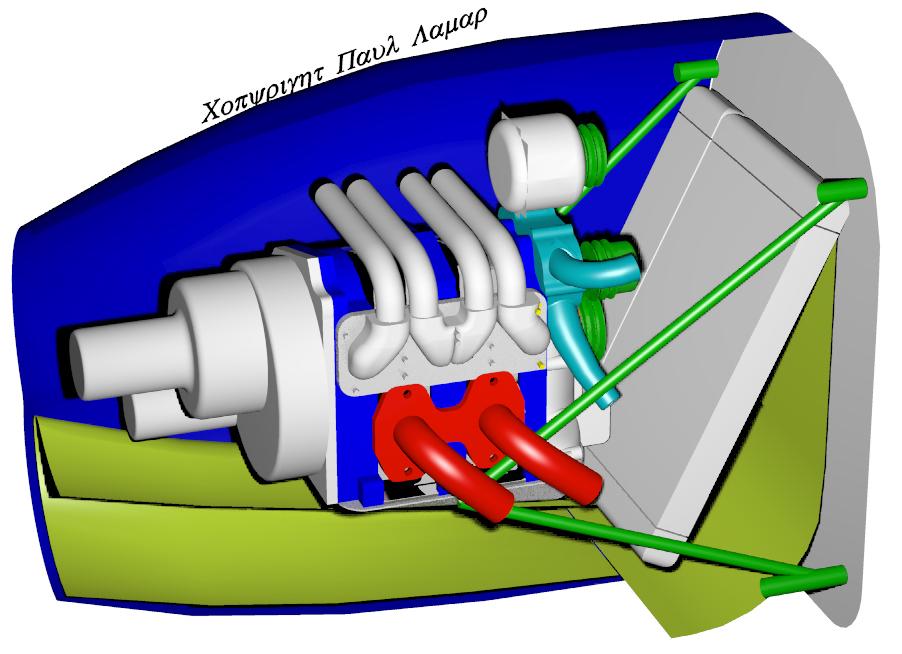
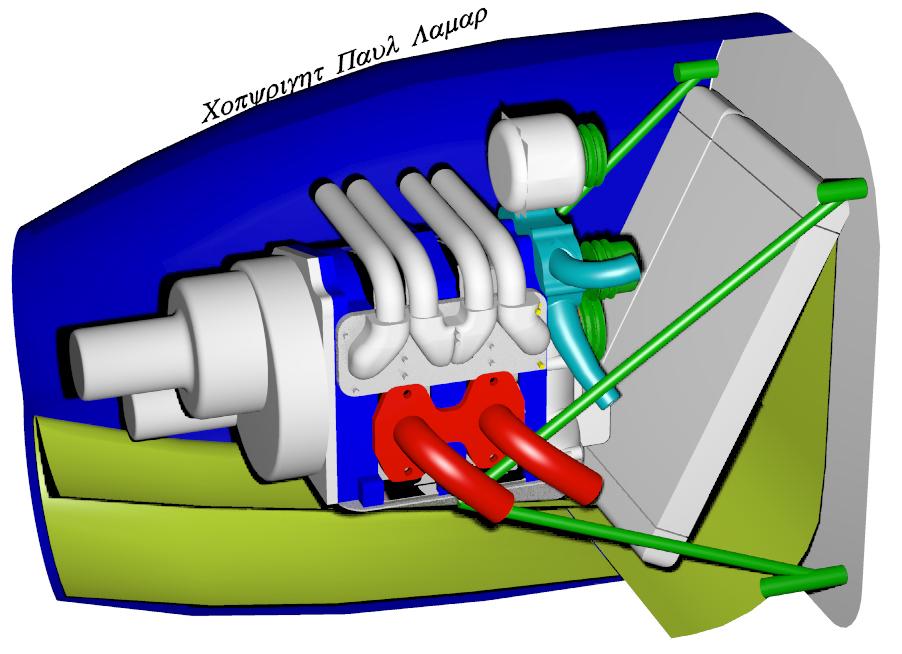
Also with enough room a rad behind the engine can work. The best way to do
that is introduce the cooling air to the rad between the rad and the firewall
and let the hot air flow forward over the engine.

I also think a fan on the engine drawing air through the rad towards the
front of the aircraft from a rad mounted on the firewall will also work.
You need some sort of clutch to disconnect the fan at cruise speed where
it is not needed or lots of HP will be consumed by the fan. Also the
dead engine fan and required duct becomes a restrictor at high cruise speeds.

I think you mean cooling air flow ejector rather than "Exhaust airflow
augmentation". The distinction is important when trying to search the NACA
data base.  According to NACA it can work well if you have the room to implement
a proper diffuser.

The thing about cooling systems is they are highly nonlinear. Something
working at 230 degrees F is adequate. 235 degrees F can be disastrous.
It is hard to talk about percentages. Therefore a cowl flap
can make or break a cooling system

Other coolants have been used successfully. Ken has been using
Evans propylene glycol that boils at 300 F.

Paul Lamar

The Rotary Engine NewsLetter.  Powered by Linux.
ACRE NL web site. http://home.earthlink.net/~rotaryeng/
Copyright 1998-2004 All world wide rights reserved.