Al Gietzen wrote:
Vince:

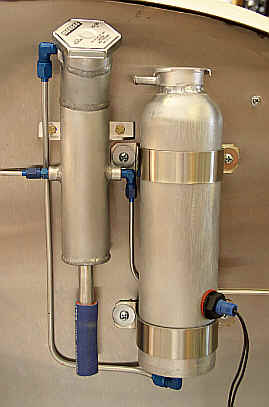
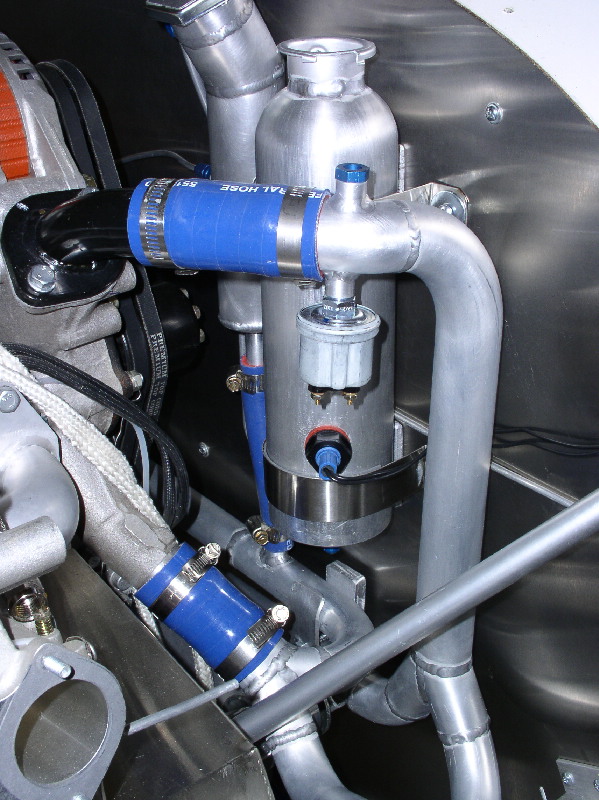
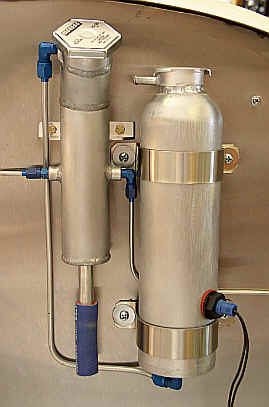
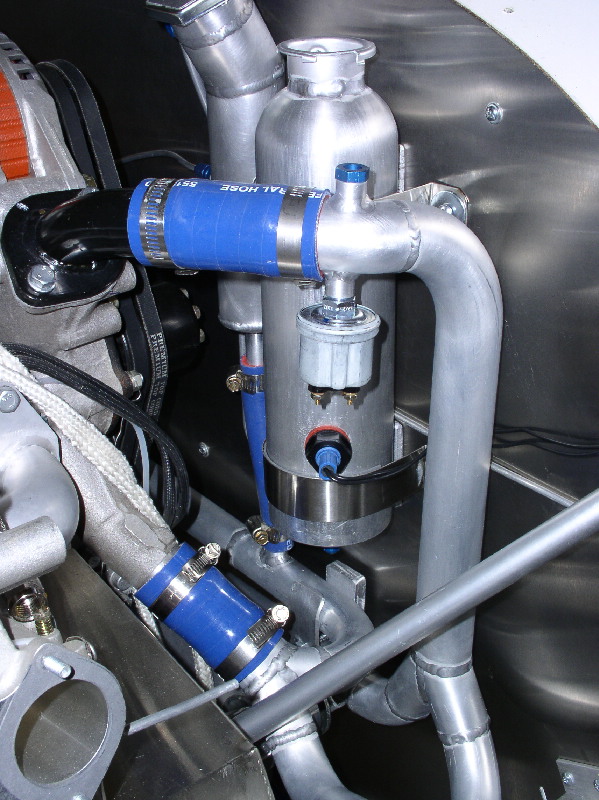
I have a system quite similar to what your are planning on my 20B in a
Velocity RG.  It has a "filler" bottle which is just a section of 2" tubing
with a 25 psi 'system' pressure cap and a overflow bottle (with 13 psi
pressure cap) made from a aluminum fire extinguisher that I picked up free
at a extinguisher service shop. Photo attached.  There are 2 rads, and an
air bleed line comes from each to the filler bottle.  The line out the
bottom of the filler bottle connects to the line just upstream from the pump
return inlet.
What is the minimum size (volume) of the overflow bottle?
The over flow bottle is close to 3" i.d. and 11" tall - which is just under
1 1/2 quarts.  I've measured about 3" of coolant in the overflow bottle at
ambient before engine start, and about 2" from the top at 205 F coolant.
That is just over 3/4 of a quart (24 oz) volume expansion in a 20B.  This is
operating at low power level, so there is no nucleate boiling in the engine.
I expect that at higher power there will be more expansion.  Haven't
operated there yet.
How many lbs of pressure should the overflow bottle hold?
I have a 13 psi cap on the overflow bottle.  Note that with pressure caps on
both, the system pressure can get to the sum of them both. With a 25 psi
system cap, I pressure tested to a measured 40 psi.  So for low altitude
operation I may just keep the overflow bottle cap at the first notch.

Also note that a quality racing cap is need for the system cap.  A stock
automotive cap is likely to leak around the secondary seal before pushing
the 13-15 psi into the overflow bottle.

With the fill air bleed at the pump oulet, and the bleeds from each rad tank
there was no problem purging the air from the system.  Interesting that on
the very first run I did without a prop, a rapid increase in rpm would
generate enough negative pressure at the pump inlet side to draw coolant
back into the filler neck from the overflow bottle.

Al
You do nice work Al.
You need some of those Breeze constant torque hose clamps.
Will be easier on your expensive silicon rubber hose as well
as regulating the clamping pressure with temperature changes.

Paul lamar

The Rotary Engine NewsLetter.  Powered by Linux.
ACRE NL web site. http://home.earthlink.net/~rotaryeng/
Copyright 1998-2004 All world wide rights reserved.