Frankly this is a lot better than I expected and it removes
one of the possible arguments for not using a P-port.

Many of the P-port neigh sayers state high fuel consumption
as one of the reasons for not using them.
It appears that if exhaust gas mixing is taking place it is
compensated
for by the better breathing.

Paul Lamar
George Lendich wrote:
Paul,
I was surprised at that BSFC also - what would it be leaned ?

You may very well be correct with your assumption on the better
breathing
compensating for the exhaust gas 'overlap' mix. However they may
have
a
little bit of housing ( inlet) shape that we don't know about,
which
would
help here also.

All that need to be concerned about  now is the back pressure and
as
, if
you say, the closer butterfly compensates for the backpressure, as
Richard's
6" manifold clearly demonstrates, with resulting 1,200 rpm smooth
idle.
George (down under)
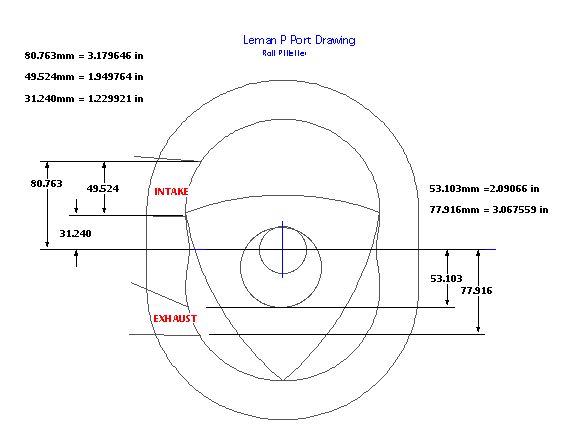
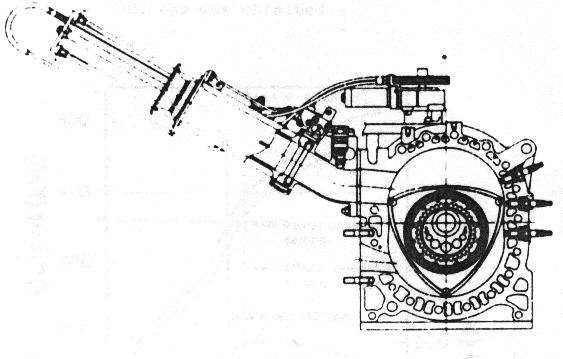
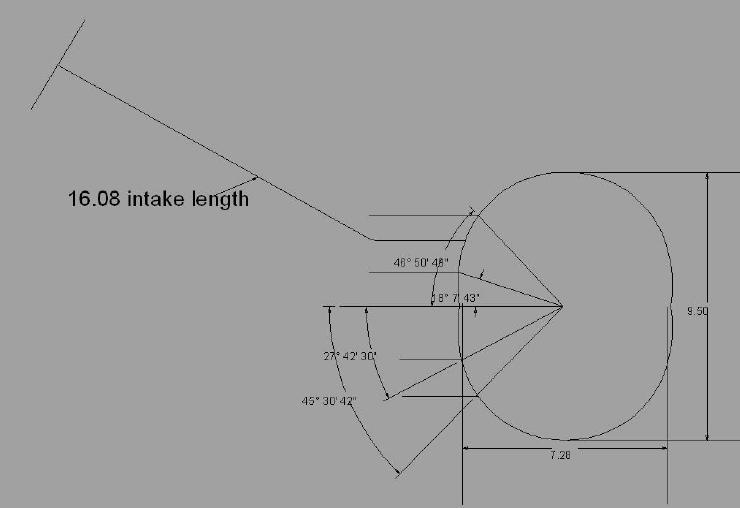
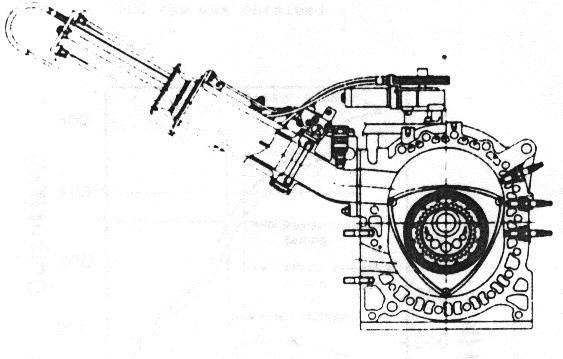
There is nothing trick about the Lemans engine housing shape.
It is a more or less a large mostly round hole. You can scale the
port diameter and timing from this drawing.
I never understood why people could not understand that while for
the last five years we have been talking about the Lemans geometry
and port timing. I think I mentioned it many times until I got
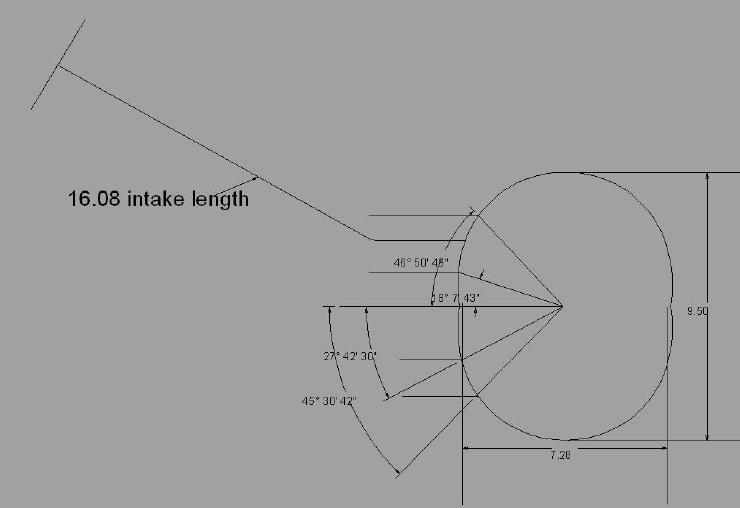
tired of mentioning it over and over again. You can also scale the
fixed length of the runners and add the lengths from this chart
for any RPM between 6000 and 9000.

The butterfly does not compensate for the exhaust back pressure HP
wise.
You still need to keep the exhaust back pressure down if you want
good
HP.
6.5 inches is not close for the butterfly. The Power Sport engine
has the butterfly in the rotor housing. Richard's engine is not yet
tuned
with long runners so the jury is still out on the quality of the
idle.
Paul Lamar
I scaled out this drawing two years ago and I still have the drawing.
It is not that hard to do if you have a program like Pagemaker (now
InDesign).  The Leman p port was constantly on my mind as we designed
our implementation.  Our port is smaller and opens later which should
help with the overlap.   I expect to have better BSFC than the Leman
engine at our RPM for this reason.  The main difference between the
Leman  engine and  stock is the additional spark plug.  .      Jerry
The thrid plug was worth about a 3% increase in torque and a 3%
reduction
in BSFC. Hard to measure. More like 2% in the 4500 to 6000 RPM range.
SAE paper 920309.

Paul Lamar
Jerry Hey wrote:
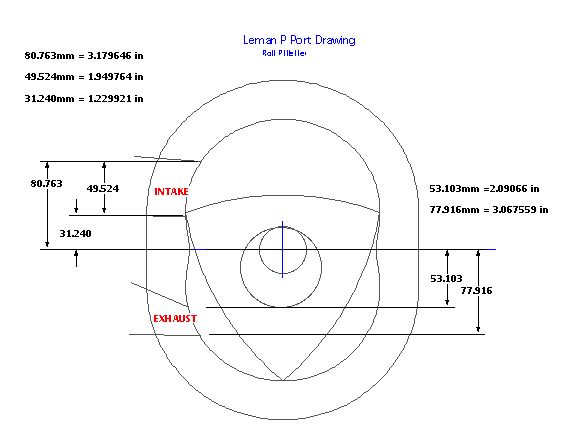
Looking through my p port folder, I came across this drawing which I am
attributing to Rolf, though I can't remember for sure.  This drawing
uses the intake and exhaust information I derived from scaling the
drawing published by Mazda. It is particularly valuable because it also
shows exhaust ports timing.   Jerry
You did a good job Jerry. The actual intake port diameter according to
Doug
is 51 mm.


Paul Lamar
Paul,
For those interested, I just found some old info on the Le man's port timing
and factory P-port.

Factory P-port        Le man's
IO 86 BTDC          IO 105 BTDC
IC 75 ABDC          IC   74 ABDC

EO 73 BBDC
EC 65 ATDC

The closing (IC) events are very similar, which leads me to believe this
about as far as you can go without too much back pressure affecting the
inlet charge. At 75 ABDC is pretty high up on the housing anyway.

Interestingly the Le man's opening (IO) event is 20 degrees sooner than the
factory P-port which indicates to me that the exhaust gas contamination (
overlap) is considered the lesser of the two evils as they would opt for
more overlap and limit the backpressure.

I don't know the Le mans exhaust timing, they could very well have made it a
little sooner as well. Anyone got those numbers?

So my conclusion is that a preferred IO is sooner rather than later and IC
sooner rather than later with distance between the IO and IC being closer
rather than wider. This approach results in a rectangular type port.

Now having said that I superimposed this type port over a round port like
Jerry's and found there wasn't a hell of a lot of difference - I assume
Jerry did the same exercise and found a round hole is so much easier to cut.
I don't remember but I doubt that Jerry has exceeded the IC 75 ABDC, so his
position falls within these figures.

For those not interested, excuse my ramblings, but for people like Richard
Sohn, who I'm sure is interested, this will mean something as I believe he
has opted for an early timing whereas Jerry has opted for a slightly later
timing.

George (down under)
Here is Jerry diagram and my diagram derived by scaling the Leman
engine drawing.

What is really confusing about the opening and closing is referencing
the numbers to the e-shaft position. To eliminate confusion it is
best to reference the numbers to the drawing angles as both Jerry and
I have done here.

Remember the intake  port stays open for roughly 360 degrees of e-shaft
rotation. This is because the rotor is rotating at one third
e-shaft speed.

To show how confusing this can be the flank of the rotor
ahead of the flank doing the intake process  goes through and well
beyond top dead center while the intake flank is opened and
closed. Using old piston engine nomenclature of top
dead center and bottom dead center just confuses the issue.

To further confuse the issue a side port located  at the same drawing
angle as a P-port would open many e-shaft degrees later as the rotor
flank must move away from the rotor housing inner wear surface.
If this were not the case you would lose the corner seals out of
the intake port hole. This is one reason a bridge port shows so much
more power than a simple side port. It opens much earlier.

The bottom line is you can't compare P-port timing with side
port timing in any simple fashion.

Paul Lamar

The Rotary Engine NewsLetter.  Powered by Linux.
ACRE NL web site. http://home.earthlink.net/~rotaryeng/
Copyright 1998-2004 All world wide rights reserved.