I,m confused, say you decided to side step several issues and went the supercharging route. Thus exhaust system back pressure is not a problem (you're supercharging because you want more power than
a normally aspirated lemans type p-port will provide). Do you want more or less overlap or is detonation more of a concern so retarding is the order of the day. cliff
On balance a supercharger sucks more power from the engine as it is not utilizing
any of the 50% of a gallon of gas waste energy in the exhaust. A turbo charger does
utilize some of that energy.

It takes HP to compress air. In the case of a supercharger that comes directly
and completely from the e-shaft. In a turbo charger most of the HP comes from
the exhaust with only a slight penalty in back pressure.

Let me put it this way. A 250 HP net output supercharged engine might be generating
300 HP internally. 50 of the HP is going into the supercharger. That 50 HP
also adds to the cooling requirements.

In a 250 HP net output turbo charged engine only about 10 HP or so is manifest in
back pressure. That means the engines is only generating 260 HP internally.

Getting down to the problem of overlap. With a p-port exhaust and intake
you always have a lot of overlap due to the combustion chamber being in the face
of the rotor. You won't affect the amount very much one way
or another no matter what the timing is. Timing in a p-port engine is way
over rated when it comes to controlling over lap. What is far more
important is the length of the exhaust pipe and intake pipes. In that case
the exchange of gases between the exhaust and intake will be highly dependent on
RPM, the amount of boost and the  instantaneous pressure difference between
intake and the exhaust. Gases flow from a high pressure area to a low pressure
area. In a turbo or supercharged engines intake gases sometimes flow into
the exhaust area increasing the BSFC and sometimes they flow from the exhaust
to the intake affecting combustion stability.

To my knowledge nobody is measuring that pressure difference in real time.
In other words when the engine is running at 6000 RPM nobody really knows
what is going on millisecond by millisecond. Perhaps Mazda does.

Paul Lamar
I, knew you would be taking a hit to power your supercharger but that much?
Superchargers are getting more efficient; there's one company that claims
theirs is 99.8% efficient.

Well maybe not that much HP but the most efficient super chargers use turbo
charger compressors. The ratio of HP consumed will stay the same.

The bottom line is the turbo charger is still the way to go if you
don't need instantaneous acceleration.

Besides, with a little extra work a turbo charger can be converted into
a turbo compound configuration which will really pay off big
time in reduced fuel consumption.

Paul Lamar
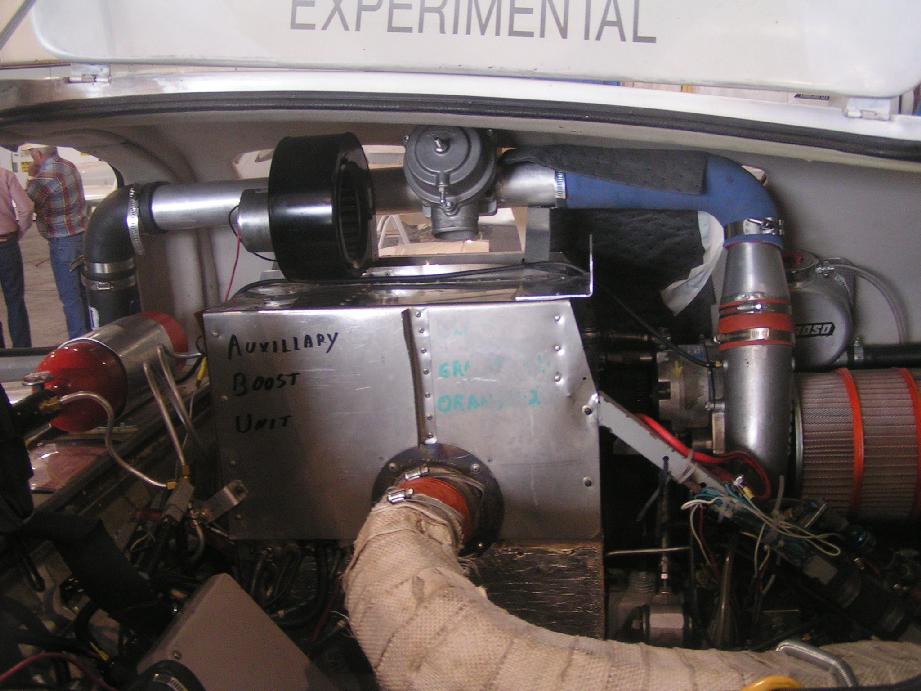
BTW as a data point the Reno racer White Lightning owned by Will Mathews
has an 80 HP two stroke piston engine in the back seat driving the supercharger for a
210 HP Continental IO-360 giving a net output of 300 HP. The airplane qualified
at 260 MPH. This engine would not do nearly as well if it had to
drive that supercharger itself.

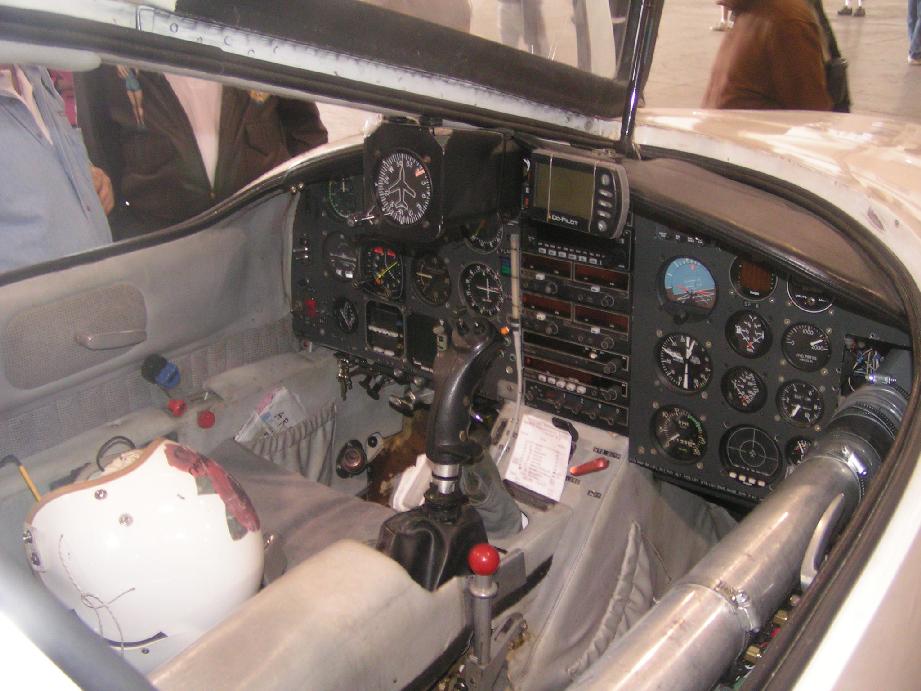
Here are some pictures I took at Reno of this airplane.
The large pipe passing through the right side of the cockpit feeds
pressurized air to the engine.

Paul Lamar

The Rotary Engine NewsLetter.  Powered by Linux.
ACRE NL web site. http://home.earthlink.net/~rotaryeng/
Copyright 1998-2004 All world wide rights reserved.