Robert,
What we all share ( in this group) is a genuine interest in
Aviation
and the
development of the Rotary engine, any Rotary engine for that
matter,
that
would be suitable for aircraft use.
We have one member ( perhaps more), Chris Cosman, who has designed
his
aircraft to specifically use the Rotary - which is a good move
IMHO.
There are those ( of this group) who are endeavouring to make an
installation more user friendly (to coin a phrase).

I personally would like to see what you have in mind for your
design.
You will get much support and advice on here (Acre).
George (down under)
Robert Clark - CAD/Graphics wrote:
Thank you George for the kind words and being clear on the intent of
the
group for I am new to the group, and have lots to learn.

  I will scan some sketches and see I can get some modeling done to
display the projects (yes I have multiple Projects).  Know how do I
post
Pictures?  Can I include them in the text e-mail?


Robert Clark
CAD/Graphics Planner
KBR - Houston, Texas
(713) 753-2390
Yes but try to keep them less than 100K.
If they are larger send them anyway as I can reduce them if I have to.

Paul Lamar
I am curious Paul. What is it that would make a design specially
suited to
a Mazda? It seems that several very conventional designs are being
built and applied with rotary power with what appear to be good
results - what would you revise? - Vance
In the case of the Reno racer Sports class the frontal area can be reduced
due to to the narrowness of the rotary engine.  So far in my iterations
the fuselage max cross section (mostly width) is determined by the pilot.
I am laying him back about 40 degrees which is about as far as one can go
and still be comfortable. I spent a lot of time on this over the last
three days.

The cowl taper can also be improved due to the overall small cross
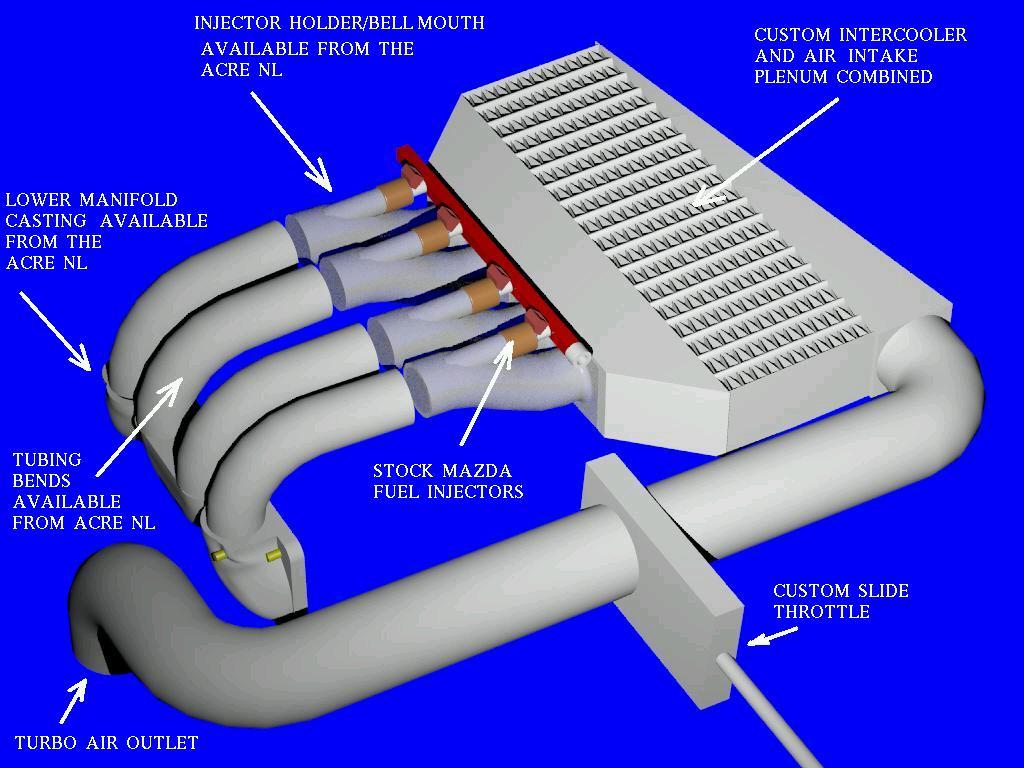
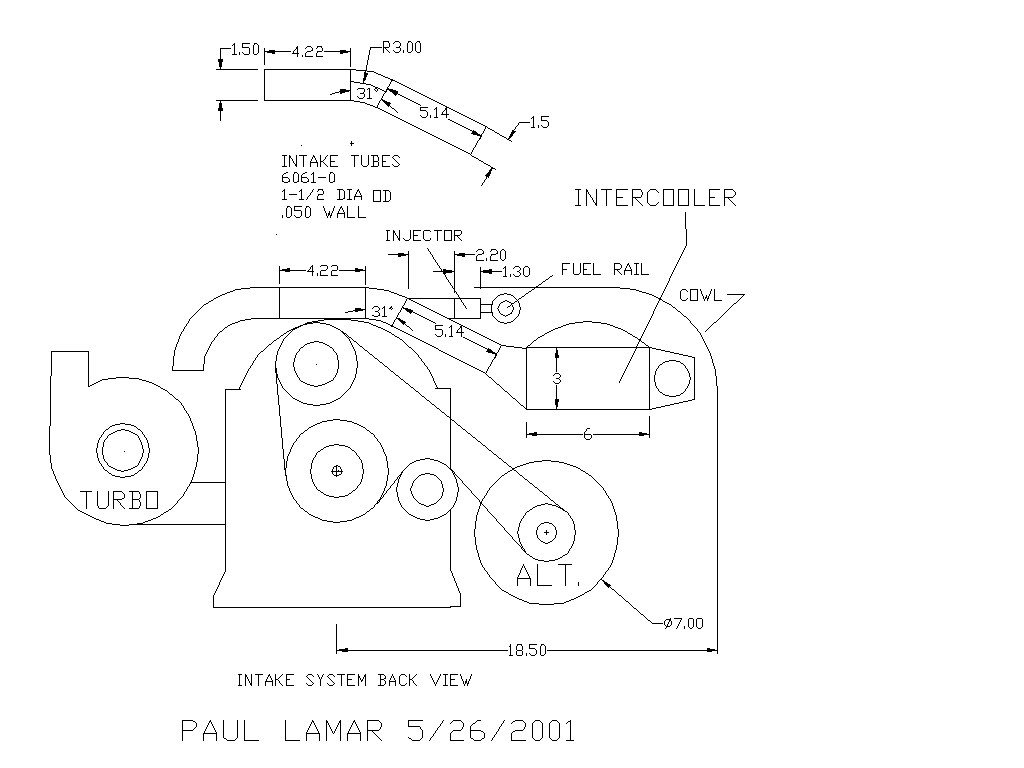
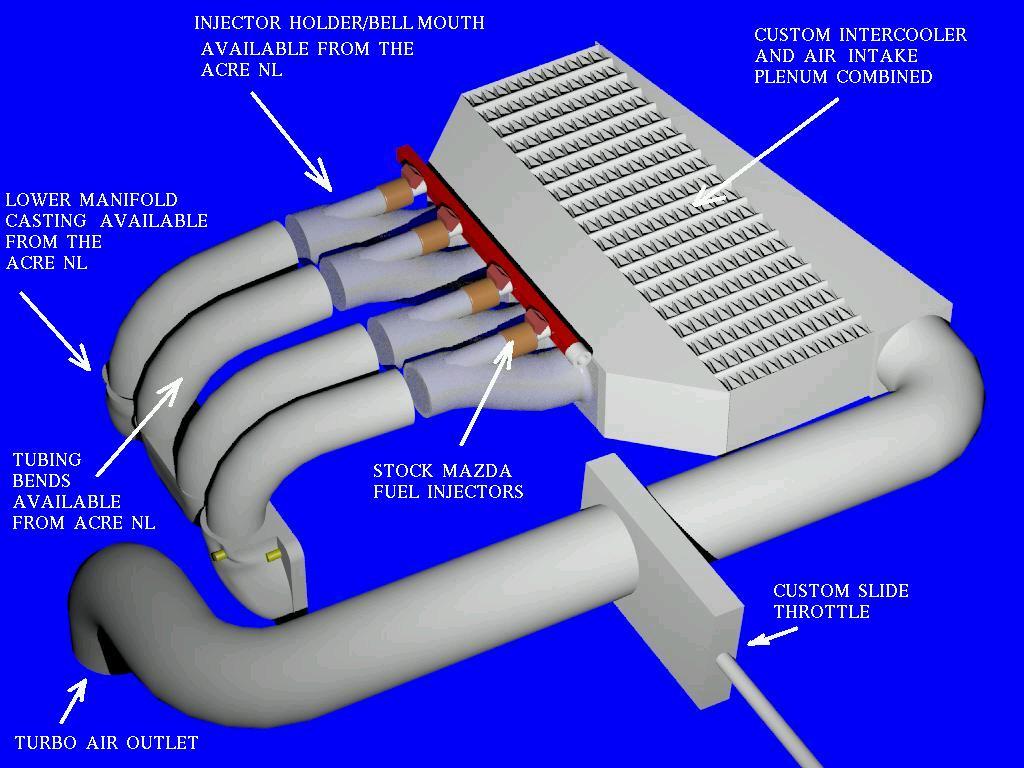
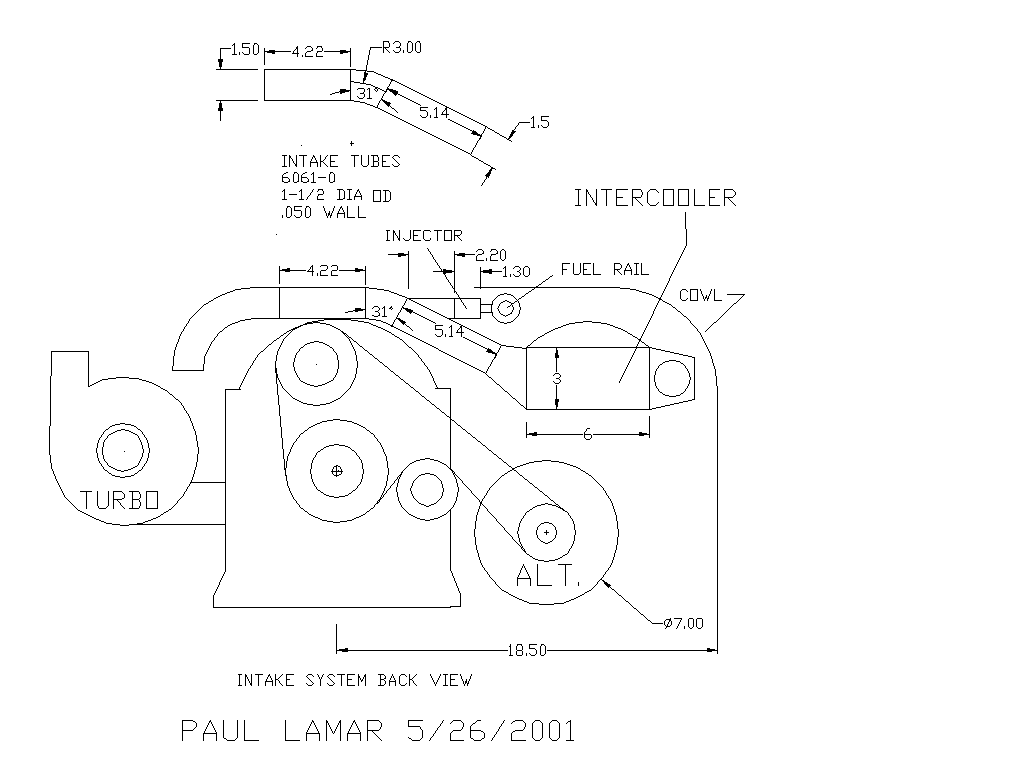
section of the rotary. Combining the intake manifold and the air to liquid
intercooler also helps to keep down the cross section of the engine and
hence the taper of the nose. One can almost get the engine completely
hidden
by a 14 inch diameter spinner (shown in this 3D drawing) let alone the 19
inch
diameter spinner John Sharp is using on the Nemesis Next.

The horizontal rad above the engine is about 30 inches long by 20 inches
wide
and two inches thick for a core volume of about 1100 cubic inches.

For my next trick I am going to incorporate the oil cooler in the oil pan
for a further reduction in frontal area and engine over all package
volume.
Paul Lamar
Gee! the last I heard, you were still trying to get your 13B to fit inside
the KIS Cruiser cowling that was sized for for a Lyc 360. The basic
engine cross section is small, but by the time you install all the
plumbing and acc. it becomes pretty large. For frontal area vs power
it is pretty hard to beat a V 12!   but the turbines really win.
The big difference is the combined intake manifold and ice water to air intercooler.
Not really practical for anything other than a racer. Also intake tuning
is sacrificed as BSFC is not really an issue for racers. The turbo charger
is located behind the engine and not along side. That is another factor
in the reduced frontal area. That would also not be practical for the KIS
Cruiser because the firewall is where it is and the prop is where it is.

Fact is a current 3.9 L turbo 3 rotor is getting 400 HP per rotor for
1200 HP total. A four rotor version would be about the same HP
as a stock V12 Merlin or 1600 HP with way less frontal area.

A scaled up double displacement (10.4 L or 634 cubic inches) turbo four rotor
rotary would still have less frontal area than a 1630 cubic inch race tuned Merlin
and much more HP. 800 HP per rotor or 3200 HP total. RPM capabilities would be
about the same as the rotor bearing area (a limiting factor when it comes to RPM)
would also increase. Face it Vance... piston engines will shortly become history for
aircraft use :)

Paul Lamar

The Rotary Engine NewsLetter.  Powered by Linux.
ACRE NL web site. http://home.earthlink.net/~rotaryeng/
Copyright 1998-2004 All world wide rights reserved.